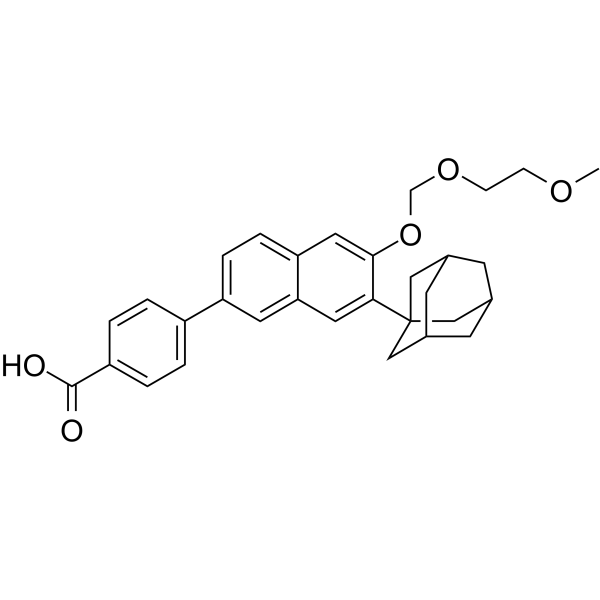
Physicochemical Properties
| Molecular Formula | C31H34O5 |
| Molecular Weight | 486.61 |
| Exact Mass | 486.241 |
| CAS # | 170355-78-9 |
| PubChem CID | 216241 |
| Appearance | White to off-white solid powder |
| Density | 1.227g/cm3 |
| Boiling Point | 668.6ºC at 760mmHg |
| Flash Point | 219.3ºC |
| Vapour Pressure | 8.7E-19mmHg at 25°C |
| Index of Refraction | 1.623 |
| LogP | 6.672 |
| Hydrogen Bond Donor Count | 1 |
| Hydrogen Bond Acceptor Count | 5 |
| Rotatable Bond Count | 9 |
| Heavy Atom Count | 36 |
| Complexity | 717 |
| Defined Atom Stereocenter Count | 0 |
| InChi Key | JBALRFFXKQPVLT-UHFFFAOYSA-N |
| InChi Code | InChI=1S/C31H34O5/c1-34-8-9-35-19-36-29-15-26-7-6-25(23-2-4-24(5-3-23)30(32)33)13-27(26)14-28(29)31-16-20-10-21(17-31)12-22(11-20)18-31/h2-7,13-15,20-22H,8-12,16-19H2,1H3,(H,32,33) |
| Chemical Name | 4-[7-(1-adamantyl)-6-(2-methoxyethoxymethoxy)naphthalen-2-yl]benzoic acid |
| Synonyms | CD-2665; CD 2665; CD2665 |
| HS Tariff Code | 2934.99.9001 |
| Storage |
Powder-20°C 3 years 4°C 2 years In solvent -80°C 6 months -20°C 1 month |
| Shipping Condition | Room temperature (This product is stable at ambient temperature for a few days during ordinary shipping and time spent in Customs) |
Biological Activity
| ln Vitro | Cell development and differentiation are significantly impacted by CD2665 (100 nM; 9 days; 3T3 cells) [1]. |
| ln Vivo | Mice treated with alcohol show full inhibition of RARβ mRNA upregulation in their brains when CD2665 (0.6 mg/kg; subcutaneous injection; once daily for 22 days) is administered [2]. Growth plate enlargement and the anticipated maturation delay are brought on by CD2665, a selective retinol antagonist [3]. |
| Cell Assay |
Cell proliferation assay[1] Cell Types: 3T3 Cell Tested Concentrations: 100 nM Incubation Duration: 9 days Experimental Results: Elimination of ATRA, CD271 (adapalene, a RAR-β,γ agonist) and CD2043 (RAR-α,β ), a gamma pan-agonist) restored cell number and LFCS percentage to control levels. |
| Animal Protocol |
Animal/Disease Models: Mice received ethanol consumption for 10 months [2]. Doses: 0.6 mg/kg Route of Administration: subcutaneous injection; one time/day for 22 days. Experimental Results: Brain RARβ mRNA levels were diminished (50% relative to control) without any change in RXR β/γ mRNA levels. Animal/Disease Models: Male and female mice (3 weeks) [3]. Doses: 1.6 mg/kg Route of Administration: po (oral gavage)/intragastric; one time/day for 31 days. Experimental Results: Growth plate closure was largely prevented in LDE225/antagonist co-treated mice compared to mice receiving LDE225 alone. |
| References |
[1]. The role of specific retinoid receptors in sebocyte growth and differentiation in culture. J Invest Dermatol. 2000 Feb;114(2):349-53. [2]. A retinoic acid receptor antagonist suppresses brain retinoic acid receptor overexpression and reverses a working memory deficit induced by chronic ethanol consumption in mice. Alcohol Clin Exp Res. 2001 Oct;25(10):1506-14. [3]. Premature Growth Plate Closure Caused by a Hedgehog Cancer Drug Is Preventable by Co-Administration of a Retinoid Antagonist in Mice. J Bone Miner Res. 2021 Jul;36(7):1387-1402. |
Solubility Data
| Solubility (In Vitro) | DMSO : ~62.5 mg/mL (~128.44 mM) |
| Solubility (In Vivo) |
Note: Listed below are some common formulations that may be used to formulate products with low water solubility (e.g. < 1 mg/mL), you may test these formulations using a minute amount of products to avoid loss of samples. Injection Formulations (e.g. IP/IV/IM/SC) Injection Formulation 1: DMSO : Tween 80: Saline = 10 : 5 : 85 (i.e. 100 μL DMSO stock solution → 50 μL Tween 80 → 850 μL Saline) *Preparation of saline: Dissolve 0.9 g of sodium chloride in 100 mL ddH ₂ O to obtain a clear solution. Injection Formulation 2: DMSO : PEG300 :Tween 80 : Saline = 10 : 40 : 5 : 45 (i.e. 100 μL DMSO → 400 μLPEG300 → 50 μL Tween 80 → 450 μL Saline) Injection Formulation 3: DMSO : Corn oil = 10 : 90 (i.e. 100 μL DMSO → 900 μL Corn oil) Example: Take the Injection Formulation 3 (DMSO : Corn oil = 10 : 90) as an example, if 1 mL of 2.5 mg/mL working solution is to be prepared, you can take 100 μL 25 mg/mL DMSO stock solution and add to 900 μL corn oil, mix well to obtain a clear or suspension solution (2.5 mg/mL, ready for use in animals). Injection Formulation 4: DMSO : 20% SBE-β-CD in saline = 10 : 90 [i.e. 100 μL DMSO → 900 μL (20% SBE-β-CD in saline)] *Preparation of 20% SBE-β-CD in Saline (4°C,1 week): Dissolve 2 g SBE-β-CD in 10 mL saline to obtain a clear solution. Injection Formulation 5: 2-Hydroxypropyl-β-cyclodextrin : Saline = 50 : 50 (i.e. 500 μL 2-Hydroxypropyl-β-cyclodextrin → 500 μL Saline) Injection Formulation 6: DMSO : PEG300 : castor oil : Saline = 5 : 10 : 20 : 65 (i.e. 50 μL DMSO → 100 μLPEG300 → 200 μL castor oil → 650 μL Saline) Injection Formulation 7: Ethanol : Cremophor : Saline = 10: 10 : 80 (i.e. 100 μL Ethanol → 100 μL Cremophor → 800 μL Saline) Injection Formulation 8: Dissolve in Cremophor/Ethanol (50 : 50), then diluted by Saline Injection Formulation 9: EtOH : Corn oil = 10 : 90 (i.e. 100 μL EtOH → 900 μL Corn oil) Injection Formulation 10: EtOH : PEG300:Tween 80 : Saline = 10 : 40 : 5 : 45 (i.e. 100 μL EtOH → 400 μLPEG300 → 50 μL Tween 80 → 450 μL Saline) Oral Formulations Oral Formulation 1: Suspend in 0.5% CMC Na (carboxymethylcellulose sodium) Oral Formulation 2: Suspend in 0.5% Carboxymethyl cellulose Example: Take the Oral Formulation 1 (Suspend in 0.5% CMC Na) as an example, if 100 mL of 2.5 mg/mL working solution is to be prepared, you can first prepare 0.5% CMC Na solution by measuring 0.5 g CMC Na and dissolve it in 100 mL ddH2O to obtain a clear solution; then add 250 mg of the product to 100 mL 0.5% CMC Na solution, to make the suspension solution (2.5 mg/mL, ready for use in animals). Oral Formulation 3: Dissolved in PEG400 Oral Formulation 4: Suspend in 0.2% Carboxymethyl cellulose Oral Formulation 5: Dissolve in 0.25% Tween 80 and 0.5% Carboxymethyl cellulose Oral Formulation 6: Mixing with food powders Note: Please be aware that the above formulations are for reference only. InvivoChem strongly recommends customers to read literature methods/protocols carefully before determining which formulation you should use for in vivo studies, as different compounds have different solubility properties and have to be formulated differently. (Please use freshly prepared in vivo formulations for optimal results.) |
| Preparing Stock Solutions | 1 mg | 5 mg | 10 mg | |
| 1 mM | 2.0550 mL | 10.2752 mL | 20.5503 mL | |
| 5 mM | 0.4110 mL | 2.0550 mL | 4.1101 mL | |
| 10 mM | 0.2055 mL | 1.0275 mL | 2.0550 mL |