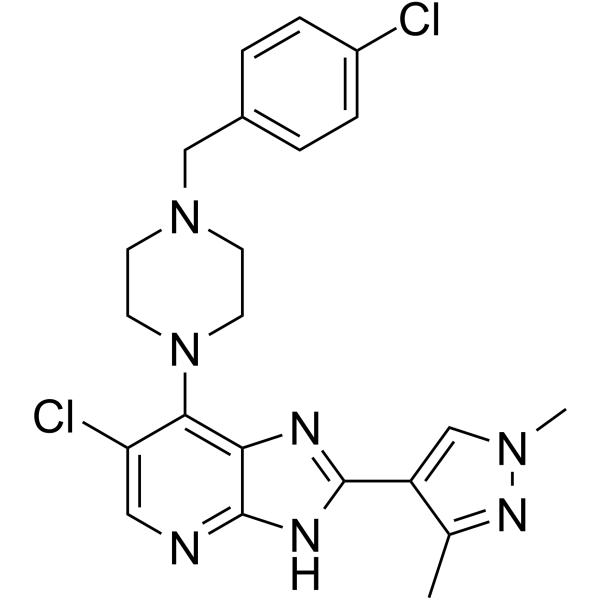
Physicochemical Properties
| Molecular Formula | C22H23CL2N7 |
| Molecular Weight | 456.375 |
| Exact Mass | 455.139 |
| Elemental Analysis | C, 57.90; H, 5.08; Cl, 15.54; N, 21.48 |
| CAS # | 1402709-93-6 |
| PubChem CID | 71454279 |
| Appearance | White to off-white solid powder |
| Density | 1.5±0.1 g/cm3 |
| Index of Refraction | 1.727 |
| LogP | 4.55 |
| Hydrogen Bond Donor Count | 1 |
| Hydrogen Bond Acceptor Count | 5 |
| Rotatable Bond Count | 4 |
| Heavy Atom Count | 31 |
| Complexity | 596 |
| Defined Atom Stereocenter Count | 0 |
| SMILES | C12NC(C3=CN(C)N=C3C)=NC1=C(N1CCN(CC3=CC=C(Cl)C=C3)CC1)C(Cl)=CN=2 |
| InChi Key | AKJBLKUZXRMECW-UHFFFAOYSA-N |
| InChi Code | InChI=1S/C22H23Cl2N7/c1-14-17(13-29(2)28-14)21-26-19-20(18(24)11-25-22(19)27-21)31-9-7-30(8-10-31)12-15-3-5-16(23)6-4-15/h3-6,11,13H,7-10,12H2,1-2H3,(H,25,26,27) |
| Chemical Name | 6-chloro-7-[4-[(4-chlorophenyl)methyl]piperazin-1-yl]-2-(1,3-dimethylpyrazol-4-yl)-1H-imidazo[4,5-b]pyridine |
| Synonyms | CCT 241736; CCT-241736; CCT241736 |
| HS Tariff Code | 2934.99.03.00 |
| Storage |
Powder-20°C 3 years 4°C 2 years In solvent -80°C 6 months -20°C 1 month |
| Shipping Condition | Room temperature (This product is stable at ambient temperature for a few days during ordinary shipping and time spent in Customs) |
Biological Activity
| ln Vitro | CCT241736 (Compound 27e) is a strong, orally accessible dual inhibitor of FLT3 and Aurora kinase. It inhibits FLT3 kinase (Kd, 6.2 nM), FLT3 mutants (Kd, 38 nM), and FLT3-A (Kd, 7.5 nM, IC50, 38 nM, Aurora-B Kd, 48 nM). A variety of human tumor cell lines, including human colon cancer HCT116 (GI50, 0.300 μM), human FLT3-ITD positive AML cell lines MOLM-13 (GI50, 0.104 μM), and MV4-11 (GI50, 0.291μM), demonstrate antiproliferative activity in response to CCT241736. Additionally, CCT241736 has a significant effect via inhibiting histone H3 phosphorylation at S10 (a biomarker for Aurora-B inhibition; IC50, 0.148 μM) and autophosphorylation of Aurora-A at T288 (a biomarker for Aurora-A inhibition; IC50, 0.030 μM). Cell viability is compared between Aurora-A and -B. In MOLM-13 cells, CCT241736 suppresses Aurora-A while also inhibiting FLT3 signaling [1]. |
| ln Vivo | When taken orally at 100 mg/kg twice day, CCT241736 (50, 100 mg/kg, bid, po) entirely eradicates tumors and slows the growth of MV4-11 human tumor xenografts in a dose-dependent manner [1]. |
| References |
[1]. Optimization of imidazo[4,5-b]pyridine-based kinase inhibitors: identification of a dual FLT3/Aurora kinase inhibitor as an orally bioavailable preclinical development candidate for the treatment of acute myeloid leukemia. J Med Chem. |
| Additional Infomation | Aurora Kinase/FLT3 Inhibitor EP0042 is an orally bioavailable inhibitor of both the serine/threonine protein kinase Aurora kinase and FMS-related tyrosine kinase 3 (FLT3; STK1; CD135; FLK2), with potential antineoplastic activity. Upon oral administration, Aurora kinase/FLT3 inhibitor EP0042 specifically binds to and inhibits Aurora kinase and FLT3, which interferes with the activation of Aurora kinase- and FLT3-mediated signal transduction pathways. This may result in the disruption of the assembly of the mitotic spindle apparatus, the disruption of chromosome segregation and the inhibition of cell proliferation in tumor cells that overexpress Aurora kinase and/or FLT3. Aurora kinase plays essential roles in mitotic checkpoint control during mitosis. Aurora kinase and FLT3 are overexpressed in a variety of cancers and play key roles in tumor cell proliferation. |
Solubility Data
| Solubility (In Vitro) | DMSO : ~12.5 mg/mL (~27.39 mM) |
| Solubility (In Vivo) |
Solubility in Formulation 1: 2.5 mg/mL (5.48 mM) in 10% DMSO + 40% PEG300 + 5% Tween80 + 45% Saline (add these co-solvents sequentially from left to right, and one by one), suspension solution; with heating and sonication. For example, if 1 mL of working solution is to be prepared, you can add 100 μL of 25.0 mg/mL clear DMSO stock solution to 400 μL PEG300 and mix evenly; then add 50 μL Tween-80 to the above solution and mix evenly; then add 450 μL normal saline to adjust the volume to 1 mL. Preparation of saline: Dissolve 0.9 g of sodium chloride in 100 mL ddH₂ O to obtain a clear solution. Solubility in Formulation 2: 2.5 mg/mL (5.48 mM) in 10% DMSO + 90% (20% SBE-β-CD in Saline) (add these co-solvents sequentially from left to right, and one by one), suspension solution; with heating and sonication. For example, if 1 mL of working solution is to be prepared, you can add 100 μL of 25.0 mg/mL clear DMSO stock solution to 900 μL of 20% SBE-β-CD physiological saline solution and mix evenly. Preparation of 20% SBE-β-CD in Saline (4°C,1 week): Dissolve 2 g SBE-β-CD in 10 mL saline to obtain a clear solution. Solubility in Formulation 3: ≥ 2.5 mg/mL (5.48 mM) (saturation unknown) in 10% DMSO + 90% Corn Oil (add these co-solvents sequentially from left to right, and one by one), clear solution. For example, if 1 mL of working solution is to be prepared, you can add 100 μL of 25.0 mg/mL clear DMSO stock solution to 900 μL of corn oil and mix evenly. (Please use freshly prepared in vivo formulations for optimal results.) |
| Preparing Stock Solutions | 1 mg | 5 mg | 10 mg | |
| 1 mM | 2.1912 mL | 10.9558 mL | 21.9116 mL | |
| 5 mM | 0.4382 mL | 2.1912 mL | 4.3823 mL | |
| 10 mM | 0.2191 mL | 1.0956 mL | 2.1912 mL |