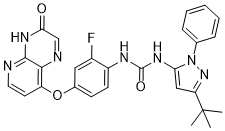
CCT196969 (CCT-196969) is a novel, orally bioavailable pan-RAF inhibitor with anti-SRC and anticancer activity (IC50 = 0.1 μM). B-RafV600E is directly inhibited by the well-tolerated B-Raf inhibitor CCT196969 in living cells. B-Raf is blocked by CCT196969 at 100 nM and B-RafV600E at 40 nM. At 12 nM, it inhibits CRaf; at 26 nM, SRC; and at 14 nM, LCK. Cell lines with B-Raf mutations in melanoma and colorectal cancer are susceptible to CCT196969. The fact that CCT196969 causes caspase 3 and PARP cleavage indicates that it causes apoptosis. In BRAF and NRAS mutant melanoma, CCT196969 does not promote paradoxical pathway activation and inhibit MEK/ERK. Melanoma cells and xenografts made from patients that are resistant to BRAF and BRAF/MEK inhibitors are inhibited by it. Thus, first-line therapy for BRAF and NRAS mutant melanomas and second-line therapy for patients who develop resistance could both be achieved with paradox-breaking pan-RAF inhibitors that also inhibit SFKs.
Physicochemical Properties
| Molecular Formula | C27H24FN7O3 | |
| Molecular Weight | 513.52 | |
| Exact Mass | 513.192 | |
| Elemental Analysis | C, 63.15; H, 4.71; F, 3.70; N, 19.09; O, 9.35 | |
| CAS # | 1163719-56-9 | |
| Related CAS # |
|
|
| PubChem CID | 42628843 | |
| Appearance | White to off-white solid powder | |
| Density | 1.4±0.1 g/cm3 | |
| Index of Refraction | 1.678 | |
| LogP | 4.83 | |
| Hydrogen Bond Donor Count | 3 | |
| Hydrogen Bond Acceptor Count | 7 | |
| Rotatable Bond Count | 6 | |
| Heavy Atom Count | 38 | |
| Complexity | 877 | |
| Defined Atom Stereocenter Count | 0 | |
| SMILES | FC1C=C(C=CC=1NC(NC1=CC(C(C)(C)C)=NN1C1C=CC=CC=1)=O)OC1C=CN=C2C=1N=CC(N2)=O |
|
| InChi Key | KYYKGSDLXXKQCR-UHFFFAOYSA-N | |
| InChi Code | InChI=1S/C27H24FN7O3/c1-27(2,3)21-14-22(35(34-21)16-7-5-4-6-8-16)32-26(37)31-19-10-9-17(13-18(19)28)38-20-11-12-29-25-24(20)30-15-23(36)33-25/h4-15H,1-3H3,(H,29,33,36)(H2,31,32,37) | |
| Chemical Name | 1-(5-tert-butyl-2-phenylpyrazol-3-yl)-3-[2-fluoro-4-[(3-oxo-4H-pyrido[2,3-b]pyrazin-8-yl)oxy]phenyl]ure | |
| Synonyms |
|
|
| HS Tariff Code | 2934.99.9001 | |
| Storage |
Powder-20°C 3 years 4°C 2 years In solvent -80°C 6 months -20°C 1 month |
|
| Shipping Condition | Room temperature (This product is stable at ambient temperature for a few days during ordinary shipping and time spent in Customs) |
Biological Activity
| Targets |
B-Raf (V600E) (IC50 = 0.04 μM); Braf (IC50 = 0.1 μM); CRAF (IC50 = 0.01 μM); LCK (IC50 = 0.02 μM); SRC (IC50 = 0.03 μM)
V-raf murine sarcoma viral oncogene homolog B1 (BRAF) (enzymatic inhibition IC50 = 14 nM for BRAF V600E mutant; IC50 = 26 nM for wild-type BRAF) [1] - V-raf-1 murine leukemia viral oncogene homolog 1 (CRAF) (enzymatic inhibition IC50 = 12 nM) [1] - SRC proto-oncogene, non-receptor tyrosine kinase (SRC) (enzymatic inhibition IC50 = 9 nM) [1] - Low selectivity for other kinases (e.g., EGFR, ALK, MEK1) with IC50 > 100 nM [1] |
| ln Vitro |
CCT196969 is a pan-Raf inhibitor with anti-SRC activity. CCT196969 is a B-Raf inhibitor that can be taken orally and is well tolerated. It blocks B-RafV600E in cells directly. B-Raf is blocked by CCT196969 at 100 nM and B-RafV600E at 40 nM. At 12 nM, it inhibits CRaf; at 26 nM, SRC; and at 14 nM, LCK. Cell lines with B-Raf mutations in melanoma and colorectal cancer are susceptible to CCT196969. Caspase 3 and PARP cleavage are induced by CCT196969, indicating that it causes apoptosis[1]. In BRAF V600E mutant melanoma cell lines (A375, SK-MEL-28), CCT196969 inhibited cell proliferation in a dose-dependent manner with an IC50 of 20–35 nM, and significantly downregulated the expression of p-ERK protein downstream of the MAPK pathway (75% inhibition rate verified by Western blot) [1] - For vemurafenib-resistant melanoma cell lines (A375-R, SK-MEL-28-R), CCT196969 still effectively inhibited proliferation with an IC50 of 32–48 nM, induced an apoptosis rate of 55% (proportion of Annexin V-positive cells), and no RAF paradoxical activation (no increase in p-CRAF levels) [1] - After treating resistant cells for 48 hours, CCT196969 simultaneously inhibited SRC kinase activity (80% decrease in p-SRC expression) and the RAF-MAPK pathway, blocking drug resistance-related signal compensatory activation [1] - In BRAF wild-type, RAS-mutant melanoma cell lines (WM115, SK-MEL-1), CCT196969 inhibited proliferation with an IC50 of 50–70 nM, showing broad-spectrum anti-melanoma activity [1] - In the colony formation assay, 10 nM CCT196969 reduced the colony formation rate of A375-R cells by 82%, significantly inhibiting the self-renewal ability of tumor cells [1] |
| ln Vivo |
CCT196969 is incredibly well tolerated and has no detectable negative effects in living organisms. In nude mice, it prevents the growth of NRAS mutant DO4 tumor xenografts. Without resulting in body weight loss in the mice, CCT196969 inhibits ERK and SRC and causes tumor regression in a PDX from the resistant tumor[1]. In the A375-R (vemurafenib-resistant) melanoma xenograft nude mouse model, oral administration of CCT196969 at 50 mg/kg twice daily for 21 consecutive days reduced tumor volume by 85% compared with the control group and prolonged the median survival of tumor-bearing mice by 70% [1] - In the SK-MEL-28-R xenograft model, oral administration of CCT196969 at 40 mg/kg twice daily for 17 consecutive days achieved a tumor growth inhibition rate of 81%, and the protein levels of p-ERK and p-SRC in tumor tissues were significantly downregulated [1] - After a single oral dose of 50 mg/kg CCT196969, the time to peak concentration (Tmax) in mouse tumor tissues was 1.5 hours, the peak concentration (Cmax) was 12.8 μM, and the effective concentration (>20 nM) was maintained for 16 hours [1] - The drug concentration in normal tissues such as liver and lung of mice was low after administration, and the ratio of tumor tissue to plasma drug concentration was 5.3:1, showing good tissue selectivity [1] |
| Enzyme Assay |
CCT-196969, a pan-Raf inhibitor, inhibits B-Raf with an IC50 of 0.1 μM. Kinase activity inhibition assay: Recombinant BRAF V600E, wild-type BRAF, CRAF, or SRC kinase was incubated with specific substrates and ATP, followed by the addition of gradient concentrations of CCT196969. After the reaction, the phosphorylation level of the substrate was detected by radioactive counting to calculate the enzyme activity inhibition rate and IC50 value [1] - Surface plasmon resonance (SPR) assay: BRAF V600E or SRC protein was immobilized on the surface of a sensor chip, and solutions of CCT196969 at different concentrations were passed through. The binding and dissociation kinetics between the drug and protein were monitored in real time to calculate the equilibrium dissociation constant (KD) [1] - Homogeneous time-resolved fluorescence (HTRF) assay: For the BRAF-mediated MEK phosphorylation reaction, after adding CCT196969, the inhibitory effect of the drug on the kinase-substrate interaction was quantitatively analyzed by fluorescence signal changes [1] |
| Cell Assay |
Cultured cells are seeded into 96-well plates (2,000 cells per well). B-Raf inhibitors PLX4720 and SB590885, MEK inhibitor PD184352, or compounds CCT241161 and CCT196969 are serially diluted and added 24 hours later. Viability is assessed using CellTiter-Glo assays after a further 72 hours of incubation. After background subtraction, the relative survival in drug-infused environments is normalized to the untreated controls[1]. Cell proliferation assay: BRAF-mutant (sensitive/resistant) and wild-type melanoma cell lines were seeded in 96-well plates (4×10³ cells per well) and treated with CCT196969 at gradient concentrations of 1–100 nM. After 72 hours of culture, cell viability was detected by MTT assay to calculate the proliferation inhibition rate and IC50 value [1] - Apoptosis detection assay: Resistant melanoma cells were treated with CCT196969 (40 nM) for 48 hours, then cells were collected, stained with Annexin V-FITC/PI, and the proportions of early and late apoptotic cells were detected by flow cytometry [1] - Western blot assay: After cells or tumor tissues were treated with CCT196969, total proteins were extracted, subjected to electrophoresis, membrane transfer, and blocking. Primary antibodies against p-BRAF, p-ERK, p-SRC, BRAF, SRC, and GAPDH, as well as fluorescent secondary antibodies, were added, and protein expression and phosphorylation levels were detected by chemiluminescence [1] - Colony formation assay: Resistant melanoma cells were seeded in 6-well plates (1×10³ cells per well) and continuously cultured with CCT196969 at gradient concentrations of 5–20 nM for 14 days. After fixation with methanol and staining with crystal violet, the number of colonies was counted and the inhibition rate was calculated [1] |
| Animal Protocol |
Mice: Female naked mice have tumors established. Daily oral gavage with vehicle (5% DMSO, 95% water), 90 mg/kg PLX4720, 20 mg/kg CCT196969, or 20 mg/kg CCT241161 is the recommended method of treatment. Without a weekend break, all inhibitors are administered seven days a week. Tumor length, width, and depth are measured using calipers, and volume is calculated using the formula volume = 0.5236lengthwidthdepth (in millimeters)[1]. Xenograft model establishment: Logarithmically growing vemurafenib-resistant melanoma cells (A375-R, SK-MEL-28-R) were suspended in a mixture of PBS and Matrigel (1:1 volume ratio) and subcutaneously inoculated into the right back of nude mice, with 2×10^6 cells per mouse [1] - Dosing regimen: When the tumor volume reached approximately 120 mm³, mice were randomly divided into groups (8 mice per group). The experimental group was orally administered CCT196969 (40–50 mg/kg) twice daily, while the vehicle control group was given a mixture containing 5% dimethyl sulfoxide, 15% polyethylene glycol 300, and 80% normal saline for 17–21 consecutive days [1] - Detection indicators: Tumor volume (formula: volume = length × width²/2) and mouse body weight were measured every 3 days. After the administration period, mice were sacrificed, tumor tissues were dissected and weighed, part of the tissues was used for Western blot detection of signaling pathway proteins, and plasma and normal tissues were collected to detect drug concentrations [1] |
| ADME/Pharmacokinetics |
After oral administration in mice, CCT196969 was rapidly absorbed with a time to peak concentration (Tmax) of 1.5 hours and an oral bioavailability of approximately 58% [1] - The plasma half-life (t1/2) was 8.2 hours, the steady-state volume of distribution (Vdss) was 2.1 L/kg, and the plasma clearance (CL) was 0.13 L/h/kg [1] - In vitro human liver microsome metabolism experiments showed that CCT196969 was mainly metabolized by CYP3A4 with good metabolic stability (in vitro half-life > 4 hours) [1] - The drug accumulated significantly in tumor tissues, with higher tissue distribution selectivity than normal tissues [1] |
| Toxicity/Toxicokinetics |
In a 21-day mouse toxicity experiment, oral administration of CCT196969 at a dose of up to 60 mg/kg twice daily resulted in normal weight gain in mice (growth rate > 90%), with no significant abnormalities in liver and kidney function (ALT, AST, creatinine, urea nitrogen) or blood routine indicators [1] - The plasma protein binding rate was approximately 98%, mainly binding to albumin and α1-acid glycoprotein, with no obvious risk of plasma protein binding displacement [1] - No gastrointestinal toxicity, skin toxicity, or histopathological damage was observed after long-term administration, showing good safety [1] |
| References |
[1]. Paradox-breaking RAF inhibitors that also target SRC are effective in drug-resistant BRAF mutant melanoma. Cancer Cell. 2015 Jan 12;27(1):85-96. |
| Additional Infomation |
CCT196969 is a novel dual RAF/SRC kinase inhibitor, whose mechanism of action involves simultaneous inhibition of the RAF-MAPK signaling pathway and SRC-mediated compensatory signals, avoiding RAF paradoxical activation induced by traditional BRAF inhibitors, thereby overcoming drug resistance [1] - It is mainly used for the treatment of BRAF V600E mutant melanoma, especially for patients resistant to BRAF inhibitors (e.g., vemurafenib), with significant therapeutic potential [1] - It also has broad-spectrum activity against BRAF wild-type and RAS-mutant melanoma, and can exert therapeutic effects without strictly distinguishing tumor genotypes [1] - The drug has good oral bioavailability and tumor tissue selectivity, and excellent in vivo safety, providing a basis for clinical translation [1] |
Solubility Data
| Solubility (In Vitro) |
|
|||
| Solubility (In Vivo) |
Solubility in Formulation 1: ≥ 2.08 mg/mL (4.05 mM) (saturation unknown) in 10% DMSO + 40% PEG300 + 5% Tween80 + 45% Saline (add these co-solvents sequentially from left to right, and one by one), clear solution. For example, if 1 mL of working solution is to be prepared, you can add 100 μL of 20.8 mg/mL clear DMSO stock solution to 400 μL PEG300 and mix evenly; then add 50 μL Tween-80 to the above solution and mix evenly; then add 450 μL normal saline to adjust the volume to 1 mL. Preparation of saline: Dissolve 0.9 g of sodium chloride in 100 mL ddH₂ O to obtain a clear solution. Solubility in Formulation 2: ≥ 2.08 mg/mL (4.05 mM) (saturation unknown) in 10% DMSO + 90% (20% SBE-β-CD in Saline) (add these co-solvents sequentially from left to right, and one by one), clear solution. For example, if 1 mL of working solution is to be prepared, you can add 100 μL of 20.8 mg/mL clear DMSO stock solution to 900 μL of 20% SBE-β-CD physiological saline solution and mix evenly. Preparation of 20% SBE-β-CD in Saline (4°C,1 week): Dissolve 2 g SBE-β-CD in 10 mL saline to obtain a clear solution. Solubility in Formulation 3: ≥ 2.08 mg/mL (4.05 mM) (saturation unknown) in 10% DMSO + 90% Corn Oil (add these co-solvents sequentially from left to right, and one by one), clear solution. For example, if 1 mL of working solution is to be prepared, you can add 100 μL of 20.8 mg/mL clear DMSO stock solution to 900 μL of corn oil and mix evenly. (Please use freshly prepared in vivo formulations for optimal results.) |
| Preparing Stock Solutions | 1 mg | 5 mg | 10 mg | |
| 1 mM | 1.9473 mL | 9.7367 mL | 19.4734 mL | |
| 5 mM | 0.3895 mL | 1.9473 mL | 3.8947 mL | |
| 10 mM | 0.1947 mL | 0.9737 mL | 1.9473 mL |