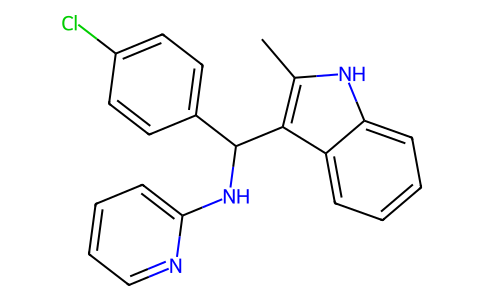
Physicochemical Properties
| Molecular Formula | C21H18CLN3 |
| Molecular Weight | 347.84 |
| Exact Mass | 347.119 |
| Elemental Analysis | C, 72.51; H, 5.22; Cl, 10.19; N, 12.08 |
| CAS # | 305372-78-5 |
| PubChem CID | 3634881 |
| Appearance | Typically exists as solid at room temperature |
| LogP | 5.799 |
| Hydrogen Bond Donor Count | 2 |
| Hydrogen Bond Acceptor Count | 2 |
| Rotatable Bond Count | 4 |
| Heavy Atom Count | 25 |
| Complexity | 423 |
| Defined Atom Stereocenter Count | 0 |
| SMILES | CC1=C(C2=CC=CC=C2N1)C(C3=CC=C(C=C3)Cl)NC4=CC=CC=N4 |
| InChi Key | IFOHRIXRQPOHQZ-UHFFFAOYSA-N |
| InChi Code | InChI=1S/C21H18ClN3/c1-14-20(17-6-2-3-7-18(17)24-14)21(15-9-11-16(22)12-10-15)25-19-8-4-5-13-23-19/h2-13,21,24H,1H3,(H,23,25) |
| Chemical Name | N-[(4-chlorophenyl)-(2-methyl-1H-indol-3-yl)methyl]pyridin-2-amine |
| Synonyms | CCT 036477; CCT-036477; 305372-78-5; CCT036477; N-[(4-chlorophenyl)-(2-methyl-1H-indol-3-yl)methyl]pyridin-2-amine; 1H-Indole-3-methanamine, alpha-(4-chlorophenyl)-2-methyl-N-2-pyridinyl-; N-((4-chlorophenyl)(2-methyl-1H-indol-3-yl)methyl)pyridin-2-amine; F0388-0065; N-[(4-chlorophenyl)(2-methyl-1H-indol-3-yl)methyl]pyridin-2-amine; N-[(4-chlorophenyl)-(2-methyl-1H-indol-3-yl)methyl]-2-pyridinamine; CCT036477 |
| HS Tariff Code | 2934.99.9001 |
| Storage |
Powder-20°C 3 years 4°C 2 years In solvent -80°C 6 months -20°C 1 month |
| Shipping Condition | Room temperature (This product is stable at ambient temperature for a few days during ordinary shipping and time spent in Customs) |
Biological Activity
| Targets | Wnt/β-catenin |
| ln Vitro |
PC3, DU-145, and LNCaP human prostate cancer cells were exposed to Wnt/β-catenin pathway inhibitor CCT036477 (iWnt) with salinomycin for 48 h, followed by cabazitaxel treatment for 48 h. Cell viability, mRNA, and protein expression changes were evaluated by MTT, RT-qPCR, and Western blot assays, respectively. Apoptosis was determined by image-based cytometry, and cell migration was assessed by wound healing assay. Three-dimensional culture was established to assess the malignant phenotype and stemness potential of transformed or cancer cells. CD44 + CSCs were isolated using magnetic-activated cell sorting system. Pretreatment of PC3, DU-145, and LNCaP cells with salinomycin iWnt significantly sensitized the cells to cabazitaxel therapy. Spheroid culture confirmed that the treatment modality was more effective than a single administration of chemotherapy. The pretreatment of PC3 cells increased the rate of apoptosis compared to single administration of cabazitaxel, which downregulated Bcl-2 and upregulated caspase 3, caspase 8 expressions. The pretreatment suppressed cell migration, downregulated the expression of Sox2 and Nanog, and significantly reduced CD44 + CSC numbers. Notably, the treatment modality reduced pAKT, p-P38 MAPK, and pERK1/2. The data suggest that pretreatment of prostate cancer cells with salinomycin and Wnt inhibitor may increase the efficacy of cabazitaxel therapy by inhibiting cell proliferation and migration, and eliminating cancer stem cells.[1] Researchers showed that MCL-ICs are resistant to genotoxic agents vincristine, doxorubicin, and the newly approved Burton tyrosine kinase (BTK) inhibitor ibrutinib. We confirmed the differential up-regulation of Wnt pathway in MCL-ICs. Indeed, MCL-ICs were particularly sensitive to Wnt pathway inhibitors. Targeting β-catenin-TCF4 interaction with CCT036477, iCRT14, or PKF118-310 preferentially eliminated the MCL-ICs.[2] |
| Cell Assay | Cells and clinical information from MCL patients described in this manuscript (Additional file 4: Table S2) were collected and published with the written informed consent of each patient under The University of Texas MD Anderson Cancer Center IRB-approved clinical protocol LAB08-0190 for use of human tissues. The following agents were tested: Wnt inhibitors XAV939, iCRT14, CCT036477, PKF118-310, IWP2, IWR1-endo, and IWR1-exo; Hedgehog inhibitors GANT61, LDE225 and Cyclopamine; Notch inhibitor RO4929097.[2] |
| References |
[1]. Pretreatment of prostate cancer cells with salinomycin and Wnt inhibitor increases the efficacy of cabazitaxel by inducing apoptosis and decreasing cancer stem cells. Med Oncol. 2023 Jun 1;40(7):194. [2]. Targeting Wnt pathway in mantle cell lymphoma-initiating cells. J Hematol Oncol. 2015 Jun 6;8:63. |
| Additional Infomation |
N-[(4-chlorophenyl)-(2-methyl-1H-indol-3-yl)methyl]-2-pyridinamine is a member of indoles. Mantle cell lymphoma (MCL) is an aggressive and incurable form of non-Hodgkin’s lymphoma. Despite initial intense chemotherapy, up to 50 % of cases of MCL relapse often in a chemoresistant form. We hypothesized that the recently identified MCL-initiating cells (MCL-ICs) are the main reason for relapse and chemoresistance of MCL. Cancer stem cell-related pathways such as Wnt could be responsible for their maintenance and survival. Methods We isolated MCL-ICs from primary MCL cells on the basis of a defined marker expression pattern (CD34-CD3-CD45+CD19-) and investigated Wnt pathway expression. We also tested the potential of Wnt pathway inhibitors in elimination of MCL-ICs. Results We showed that MCL-ICs are resistant to genotoxic agents vincristine, doxorubicin, and the newly approved Burton tyrosine kinase (BTK) inhibitor ibrutinib. We confirmed the differential up-regulation of Wnt pathway in MCL-ICs. Indeed, MCL-ICs were particularly sensitive to Wnt pathway inhibitors. Targeting β-catenin-TCF4 interaction with CCT036477, iCRT14, or PKF118-310 preferentially eliminated the MCL-ICs. Conclusions Our results suggest that Wnt signaling is critical for the maintenance and survival of MCL-ICs, and effective MCL therapy should aim to eliminate MCL-ICs through Wnt signaling inhibitors.[2] Cancer stem cells (CSCs) are associated with metastasis and recurrence in prostate cancer as well as other cancers. We aimed to enhance the sensitivity of cabazitaxel in prostate cancer cell therapy by targeting CSCs with a Wnt inhibitor and salinomycin pretreatment. PC3, DU-145, and LNCaP human prostate cancer cells were exposed to Wnt/β-catenin pathway inhibitor CCT036477 (iWnt) with salinomycin for 48 h, followed by cabazitaxel treatment for 48 h. Cell viability, mRNA, and protein expression changes were evaluated by MTT, RT-qPCR, and Western blot assays, respectively. Apoptosis was determined by image-based cytometry, and cell migration was assessed by wound healing assay. Three-dimensional culture was established to assess the malignant phenotype and stemness potential of transformed or cancer cells. CD44 + CSCs were isolated using magnetic-activated cell sorting system. Pretreatment of PC3, DU-145, and LNCaP cells with salinomycin iWnt significantly sensitized the cells to cabazitaxel therapy. Spheroid culture confirmed that the treatment modality was more effective than a single administration of chemotherapy. The pretreatment of PC3 cells increased the rate of apoptosis compared to single administration of cabazitaxel, which downregulated Bcl-2 and upregulated caspase 3, caspase 8 expressions. The pretreatment suppressed cell migration, downregulated the expression of Sox2 and Nanog, and significantly reduced CD44 + CSC numbers. Notably, the treatment modality reduced pAKT, p-P38 MAPK, and pERK1/2. The data suggest that pretreatment of prostate cancer cells with salinomycin and Wnt inhibitor may increase the efficacy of cabazitaxel therapy by inhibiting cell proliferation and migration, and eliminating cancer stem cells.[1] |
Solubility Data
| Solubility (In Vitro) | May dissolve in DMSO (in most cases), if not, try other solvents such as H2O, Ethanol, or DMF with a minute amount of products to avoid loss of samples |
| Solubility (In Vivo) |
Note: Listed below are some common formulations that may be used to formulate products with low water solubility (e.g. < 1 mg/mL), you may test these formulations using a minute amount of products to avoid loss of samples. Injection Formulations (e.g. IP/IV/IM/SC) Injection Formulation 1: DMSO : Tween 80: Saline = 10 : 5 : 85 (i.e. 100 μL DMSO stock solution → 50 μL Tween 80 → 850 μL Saline) *Preparation of saline: Dissolve 0.9 g of sodium chloride in 100 mL ddH ₂ O to obtain a clear solution. Injection Formulation 2: DMSO : PEG300 :Tween 80 : Saline = 10 : 40 : 5 : 45 (i.e. 100 μL DMSO → 400 μLPEG300 → 50 μL Tween 80 → 450 μL Saline) Injection Formulation 3: DMSO : Corn oil = 10 : 90 (i.e. 100 μL DMSO → 900 μL Corn oil) Example: Take the Injection Formulation 3 (DMSO : Corn oil = 10 : 90) as an example, if 1 mL of 2.5 mg/mL working solution is to be prepared, you can take 100 μL 25 mg/mL DMSO stock solution and add to 900 μL corn oil, mix well to obtain a clear or suspension solution (2.5 mg/mL, ready for use in animals). Injection Formulation 4: DMSO : 20% SBE-β-CD in saline = 10 : 90 [i.e. 100 μL DMSO → 900 μL (20% SBE-β-CD in saline)] *Preparation of 20% SBE-β-CD in Saline (4°C,1 week): Dissolve 2 g SBE-β-CD in 10 mL saline to obtain a clear solution. Injection Formulation 5: 2-Hydroxypropyl-β-cyclodextrin : Saline = 50 : 50 (i.e. 500 μL 2-Hydroxypropyl-β-cyclodextrin → 500 μL Saline) Injection Formulation 6: DMSO : PEG300 : castor oil : Saline = 5 : 10 : 20 : 65 (i.e. 50 μL DMSO → 100 μLPEG300 → 200 μL castor oil → 650 μL Saline) Injection Formulation 7: Ethanol : Cremophor : Saline = 10: 10 : 80 (i.e. 100 μL Ethanol → 100 μL Cremophor → 800 μL Saline) Injection Formulation 8: Dissolve in Cremophor/Ethanol (50 : 50), then diluted by Saline Injection Formulation 9: EtOH : Corn oil = 10 : 90 (i.e. 100 μL EtOH → 900 μL Corn oil) Injection Formulation 10: EtOH : PEG300:Tween 80 : Saline = 10 : 40 : 5 : 45 (i.e. 100 μL EtOH → 400 μLPEG300 → 50 μL Tween 80 → 450 μL Saline) Oral Formulations Oral Formulation 1: Suspend in 0.5% CMC Na (carboxymethylcellulose sodium) Oral Formulation 2: Suspend in 0.5% Carboxymethyl cellulose Example: Take the Oral Formulation 1 (Suspend in 0.5% CMC Na) as an example, if 100 mL of 2.5 mg/mL working solution is to be prepared, you can first prepare 0.5% CMC Na solution by measuring 0.5 g CMC Na and dissolve it in 100 mL ddH2O to obtain a clear solution; then add 250 mg of the product to 100 mL 0.5% CMC Na solution, to make the suspension solution (2.5 mg/mL, ready for use in animals). Oral Formulation 3: Dissolved in PEG400 Oral Formulation 4: Suspend in 0.2% Carboxymethyl cellulose Oral Formulation 5: Dissolve in 0.25% Tween 80 and 0.5% Carboxymethyl cellulose Oral Formulation 6: Mixing with food powders Note: Please be aware that the above formulations are for reference only. InvivoChem strongly recommends customers to read literature methods/protocols carefully before determining which formulation you should use for in vivo studies, as different compounds have different solubility properties and have to be formulated differently. (Please use freshly prepared in vivo formulations for optimal results.) |
| Preparing Stock Solutions | 1 mg | 5 mg | 10 mg | |
| 1 mM | 2.8749 mL | 14.3744 mL | 28.7489 mL | |
| 5 mM | 0.5750 mL | 2.8749 mL | 5.7498 mL | |
| 10 mM | 0.2875 mL | 1.4374 mL | 2.8749 mL |