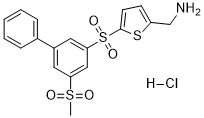
Physicochemical Properties
| Molecular Formula | C18H18CLNO4S3 |
| Molecular Weight | 443.9878 |
| Exact Mass | 443.008 |
| CAS # | 2126136-98-7 |
| Related CAS # | CCT365623;2126134-01-6 |
| PubChem CID | 139266765 |
| Appearance | White to yellow solid powder |
| Hydrogen Bond Donor Count | 2 |
| Hydrogen Bond Acceptor Count | 6 |
| Rotatable Bond Count | 5 |
| Heavy Atom Count | 27 |
| Complexity | 674 |
| Defined Atom Stereocenter Count | 0 |
| SMILES | Cl[H].S(C1=C([H])C([H])=C(C([H])([H])N([H])[H])S1)(C1=C([H])C(C2C([H])=C([H])C([H])=C([H])C=2[H])=C([H])C(=C1[H])S(C([H])([H])[H])(=O)=O)(=O)=O |
| InChi Key | MKBRQENFVVWIGU-UHFFFAOYSA-N |
| InChi Code | InChI=1S/C18H17NO4S3.ClH/c1-25(20,21)16-9-14(13-5-3-2-4-6-13)10-17(11-16)26(22,23)18-8-7-15(12-19)24-18;/h2-11H,12,19H2,1H3;1H |
| Chemical Name | [5-(3-methylsulfonyl-5-phenylphenyl)sulfonylthiophen-2-yl]methanamine;hydrochloride |
| Synonyms | 365623 HCl CCT365623HClCCT-365623 HCl |
| HS Tariff Code | 2934.99.9001 |
| Storage |
Powder-20°C 3 years 4°C 2 years In solvent -80°C 6 months -20°C 1 month Note: Please store this product in a sealed and protected environment, avoid exposure to moisture. |
| Shipping Condition | Room temperature (This product is stable at ambient temperature for a few days during ordinary shipping and time spent in Customs) |
Biological Activity
| ln Vitro | In biosensor systems, CCT365623 suppresses LOX at a concentration of around 5 μM [1]. Surface EGFR protein levels are concentration-dependently decreased by CCT365623 (0-40 μM) [1]. The protein levels of pY1068 EGFR, pAKT, and MATN2 are decreased by CCT365623 (5 μM), but the protein level of pSMAD2 is increased [1]. Inhibiting EGFR surface retention, inhibiting MATN2 expression, inhibiting TGFβ1 signaling, disrupting HTRA1 multimerization, and inhibiting EGFR signaling are all caused by CCT365623 [1]. |
| ln Vivo | In mouse liver microsomes, CCT365623 has good stability and does not block the hERG cardiac potassium channel[1]. In rats, CCT365623 (70 mg/kg, once daily oral gavage) greatly slowed the growth of primary tumors and reduced the burden of lung metastases. The EGFR cell surface retention is disrupted and the proliferation of primary and metastatic tumor cells is slowed down by CCT365623 [1]. T1/2PO for CCT365623 is 0.6 hours, and its oral bioavailability (F%) is 45%[1]. |
| Cell Assay |
Western blot analysis[1] Cell Types: MDA-MB-231 cells. Tested Concentrations: 0-40 μM. Incubation Duration: 24 hrs (hours) Experimental Results: Dramatically diminished protein levels of surface EGFR, pY1068 EGFR, pAKT and MATN2. Increased protein levels of pSMAD2. |
| Animal Protocol |
Animal/Disease Models: Mouse model (70 days old) of spontaneous breast cancer metastasis to the lungs [1]. Doses: 70 mg/kg. Route of Administration: Administer by po (oral gavage) daily for approximately 3 weeks. Experimental Results: MATN2 protein levels were Dramatically diminished in primary and metastatic lung tumors and were accompanied by the loss of EGFR on the plasma membrane of primary and metastatic tumor cells. |
| References |
[1]. Author Correction: Lysyl oxidase drives tumour progression by trapping EGF receptors at the cell surface. Nat Commun. 2019 Jul 18;10(1):3151. |
Solubility Data
| Solubility (In Vitro) | DMSO : ~250 mg/mL (~563.08 mM) |
| Solubility (In Vivo) |
Solubility in Formulation 1: ≥ 2.08 mg/mL (4.68 mM) (saturation unknown) in 10% DMSO + 40% PEG300 + 5% Tween80 + 45% Saline (add these co-solvents sequentially from left to right, and one by one), clear solution. For example, if 1 mL of working solution is to be prepared, you can add 100 μL of 20.8 mg/mL clear DMSO stock solution to 400 μL PEG300 and mix evenly; then add 50 μL Tween-80 to the above solution and mix evenly; then add 450 μL normal saline to adjust the volume to 1 mL. Preparation of saline: Dissolve 0.9 g of sodium chloride in 100 mL ddH₂ O to obtain a clear solution. Solubility in Formulation 2: ≥ 2.08 mg/mL (4.68 mM) (saturation unknown) in 10% DMSO + 90% (20% SBE-β-CD in Saline) (add these co-solvents sequentially from left to right, and one by one), clear solution. For example, if 1 mL of working solution is to be prepared, you can add 100 μL of 20.8 mg/mL clear DMSO stock solution to 900 μL of 20% SBE-β-CD physiological saline solution and mix evenly. Preparation of 20% SBE-β-CD in Saline (4°C,1 week): Dissolve 2 g SBE-β-CD in 10 mL saline to obtain a clear solution. Solubility in Formulation 3: ≥ 2.08 mg/mL (4.68 mM) (saturation unknown) in 10% DMSO + 90% Corn Oil (add these co-solvents sequentially from left to right, and one by one), clear solution. For example, if 1 mL of working solution is to be prepared, you can add 100 μL of 20.8 mg/mL clear DMSO stock solution to 900 μL of corn oil and mix evenly. (Please use freshly prepared in vivo formulations for optimal results.) |
| Preparing Stock Solutions | 1 mg | 5 mg | 10 mg | |
| 1 mM | 2.2523 mL | 11.2615 mL | 22.5230 mL | |
| 5 mM | 0.4505 mL | 2.2523 mL | 4.5046 mL | |
| 10 mM | 0.2252 mL | 1.1262 mL | 2.2523 mL |