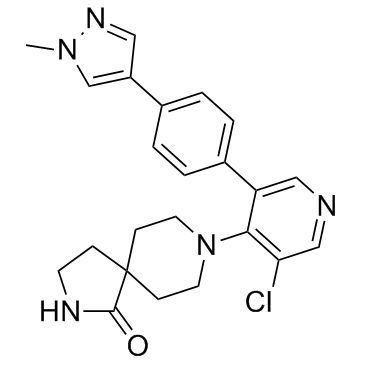
CCT251545 is a novel, potent, selective and orally bioavailable small-molecule inhibitor of WNT signaling with an IC50 of 5 nM in 7dF3 cells. It was discovered through cell-based screening and can be used as a selective chemical probe for the human Mediator complex-associated protein kinases CDK8 and CDK19 with >100-fold selectivity over 291 other kinases. In contrast to type II inhibitors of CDK8 and CDK19, CCT251545 displays potent cell-based activity. CCT251545 alters WNT pathway-regulated gene expression and other on-target effects of modulating CDK8 and CDK19, including expression of genes regulated by STAT1. CCT251545 and close analogs alter WNT pathway-regulated gene expression and other on-target effects of modulating CDK8 and CDK19, including expression of genes regulated by STAT1. Consistent with this, it was found that phosphorylation of STAT1(SER727) is a biomarker of CDK8 kinase activity in vitro and in vivo. Finally, the in vivo activity of CCT251545 in WNT-dependent tumors was evaluated.
Physicochemical Properties
| Molecular Formula | C23H24CLN5O |
| Molecular Weight | 421.9226 |
| Exact Mass | 421.166 |
| CAS # | 1661839-45-7 |
| PubChem CID | 77050682 |
| Appearance | White to off-white solid powder |
| Density | 1.4±0.1 g/cm3 |
| Boiling Point | 709.7±60.0 °C at 760 mmHg |
| Flash Point | 383.0±32.9 °C |
| Vapour Pressure | 0.0±2.3 mmHg at 25°C |
| Index of Refraction | 1.701 |
| LogP | 2.53 |
| Hydrogen Bond Donor Count | 1 |
| Hydrogen Bond Acceptor Count | 4 |
| Rotatable Bond Count | 3 |
| Heavy Atom Count | 30 |
| Complexity | 617 |
| Defined Atom Stereocenter Count | 0 |
| InChi Key | LBFYQISQYCGDDW-UHFFFAOYSA-N |
| InChi Code | InChI=1S/C23H24ClN5O/c1-28-15-18(12-27-28)16-2-4-17(5-3-16)19-13-25-14-20(24)21(19)29-10-7-23(8-11-29)6-9-26-22(23)30/h2-5,12-15H,6-11H2,1H3,(H,26,30) |
| Chemical Name | 8-(3-chloro-5-(4-(1-methyl-1H-pyrazol-4-yl)phenyl)pyridin-4-yl)-2,8-diazaspiro[4.5]decan-1-one |
| Synonyms | CCT251545; CCT 251545; CCT-251545; |
| HS Tariff Code | 2934.99.9001 |
| Storage |
Powder-20°C 3 years 4°C 2 years In solvent -80°C 6 months -20°C 1 month |
| Shipping Condition | Room temperature (This product is stable at ambient temperature for a few days during ordinary shipping and time spent in Customs) |
Biological Activity
| ln Vitro | CCT251545 substantially suppresses WNT pathway activity in COLO205-F1756 clone 4, an APC mutant human colorectal cancer cell line that is designed to express a luciferase-based WNT reporter construct, with an IC50 of 0.035 μM [1]. Tankyrase is weakly inhibited by CCT251545 (TNKS1 IC50 > 10 μM, TNKS2 IC50 = 15.0) [1]. With more than 100-fold selectivity over 291 other kinases, CCT251545 is an efficient and specific chemical probe for identifying human mediator complex-associated protein kinases CDK8 and CDK19 [2]. In addition to modulating additional on-target effects of CDK8 and CDK19, such as gene expression regulated by STAT1, CCT251545 modifies the expression of genes regulated by the WNT pathway [2]. Additionally, CCT251545, with an IC50 of 9 nM, lowers the levels of phospho-STAT1SER727 in SW620 cells [2]. Cell-based action is strong in CCT251545 [2]. |
| ln Vivo | Tumor growth is inhibited in NCr athymic mice bearing established SW620 human colorectal cancer xenografts by CCT251545 (70 mg/kg; oral; twice daily) [2]. |
| Animal Protocol |
Animal/Disease Models: 6-8 week female NCr athymic mice with established SW620 xenografts [2] Doses: 70mg/kg Route of Administration: Oral; Route of Administration: twice (two times) daily; Days 0-7 And the results on days 10-14: tumor growth was inhibited, and the final tumor weight was diminished by 70% relative to the control. |
| References |
[1]. Discovery of potent, orally bioavailable, small-molecule inhibitors of WNT signaling from a cell-based pathway screen. J Med Chem. 2015 Feb 26;58(4):1717-35. [2]. A selective chemical probe for exploring the role of CDK8 and CDK19 in human disease. Nat Chem Biol. 2015 Dec;11(12):973-980. |
| Additional Infomation | CCT251545 is a chloropyridine that is 3-chloropyridine substituted by a 1-oxo-2,8-diazaspiro[4.5]decan-8-yl group and a 4-(1-methyl-1H-pyrazol-4-yl)phenyl group at positions 4 and 5, respectively. It is an orally bioavailable inhibitor of Wnt signaling (IC50 = 5 nM) and a potent and selective chemical probe for cyclin-dependent kinases CDK8 and CDK19. It has a role as a Wnt signalling inhibitor, an antineoplastic agent and an EC 2.7.11.22 (cyclin-dependent kinase) inhibitor. It is a chloropyridine, a member of pyrazoles and an azaspiro compound. |
Solubility Data
| Solubility (In Vitro) | DMSO : ≥ 50 mg/mL (~118.51 mM) |
| Solubility (In Vivo) |
Solubility in Formulation 1: ≥ 1.67 mg/mL (3.96 mM) (saturation unknown) in 10% DMSO + 40% PEG300 + 5% Tween80 + 45% Saline (add these co-solvents sequentially from left to right, and one by one), clear solution. For example, if 1 mL of working solution is to be prepared, you can add 100 μL of 16.7 mg/mL clear DMSO stock solution to 400 μL PEG300 and mix evenly; then add 50 μL Tween-80 to the above solution and mix evenly; then add 450 μL normal saline to adjust the volume to 1 mL. Preparation of saline: Dissolve 0.9 g of sodium chloride in 100 mL ddH₂ O to obtain a clear solution. Solubility in Formulation 2: ≥ 1.67 mg/mL (3.96 mM) (saturation unknown) in 10% DMSO + 90% (20% SBE-β-CD in Saline) (add these co-solvents sequentially from left to right, and one by one), clear solution. For example, if 1 mL of working solution is to be prepared, you can add 100 μL of 16.7 mg/mL clear DMSO stock solution to 900 μL of 20% SBE-β-CD physiological saline solution and mix evenly. Preparation of 20% SBE-β-CD in Saline (4°C,1 week): Dissolve 2 g SBE-β-CD in 10 mL saline to obtain a clear solution. Solubility in Formulation 3: ≥ 1.67 mg/mL (3.96 mM) (saturation unknown) in 10% DMSO + 90% Corn Oil (add these co-solvents sequentially from left to right, and one by one), clear solution. For example, if 1 mL of working solution is to be prepared, you can add 100 μL of 16.7 mg/mL clear DMSO stock solution to 900 μL of corn oil and mix evenly. (Please use freshly prepared in vivo formulations for optimal results.) |
| Preparing Stock Solutions | 1 mg | 5 mg | 10 mg | |
| 1 mM | 2.3701 mL | 11.8506 mL | 23.7012 mL | |
| 5 mM | 0.4740 mL | 2.3701 mL | 4.7402 mL | |
| 10 mM | 0.2370 mL | 1.1851 mL | 2.3701 mL |