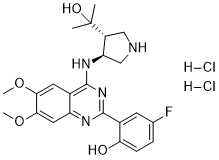
CCT241533 HCl, the dihydrochloride salt of CCT-241533, is a novel, potent and selective CHK2 inhibitor with anticancer activity. It inhibits CHK2 with an IC50 of 3 nM and a Ki of 1.16 nM. At an IC50 of 3 nM and a Ki of 1.16 nM, it inhibits CHK2. It demonstrates selectivity for Chk1 over Chk2 and a panel of 84 other kinases by >63-fold. Dihydrochloride CCT 241533 inhibits HT29 cells' Chk2 activation in response to etoposide-induced DNA damage and prevents mouse thymocytes from dying when exposed to ionizing radiation.
Physicochemical Properties
| Molecular Formula | C23H28CLFN4O4 |
| Molecular Weight | 478.944228172302 |
| Exact Mass | 514.15 |
| Elemental Analysis | C, 53.60; H, 5.67; Cl, 13.76; F, 3.69; N, 10.87; O, 12.42 |
| CAS # | 1431697-96-9 |
| Related CAS # | CCT241533 dihydrochloride;1962925-28-5;CCT241533;1262849-73-9 |
| PubChem CID | 136218645 |
| Appearance | White to light yellow solid powder |
| Hydrogen Bond Donor Count | 5 |
| Hydrogen Bond Acceptor Count | 9 |
| Rotatable Bond Count | 6 |
| Heavy Atom Count | 33 |
| Complexity | 629 |
| Defined Atom Stereocenter Count | 2 |
| SMILES | CC(C)([C@@H]1CNC[C@H]1NC2=NC(=NC3=CC(=C(C=C32)OC)OC)C4=C(C=CC(=C4)F)O)O.Cl |
| InChi Key | LAKJUTZIXHTMPC-SSPJITILSA-N |
| InChi Code | InChI=1S/C23H27FN4O4.ClH/c1-23(2,30)15-10-25-11-17(15)27-21-13-8-19(31-3)20(32-4)9-16(13)26-22(28-21)14-7-12(24)5-6-18(14)29;/h5-9,15,17,25,29-30H,10-11H2,1-4H3,(H,26,27,28);1H/t15-,17-;/m1./s1 |
| Chemical Name | 4-fluoro-2-[4-[[(3S,4R)-4-(2-hydroxypropan-2-yl)pyrrolidin-3-yl]amino]-6,7-dimethoxyquinazolin-2-yl]phenol;hydrochloride |
| Synonyms | CCT 241533; CCT241533; CCT-241533 HCl; CCT-241533; CCT 241533 dihydrochloride |
| HS Tariff Code | 2934.99.9001 |
| Storage |
Powder-20°C 3 years 4°C 2 years In solvent -80°C 6 months -20°C 1 month Note: Please store this product in a sealed and protected environment, avoid exposure to moisture. |
| Shipping Condition | Room temperature (This product is stable at ambient temperature for a few days during ordinary shipping and time spent in Customs) |
Biological Activity
| Targets | Chk2 (IC50 = 3 nM); Chk1 (IC50 = 245 nM); Chk2 (Ki = 1.16 nM) |
| ln Vitro | CCT241533 hydrochloride exhibits negligible cross-reactivity against a panel of kinases at 1 μM and inhibits CHK2 with an IC50 of 3 nM. The ATP pocket is where CCT241533 binds to CHK2, as confirmed by X-ray crystallography. In response to DNA damage, CCT241533 inhibits CHK2 activity in human tumor cell lines, as evidenced by the suppression of CHK2 autophosphorylation at S516, band-shift mobility changes, and HDMX degradation. In a number of cell lines, CCT241533 does not increase the cytotoxicity of a few genotoxic substances. Nonetheless, the cytotoxicity of two structurally different PARP inhibitors is markedly enhanced by CCT241533. A PARP inhibitor by itself clearly activates the pS516 CHK2 signal, and CCT241533 reverses this activation. According to the growth inhibitory IC50 (GI50) of the SRB assay, the cytotoxicity of CCT241533 in HT-29, HeLa, and MCF-7 is 1.7, 2.2, and 5.1 μM, in that order[1]. Potent CHK2 inhibitor CCT241533 hydrochloride (IC50=3 nM) has low hERG inhibition (IC50=22 μM) and selectivity (63-fold) over CHK1 (IC50=190 nM)[2]. |
| Cell Assay | In a 96-hour SRB assay or a 7–10 day colony forming assay, HT-29, HeLa, and MCF-7 cells are exposed to a fixed concentration (GI50) of CCT241533 in combination with increasing concentrations of either PARP inhibitor or cytotoxic drug. Potentiation index (PI), which is the ratio of GI50 for the genotoxic or PARP inhibitor alone: GI50 for the genotoxic or PARP inhibitor in combination with a CHK2 inhibitor, is used to express CCT241533's capacity to increase cell killing. Consequently, PI<1 denotes protection and PI>1 denotes potentiation[1]. |
| References |
[1]. CCT241533 is a potent and selective inhibitor of CHK2 that potentiates the cytotoxicity of PARP inhibitors. Cancer Res. 2011 Jan 15;71(2):463-72. [2]. Structure-based design of potent and selective 2-(quinazolin-2-yl)phenol inhibitors of checkpoint kinase 2. J Med Chem. 2011 Jan 27;54(2):580-90. |
Solubility Data
| Solubility (In Vitro) |
DMSO: ≥100 mg/mL (~208.8 mM) H2O: ~33.3 mg/mL (~69.6 mM) |
| Solubility (In Vivo) |
Solubility in Formulation 1: ≥ 2.5 mg/mL (5.22 mM) (saturation unknown) in 10% DMSO + 40% PEG300 + 5% Tween80 + 45% Saline (add these co-solvents sequentially from left to right, and one by one), clear solution. For example, if 1 mL of working solution is to be prepared, you can add 100 μL of 25.0 mg/mL clear DMSO stock solution to 400 μL PEG300 and mix evenly; then add 50 μL Tween-80 to the above solution and mix evenly; then add 450 μL normal saline to adjust the volume to 1 mL. Preparation of saline: Dissolve 0.9 g of sodium chloride in 100 mL ddH₂ O to obtain a clear solution. Solubility in Formulation 2: ≥ 2.5 mg/mL (5.22 mM) (saturation unknown) in 10% DMSO + 90% (20% SBE-β-CD in Saline) (add these co-solvents sequentially from left to right, and one by one), clear solution. For example, if 1 mL of working solution is to be prepared, you can add 100 μL of 25.0 mg/mL clear DMSO stock solution to 900 μL of 20% SBE-β-CD physiological saline solution and mix evenly. Preparation of 20% SBE-β-CD in Saline (4°C,1 week): Dissolve 2 g SBE-β-CD in 10 mL saline to obtain a clear solution. Solubility in Formulation 3: ≥ 2.5 mg/mL (5.22 mM) (saturation unknown) in 10% DMSO + 90% Corn Oil (add these co-solvents sequentially from left to right, and one by one), clear solution. For example, if 1 mL of working solution is to be prepared, you can add 100 μL of 25.0 mg/mL clear DMSO stock solution to 900 μL of corn oil and mix evenly. Solubility in Formulation 4: ≥ 2.5 mg/mL (5.22 mM) (saturation unknown) in 5% DMSO + 40% PEG300 + 5% Tween80 + 50% Saline (add these co-solvents sequentially from left to right, and one by one), clear solution. Preparation of saline: Dissolve 0.9 g of sodium chloride in 100 mL ddH₂ O to obtain a clear solution. Solubility in Formulation 5: ≥ 2.5 mg/mL (5.22 mM) (saturation unknown) in 5% DMSO + 95% (20% SBE-β-CD in Saline) (add these co-solvents sequentially from left to right, and one by one), clear solution. Preparation of 20% SBE-β-CD in Saline (4°C,1 week): Dissolve 2 g SBE-β-CD in 10 mL saline to obtain a clear solution. (Please use freshly prepared in vivo formulations for optimal results.) |
| Preparing Stock Solutions | 1 mg | 5 mg | 10 mg | |
| 1 mM | 2.0879 mL | 10.4397 mL | 20.8794 mL | |
| 5 mM | 0.4176 mL | 2.0879 mL | 4.1759 mL | |
| 10 mM | 0.2088 mL | 1.0440 mL | 2.0879 mL |