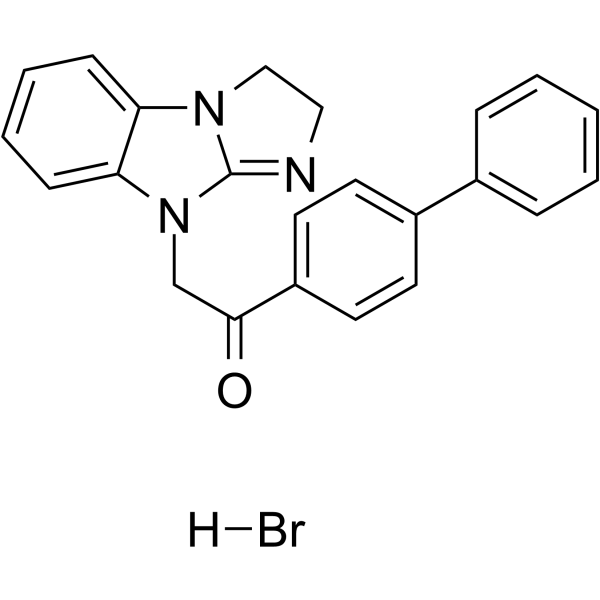
CCT-031374 (CCT031374) hydrobromide, inhibitor of β-catenin/transcription factor (TCF) complex signaling with anticancer activity. The Wnt signaling pathway is frequently deregulated in cancer due to mutations in genes encoding APC, beta-catenin, and axin.
Physicochemical Properties
| Molecular Formula | C23H19N3O.HBR |
| Molecular Weight | 434.3284 |
| Exact Mass | 433.079 |
| Elemental Analysis | C, 63.60; H, 4.64; Br, 18.40; N, 9.67; O, 3.68 |
| CAS # | 1219184-91-4 |
| PubChem CID | 18554738 |
| Appearance | Off-white to light yellow solid powder |
| LogP | 4.3 |
| Hydrogen Bond Donor Count | 1 |
| Hydrogen Bond Acceptor Count | 2 |
| Rotatable Bond Count | 4 |
| Heavy Atom Count | 28 |
| Complexity | 574 |
| Defined Atom Stereocenter Count | 0 |
| InChi Key | MPILENOYNNNGKO-UHFFFAOYSA-N |
| InChi Code | InChI=1S/C23H19N3O.BrH/c27-22(19-12-10-18(11-13-19)17-6-2-1-3-7-17)16-26-21-9-5-4-8-20(21)25-15-14-24-23(25)26;/h1-13H,14-16H2;1H |
| Chemical Name | 2-(1,2-dihydroimidazo[1,2-a]benzimidazol-4-yl)-1-(4-phenylphenyl)ethanone;hydrobromide |
| Synonyms | 1219184-91-4; CCT 031374 hydrobromide; 1-[1,1'-Biphenyl]-4-yl-2-(2,3-dihydro-9H-imidazo[1,2-a]benzimidazol-9-yl)-ethanone Hydrobromide; CCT031374 hydrobromide; CCT-031374 hydrobromide; CCT031374 (hydrobromide); 2-(1,2-dihydroimidazo[1,2-a]benzimidazol-4-yl)-1-(4-phenylphenyl)ethanone;hydrobromide; |
| HS Tariff Code | 2934.99.9001 |
| Storage |
Powder-20°C 3 years 4°C 2 years In solvent -80°C 6 months -20°C 1 month |
| Shipping Condition | Room temperature (This product is stable at ambient temperature for a few days during ordinary shipping and time spent in Customs) |
Biological Activity
| Targets | β-catenin/transcription factor (TCF) |
| ln Vitro |
CCT031374 acted at the β-catenin level based on the observation that it blocked TCF-dependent transcription induced by a stabilized form of β-catenin (N-terminal deletion of 89 amino acids), but not by a constitutively active TCF-VP16 fusion protein. Consistent with this mechanism, CCT031174 increased the degradation of endogenous wild-type β-catenin in mouse L-cells that had been stabilized by the GSK-3 inhibitor BIO. CCT031374 did not increase β-catenin N-terminal phosphorylation in the presence of BIO-treated cells (data not shown), suggesting that a pathway independent of phospho-β-catenin binding to β-TRCP induced increased degradation. A number of alternative β-catenin degradation routes have been described. These include pathways involving APC and the Siah1 ubiquitin ligase, the presenilin/PKA complex and the protease calpain. CCT031374 failed to induce β-catenin degradation products characteristic of calpain-induced proteolysis (data not shown) suggesting that distinct novel pathways are involved in its mechanism of action.[1] Of the top nine compounds only CCT031374 prevented BIO-induced accumulation of β-catenin (Fig. 3a). The blockade of β-catenin accumulation by CCT031374 was accompanied by a reduction in both nuclear and cytosolic β-catenin pools (Fig. 3b, Fig. S4, Fig. S5). In U2OS GFP-β-catenin human osteosarcoma cells (Bioimage, Thermo-Fisher), addition of CCT031374 induced formation of GFP-β-catenin aggregates (Fig. S3b) possibly due to sequestration by subcellular organelles, a phenotype that was occasionally observed with endogenous β-catenin in mouse L-cells (Fig. S4c). By contrast, CCT036477 did not alter β-catenin levels but blocked transcription at the β-catenin level, although not by blocking β-catenin's interaction with the histone acetyltransferases CBP or p300 (Fig. S6). Compound CCT070535, which blocked TCF-dependent transcription at the TCF level, did not alter BIO-induced levels of β-catenin, but did increase the levels of nuclear β-catenin (Fig. S4B).[1] |
| Cell Assay |
Phosphorylated Tau Experiment[1] HEK293 cells were transfected with GSK3β and/or Tau 1N4R expression vectors. After 48h, cells were exposed to 5μM BIO for 8h, after which they were treated with 20μM CCT031374 and 5μM BIO for the indicated time periods. Immunoblotting for GSK-3β, phospho and non-phospho Tau antibodies was carried out as previously described. Band peak areas were calculated using ImageJ. The phospho-Tau peak areas were normalized to the total Tau levels. GST-E-Cadherin Pulldown of β-Catenin[1] The β-catenin binding region of E-cadherin (amino acids 730-882) was fused in frame with the GST coding region of pGEX-5X-2. GST-E-cadherin fusion protein was expressed and purified using Glutathione Sepharose 4 Fast Flow beads). Ten cm dishes of HEK293 and SW480 cells were, treated with CCT031374 and/or BIO and lysed to give a final volume of 1ml cell extract. 5μg GST-E-cadherin was combined with 500μl of cell extract and precipitated following addition of glutathione beads. Bound β-catenin was detected by immunoblotting. ES Cell Quantitative PCR For LEF1[1] H9 human ES cells were cultured on feeders using standard culture methods. Using a modification of (17), neurogenic embryoid bodies were generated by culturing H9 colony fragments in suspension in neuralizing medium containing 10 μM SB431542 (TGF-β Inhibitor) and 10uM Y-27632 (ROCK inhibitor) for the first 48 hours, On day 8, medium was supplemented with BIO (5μM) and/or CCT031374 (20μM) for 24h. RNA was extracted with Rneasy. cDNA was synthesized with Superscript II Rnase H- RT. Quantitative PCR reactions were performed in DyNAmoHS master mix using the LEF1 primers: 5′accagattcttggcagaagg 3′ and 5′cagaccagcctggataaagc 3′. |
| References |
[1]. A useful approach to identify novel small-molecule inhibitors of Wnt-dependent transcription. Cancer Res. 2010 Jul 15;70(14):5963-73. |
| Additional Infomation | The Wnt signaling pathway is frequently deregulated in cancer due to mutations in genes encoding APC, beta-catenin, and axin. To identify small-molecule inhibitors of Wnt signaling as potential therapeutics, a diverse chemical library was screened using a transcription factor reporter cell line in which the activity of the pathway was induced at the level of Disheveled protein. A series of deconvolution studies was used to focus on three compound series that selectively killed cancer cell lines with constitutive Wnt signaling. Activities of the compounds included the ability to induce degradation of beta-catenin that had been stabilized by a glycogen synthase kinase-3 (GSK-3) inhibitor. This screen illustrates a practical approach to identify small-molecule inhibitors of Wnt signaling that can seed the development of agents suitable to treat patients with Wnt-dependent tumors.[1] |
Solubility Data
| Solubility (In Vitro) | May dissolve in DMSO (in most cases), if not, try other solvents such as H2O, Ethanol, or DMF with a minute amount of products to avoid loss of samples |
| Solubility (In Vivo) |
Note: Listed below are some common formulations that may be used to formulate products with low water solubility (e.g. < 1 mg/mL), you may test these formulations using a minute amount of products to avoid loss of samples. Injection Formulations (e.g. IP/IV/IM/SC) Injection Formulation 1: DMSO : Tween 80: Saline = 10 : 5 : 85 (i.e. 100 μL DMSO stock solution → 50 μL Tween 80 → 850 μL Saline) *Preparation of saline: Dissolve 0.9 g of sodium chloride in 100 mL ddH ₂ O to obtain a clear solution. Injection Formulation 2: DMSO : PEG300 :Tween 80 : Saline = 10 : 40 : 5 : 45 (i.e. 100 μL DMSO → 400 μLPEG300 → 50 μL Tween 80 → 450 μL Saline) Injection Formulation 3: DMSO : Corn oil = 10 : 90 (i.e. 100 μL DMSO → 900 μL Corn oil) Example: Take the Injection Formulation 3 (DMSO : Corn oil = 10 : 90) as an example, if 1 mL of 2.5 mg/mL working solution is to be prepared, you can take 100 μL 25 mg/mL DMSO stock solution and add to 900 μL corn oil, mix well to obtain a clear or suspension solution (2.5 mg/mL, ready for use in animals). Injection Formulation 4: DMSO : 20% SBE-β-CD in saline = 10 : 90 [i.e. 100 μL DMSO → 900 μL (20% SBE-β-CD in saline)] *Preparation of 20% SBE-β-CD in Saline (4°C,1 week): Dissolve 2 g SBE-β-CD in 10 mL saline to obtain a clear solution. Injection Formulation 5: 2-Hydroxypropyl-β-cyclodextrin : Saline = 50 : 50 (i.e. 500 μL 2-Hydroxypropyl-β-cyclodextrin → 500 μL Saline) Injection Formulation 6: DMSO : PEG300 : castor oil : Saline = 5 : 10 : 20 : 65 (i.e. 50 μL DMSO → 100 μLPEG300 → 200 μL castor oil → 650 μL Saline) Injection Formulation 7: Ethanol : Cremophor : Saline = 10: 10 : 80 (i.e. 100 μL Ethanol → 100 μL Cremophor → 800 μL Saline) Injection Formulation 8: Dissolve in Cremophor/Ethanol (50 : 50), then diluted by Saline Injection Formulation 9: EtOH : Corn oil = 10 : 90 (i.e. 100 μL EtOH → 900 μL Corn oil) Injection Formulation 10: EtOH : PEG300:Tween 80 : Saline = 10 : 40 : 5 : 45 (i.e. 100 μL EtOH → 400 μLPEG300 → 50 μL Tween 80 → 450 μL Saline) Oral Formulations Oral Formulation 1: Suspend in 0.5% CMC Na (carboxymethylcellulose sodium) Oral Formulation 2: Suspend in 0.5% Carboxymethyl cellulose Example: Take the Oral Formulation 1 (Suspend in 0.5% CMC Na) as an example, if 100 mL of 2.5 mg/mL working solution is to be prepared, you can first prepare 0.5% CMC Na solution by measuring 0.5 g CMC Na and dissolve it in 100 mL ddH2O to obtain a clear solution; then add 250 mg of the product to 100 mL 0.5% CMC Na solution, to make the suspension solution (2.5 mg/mL, ready for use in animals). Oral Formulation 3: Dissolved in PEG400 Oral Formulation 4: Suspend in 0.2% Carboxymethyl cellulose Oral Formulation 5: Dissolve in 0.25% Tween 80 and 0.5% Carboxymethyl cellulose Oral Formulation 6: Mixing with food powders Note: Please be aware that the above formulations are for reference only. InvivoChem strongly recommends customers to read literature methods/protocols carefully before determining which formulation you should use for in vivo studies, as different compounds have different solubility properties and have to be formulated differently. (Please use freshly prepared in vivo formulations for optimal results.) |
| Preparing Stock Solutions | 1 mg | 5 mg | 10 mg | |
| 1 mM | 2.3024 mL | 11.5120 mL | 23.0240 mL | |
| 5 mM | 0.4605 mL | 2.3024 mL | 4.6048 mL | |
| 10 mM | 0.2302 mL | 1.1512 mL | 2.3024 mL |