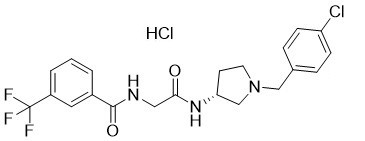
CCR2 antagonist 4 HCl (Teijin compound 1 hydrochloride) is a novel and potent CCR2 antagonist (IC50=180 nM for CCR2b) with anti-inflammatory and immunomodulatory effects.
Physicochemical Properties
| Molecular Formula | C₂₁H₂₂CL₂F₃N₃O₂ |
| Molecular Weight | 476.32 |
| Exact Mass | 475.104 |
| CAS # | 1313730-14-1 |
| Related CAS # | CCR2 antagonist 4;226226-39-7 |
| PubChem CID | 56972239 |
| Appearance | White to off-white solid powder |
| Hydrogen Bond Donor Count | 3 |
| Hydrogen Bond Acceptor Count | 6 |
| Rotatable Bond Count | 6 |
| Heavy Atom Count | 31 |
| Complexity | 597 |
| Defined Atom Stereocenter Count | 1 |
| SMILES | C1CN(C[C@@H]1NC(=O)CNC(=O)C2=CC(=CC=C2)C(F)(F)F)CC3=CC=C(C=C3)Cl.Cl |
| InChi Key | PGUQBBISBKGQDC-GMUIIQOCSA-N |
| InChi Code | InChI=1S/C21H21ClF3N3O2.ClH/c22-17-6-4-14(5-7-17)12-28-9-8-18(13-28)27-19(29)11-26-20(30)15-2-1-3-16(10-15)21(23,24)25;/h1-7,10,18H,8-9,11-13H2,(H,26,30)(H,27,29);1H/t18-;/m1./s1 |
| Chemical Name | N-[2-[[(3R)-1-[(4-chlorophenyl)methyl]pyrrolidin-3-yl]amino]-2-oxoethyl]-3-(trifluoromethyl)benzamide;hydrochloride |
| Synonyms | CCR2 antagonist 4 HCl CCR2 antagonist 4 HCl |
| HS Tariff Code | 2934.99.9001 |
| Storage |
Powder-20°C 3 years 4°C 2 years In solvent -80°C 6 months -20°C 1 month Note: Please store this product in a sealed and protected environment, avoid exposure to moisture. |
| Shipping Condition | Room temperature (This product is stable at ambient temperature for a few days during ordinary shipping and time spent in Customs) |
Biological Activity
| ln Vitro | CCR2 antagonist 4 binds to CCR2 primarily because of Ile263 and Thr292 in CCR2. The binding of protonated CCR2 antagonist 4 hydrochloride and CCL2 is greatly aided by residue Glu291 in TM7, a highly conserved residue seen in numerous CC chemokine receptors. Additionally, the CCR2 antagonist 4 hydrochloride exhibits substantial interactions with His121 on TM3 and Ile263 on TM6 [2]. |
| ln Vivo | Vp-TSL specifically targets endothelial VCAM-1 in the aortic plaque and CCR2 antagonist 4 hydrochloride in ApoE-deficient animals, thereby lowering adhesion/infiltration of a mouse monocyte/macrophage line (RAW 264.7) into the aortic plaque. vessels[3]. |
| References |
[1]. Potent antagonists of the CCR2b receptor. Part 3: SAR of the (R)-3-aminopyrrolidine series. Bioorg Med Chem Lett. 2008 Mar 15;18(6):1869-73. [2]. Elucidation of binding sites of dual antagonists in the human chemokine receptors CCR2 and CCR5. Mol Pharmacol. 2009 Jun;75(6):1325-36. [3]. VCAM-1 directed target-sensitive liposomes carrying CCR2 antagonists bind to activated endothelium and reduce adhesion and transmigration of monocytes. Eur J Pharm Biopharm. 2015 Jan;89:18-29. |
Solubility Data
| Solubility (In Vitro) | DMSO : ~250 mg/mL (~524.86 mM) |
| Solubility (In Vivo) |
Solubility in Formulation 1: ≥ 2.08 mg/mL (4.37 mM) (saturation unknown) in 10% DMSO + 40% PEG300 + 5% Tween80 + 45% Saline (add these co-solvents sequentially from left to right, and one by one), clear solution. For example, if 1 mL of working solution is to be prepared, you can add 100 μL of 20.8 mg/mL clear DMSO stock solution to 400 μL PEG300 and mix evenly; then add 50 μL Tween-80 to the above solution and mix evenly; then add 450 μL normal saline to adjust the volume to 1 mL. Preparation of saline: Dissolve 0.9 g of sodium chloride in 100 mL ddH₂ O to obtain a clear solution. Solubility in Formulation 2: ≥ 2.08 mg/mL (4.37 mM) (saturation unknown) in 10% DMSO + 90% (20% SBE-β-CD in Saline) (add these co-solvents sequentially from left to right, and one by one), clear solution. For example, if 1 mL of working solution is to be prepared, you can add 100 μL of 20.8 mg/mL clear DMSO stock solution to 900 μL of 20% SBE-β-CD physiological saline solution and mix evenly. Preparation of 20% SBE-β-CD in Saline (4°C,1 week): Dissolve 2 g SBE-β-CD in 10 mL saline to obtain a clear solution. Solubility in Formulation 3: ≥ 2.08 mg/mL (4.37 mM) (saturation unknown) in 10% DMSO + 90% Corn Oil (add these co-solvents sequentially from left to right, and one by one), clear solution. For example, if 1 mL of working solution is to be prepared, you can add 100 μL of 20.8 mg/mL clear DMSO stock solution to 900 μL of corn oil and mix evenly. (Please use freshly prepared in vivo formulations for optimal results.) |
| Preparing Stock Solutions | 1 mg | 5 mg | 10 mg | |
| 1 mM | 2.0994 mL | 10.4971 mL | 20.9943 mL | |
| 5 mM | 0.4199 mL | 2.0994 mL | 4.1989 mL | |
| 10 mM | 0.2099 mL | 1.0497 mL | 2.0994 mL |