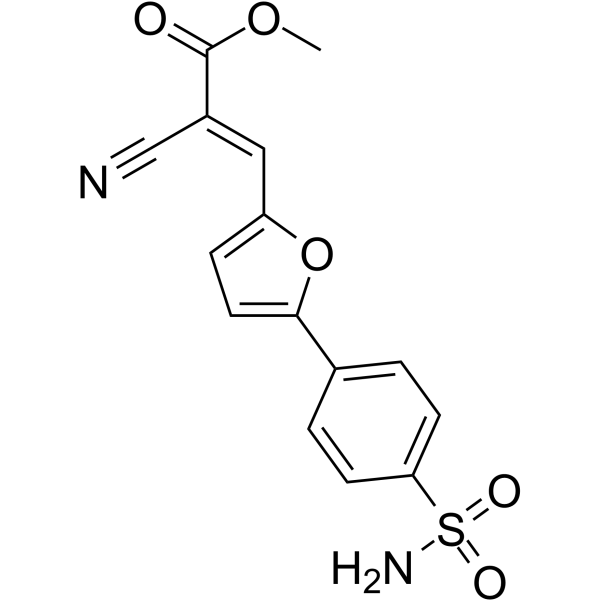
Physicochemical Properties
| Molecular Formula | C15H12N2O5S |
| Molecular Weight | 332.331182479858 |
| Exact Mass | 332.046 |
| CAS # | 292053-42-0 |
| PubChem CID | 710526 |
| Appearance | Light yellow to yellow solid powder |
| LogP | 1.9 |
| Hydrogen Bond Donor Count | 1 |
| Hydrogen Bond Acceptor Count | 7 |
| Rotatable Bond Count | 5 |
| Heavy Atom Count | 23 |
| Complexity | 620 |
| Defined Atom Stereocenter Count | 0 |
| SMILES | S(C1C=CC(=CC=1)C1=CC=C(C=C(C#N)C(=O)OC)O1)(N)(=O)=O |
| InChi Key | VEXAKEBSBMAIOB-DHZHZOJOSA-N |
| InChi Code | InChI=1S/C15H12N2O5S/c1-21-15(18)11(9-16)8-12-4-7-14(22-12)10-2-5-13(6-3-10)23(17,19)20/h2-8H,1H3,(H2,17,19,20)/b11-8+ |
| Chemical Name | methyl (E)-2-cyano-3-[5-(4-sulfamoylphenyl)furan-2-yl]prop-2-enoate |
| HS Tariff Code | 2934.99.9001 |
| Storage |
Powder-20°C 3 years 4°C 2 years In solvent -80°C 6 months -20°C 1 month |
| Shipping Condition | Room temperature (This product is stable at ambient temperature for a few days during ordinary shipping and time spent in Customs) |
Biological Activity
| Targets |
- Mitochondrial respiratory chain (inhibits mitochondrial respiration) [1] - Unfolded protein response (UPR) pathway (activates eIF2α phosphorylation) [1] - Apoptotic machinery (induces caspase-dependent apoptosis) [1] |
| ln Vitro |
- CCI-006 demonstrated selective cytotoxicity against 7/11 (64%) of tested MLL-rearranged (MLL-r) leukemia cell lines (PER-485, MOLM-13, MV4;11) at 10 μM, while sparing MLL-wild-type leukemia cells, solid tumor cells, and normal cells (including peripheral blood mononuclear cells from healthy donors at concentrations up to 20 μM) [1] - CCI-006 induced rapid mitochondrial membrane depolarization within 1 hour of treatment in sensitive MLL-r cells (e.g., PER-485), followed by apoptosis (significant increase in Annexin V+ cells within 3 hours) [1] - CCI-006 inhibited proliferation of sensitive MLL-r leukemia cells with IC50 values in the low micromolar range (0.1-10 μM) depending on cell line [1] - CCI-006 induced eIF2α phosphorylation and reduced polysome formation (inhibited protein translation) exclusively in sensitive MLL-r cells [1] - CCI-006 triggered caspase-3 and PARP cleavage, which was partially prevented by pre-treatment with pan-caspase inhibitor Q-VD-OPh (10 μM) [1] |
| Enzyme Assay |
- Mitochondrial respiration assay: Mouse liver mitochondria were isolated and treated with 1 μM CCI-006. Oxygen consumption rate was measured using a Clark electrode. CCI-006 significantly reduced mitochondrial respiration by 40-60% compared to untreated controls [1] - eIF2α phosphorylation assay: Cell lysates from CCI-006-treated (5 μM, 1-3 hours) and control cells were prepared. Western blotting was performed using antibodies against phosphorylated eIF2α (p-eIF2α) and total eIF2α to detect UPR activation specifically in sensitive MLL-r cells [1] |
| Cell Assay |
- Cell viability assay: MLL-r leukemia cells (5×10³ cells/well) were plated in 96-well plates and treated with CCI-006 (0.1-20 μM) for 72 hours. Cell viability was measured using resazurin reduction assay (fluorescence at 570 nm/600 nm). IC50 values were calculated for sensitive cell lines [1] - Mitochondrial membrane potential assay: Cells were treated with CCI-006 (5 μM) for 1 hour, stained with JC-1 dye, and analyzed by flow cytometry to quantify depolarized mitochondria (reduced red/green fluorescence ratio) [1] - Apoptosis assay: Cells were treated with CCI-006 (5 μM) for 3-24 hours, stained with Annexin V-FITC and propidium iodide, and analyzed by flow cytometry to determine percentage of apoptotic cells [1] - Polysome profiling: CCI-006-treated (5 μM, 1 hour) and control cells were lysed, and polysomes were separated by sucrose gradient centrifugation. Absorbance at 254 nm was monitored to assess translation activity (decreased polysome peaks indicated inhibition of protein synthesis) [1] |
| Animal Protocol |
- Formulation for potential in vivo use: CCI-006 can be dissolved in DMSO (stock solution: ≥83.33 mg/mL) and further diluted in a vehicle containing 10% DMSO + 40% PEG300 + 5% Tween-80 + 45% saline for animal administration [1] |
| ADME/Pharmacokinetics |
- CCI-006 exhibited low stability in liver microsomal stability assays, suggesting it would be rapidly metabolized in vivo and may not be suitable for systemic administration without structural modification [1] |
| References |
[1]. A novel small molecule that kills a subset of MLL-rearranged leukemia cells by inducing mitochondrial dysfunction. Oncogene. 2019 Jan 22. |
| Additional Infomation |
- CCI-006 is a small molecule that selectively kills MLL-r leukemia cells by inducing mitochondrial dysfunction, followed by UPR activation and apoptosis [1] - The sensitivity of MLL-r cells to CCI-006 is associated with relatively low expression levels of MEIS1, HIF1α, and ATP5A (a subunit of mitochondrial ATP synthase) [1] - CCI-006 contains a sulfonamide group, which may contribute to carbonic anhydrase inhibition (not the primary mechanism of action) [1] - Sensitive MLL-r cells are more dependent on mitochondrial respiration than glycolysis for energy production, making them vulnerable to CCI-006-induced mitochondrial dysfunction [1] - CCI-006 represents a novel approach for treating MLL-rearranged leukemias by targeting metabolic vulnerabilities [1] |
Solubility Data
| Solubility (In Vitro) | DMSO : ≥ 83.33 mg/mL (~250.74 mM) |
| Solubility (In Vivo) |
Solubility in Formulation 1: ≥ 8.33 mg/mL (25.07 mM) (saturation unknown) in 10% DMSO + 40% PEG300 +5% Tween-80 + 45% Saline (add these co-solvents sequentially from left to right, and one by one), clear solution. For example, if 1 mL of working solution is to be prepared, you can add 100 μL of 83.3 mg/mL clear DMSO stock solution to 400 μL PEG300 and mix evenly; then add 50 μL Tween-80 + to the above solution and mix evenly; then add 450 μL normal saline to adjust the volume to 1 mL. Preparation of saline: Dissolve 0.9 g of sodium chloride in 100 mL ddH₂ O to obtain a clear solution. (Please use freshly prepared in vivo formulations for optimal results.) |
| Preparing Stock Solutions | 1 mg | 5 mg | 10 mg | |
| 1 mM | 3.0091 mL | 15.0453 mL | 30.0906 mL | |
| 5 mM | 0.6018 mL | 3.0091 mL | 6.0181 mL | |
| 10 mM | 0.3009 mL | 1.5045 mL | 3.0091 mL |