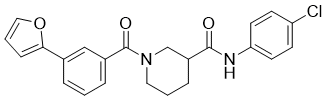
CCG-203971 is a novel, 2nd generation small-molecule inhibitor of the Rho/MRTF/SRF [RhoA/myocardin-related transcription factor A (MRTF-A)] pathway with an IC50 value of 0.64 μM for SRE. CCG-203971 suppresses the expression of collagen 1 (COL1A2), α-smooth muscle actin (α-SMA), and connective tissue growth factor (CTGF) in SSc fibroblasts as well as fibroblasts stimulated by transforming growth factor β (TGFβ) and lysophosphatidic acid (LPA). At a concentration of 25 μM, CCG-203971 significantly suppresses MKL1 expression induced by TGF-β.
Physicochemical Properties
| Molecular Formula | C23H21CLN2O3 | |
| Molecular Weight | 408.88 | |
| Exact Mass | 408.124 | |
| Elemental Analysis | C, 67.56; H, 5.18; Cl, 8.67; N, 6.85; O, 11.74 | |
| CAS # | 1443437-74-8 | |
| Related CAS # |
|
|
| PubChem CID | 71681561 | |
| Appearance | White to off-white solid powder | |
| Density | 1.3±0.1 g/cm3 | |
| Boiling Point | 656.0±55.0 °C at 760 mmHg | |
| Flash Point | 350.5±31.5 °C | |
| Vapour Pressure | 0.0±2.0 mmHg at 25°C | |
| Index of Refraction | 1.633 | |
| LogP | 3.76 | |
| Hydrogen Bond Donor Count | 1 | |
| Hydrogen Bond Acceptor Count | 3 | |
| Rotatable Bond Count | 4 | |
| Heavy Atom Count | 29 | |
| Complexity | 579 | |
| Defined Atom Stereocenter Count | 0 | |
| SMILES | ClC1C([H])=C([H])C(=C([H])C=1[H])N([H])C(C1([H])C([H])([H])N(C(C2=C([H])C([H])=C([H])C(C3=C([H])C([H])=C([H])O3)=C2[H])=O)C([H])([H])C([H])([H])C1([H])[H])=O |
|
| InChi Key | HERLZBNILRVHQN-UHFFFAOYSA-N | |
| InChi Code | InChI=1S/C23H21ClN2O3/c24-19-8-10-20(11-9-19)25-22(27)18-6-2-12-26(15-18)23(28)17-5-1-4-16(14-17)21-7-3-13-29-21/h1,3-5,7-11,13-14,18H,2,6,12,15H2,(H,25,27) | |
| Chemical Name | N-(4-chlorophenyl)-1-[3-(furan-2-yl)benzoyl]piperidine-3-carboxamide | |
| Synonyms |
|
|
| HS Tariff Code | 2934.99.9001 | |
| Storage |
Powder-20°C 3 years 4°C 2 years In solvent -80°C 6 months -20°C 1 month |
|
| Shipping Condition | Room temperature (This product is stable at ambient temperature for a few days during ordinary shipping and time spent in Customs) |
Biological Activity
| Targets | Rho; SRE.L ( IC50 = 0.64 μM ) | |
| ln Vitro |
|
|
| ln Vivo |
|
|
| Cell Assay | Plated into a 96-well plate, human dermal fibroblasts (2.0 × 10⁴) are cultured in DMEM containing 10% FBS for an entire night. After removing the media, they are replaced with DMEM that contains 0.1% DMSO control or 30 μM CCG-203971 along with 2% FBS. WST-1 dye is added to each well after 72 hours, and the absorbance at 490 nm is measured after 60 minutes. | |
| Animal Protocol |
|
|
| References |
[1]. Bioorg Med Chem Lett . 2017 Apr 15;27(8):1744-1749. [2]. J Pharmacol Exp Ther . 2014 Jun;349(3):480-6. |
Solubility Data
| Solubility (In Vitro) |
|
|||
| Solubility (In Vivo) |
Solubility in Formulation 1: 2.5 mg/mL (6.11 mM) in 10% DMSO + 90% (20% SBE-β-CD in Saline) (add these co-solvents sequentially from left to right, and one by one), suspension solution; with sonication. For example, if 1 mL of working solution is to be prepared, you can add 100 μL of 25.0 mg/mL clear DMSO stock solution to 900 μL of 20% SBE-β-CD physiological saline solution and mix evenly. Preparation of 20% SBE-β-CD in Saline (4°C,1 week): Dissolve 2 g SBE-β-CD in 10 mL saline to obtain a clear solution. Solubility in Formulation 2: ≥ 2.08 mg/mL (5.09 mM) (saturation unknown) in 10% DMSO + 40% PEG300 + 5% Tween80 + 45% Saline (add these co-solvents sequentially from left to right, and one by one), clear solution. For example, if 1 mL of working solution is to be prepared, you can add 100 μL of 20.8 mg/mL clear DMSO stock solution to 400 μL PEG300 and mix evenly; then add 50 μL Tween-80 to the above solution and mix evenly; then add 450 μL normal saline to adjust the volume to 1 mL. Preparation of saline: Dissolve 0.9 g of sodium chloride in 100 mL ddH₂ O to obtain a clear solution. Solubility in Formulation 3: ≥ 2.08 mg/mL (5.09 mM) (saturation unknown) in 10% DMSO + 90% Corn Oil (add these co-solvents sequentially from left to right, and one by one), clear solution. For example, if 1 mL of working solution is to be prepared, you can add 100 μL of 20.8 mg/mL clear DMSO stock solution to 900 μL of corn oil and mix evenly. Solubility in Formulation 4: 10% DMSO: 40% PEG300: 5% Tween-80: 45% saline: ≥ 2.5 mg/mL (Please use freshly prepared in vivo formulations for optimal results.) |
| Preparing Stock Solutions | 1 mg | 5 mg | 10 mg | |
| 1 mM | 2.4457 mL | 12.2285 mL | 24.4571 mL | |
| 5 mM | 0.4891 mL | 2.4457 mL | 4.8914 mL | |
| 10 mM | 0.2446 mL | 1.2229 mL | 2.4457 mL |