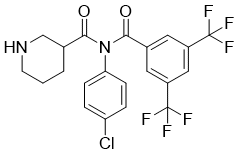
Physicochemical Properties
| Molecular Formula | C21H17CLF6N2O2 |
| Molecular Weight | 478.82 |
| Exact Mass | 478.088 |
| Elemental Analysis | C, 52.68; H, 3.58; Cl, 7.40; F, 23.81; N, 5.85; O, 6.68 |
| CAS # | 1207113-88-9 |
| Related CAS # | 1207113-88-9 |
| PubChem CID | 46190808 |
| Appearance | White to off-white solid powder |
| Density | 1.4±0.1 g/cm3 |
| Boiling Point | 563.8±50.0 °C at 760 mmHg |
| Flash Point | 294.8±30.1 °C |
| Vapour Pressure | 0.0±1.5 mmHg at 25°C |
| Index of Refraction | 1.544 |
| LogP | 5.2 |
| Hydrogen Bond Donor Count | 1 |
| Hydrogen Bond Acceptor Count | 8 |
| Rotatable Bond Count | 3 |
| Heavy Atom Count | 32 |
| Complexity | 656 |
| Defined Atom Stereocenter Count | 0 |
| SMILES | ClC1C=CC(=CC=1)N(C(C1C=C(C(F)(F)F)C=C(C(F)(F)F)C=1)=O)C(C1CNCCC1)=O |
| InChi Key | MOQCFMZWVKQBAP-UHFFFAOYSA-N |
| InChi Code | InChI=1S/C21H17ClF6N2O2/c22-16-3-5-17(6-4-16)29-18(31)12-2-1-7-30(11-12)19(32)13-8-14(20(23,24)25)10-15(9-13)21(26,27)28/h3-6,8-10,12H,1-2,7,11H2,(H,29,31) |
| Chemical Name | 1-[3,5-bis(trifluoromethyl)benzoyl]-N-(4-chlorophenyl)piperidine-3-carboxamide |
| Synonyms | CCG100602; CCG 100602; CCG-100602 |
| HS Tariff Code | 2934.99.9001 |
| Storage |
Powder-20°C 3 years 4°C 2 years In solvent -80°C 6 months -20°C 1 month Note: This product requires protection from light (avoid light exposure) during transportation and storage. |
| Shipping Condition | Room temperature (This product is stable at ambient temperature for a few days during ordinary shipping and time spent in Customs) |
Biological Activity
| ln Vitro | CCG-100602 is a particular antagonist of the signaling pathway associated with myocardin-related transcription factor A/serum response factor (MRTF-A/SRF). By preventing MRTF-A from nuclear localization, it suppresses the fibrogenic transcription factor SRF.[2] |
| ln Vivo | CCG-100602 reduces arterial compliance and strain in spontaneously hypertensive rats, which reverses the increase in aortic stiffness. This suggests a strong anti-stiffening effect brought on by the inhibition of SRF/myocardin.[3] |
| Cell Assay | After 7 days of culture in either basic culture medium (BM), osteogenic medium (OM), or adipogenic medium (AM) supplemented with 15, 20, 25, or 30 μM CCG-1423 or 3, 8, 15, or 30 μM CCG-100602 inhibitor, hASCs are subjected to A/D analysis. While a very small percentage of dead cells are stained with red dye, green dye indicates living cells. |
| Animal Protocol |
Adult (4 month-old) male spontaneously hypertensive rats (SHR) and normotensive control Wistar-Kyoto (WKY) rats 7.5 mg/kg/day osmotic minipumps |
| References |
[1]. Inflamm Bowel Dis . 2014 Jan;20(1):154-65. [2]. Stem Cells Int . 2020 Sep 22:2020:8853541. [3]. Cell Physiol Biochem . 2017;44(2):701-715. |
Solubility Data
| Solubility (In Vitro) | DMSO: ~100 mg/mL (~208.9 mM) |
| Solubility (In Vivo) |
Solubility in Formulation 1: ≥ 0.83 mg/mL (1.73 mM) (saturation unknown) in 10% DMSO + 40% PEG300 + 5% Tween80 + 45% Saline (add these co-solvents sequentially from left to right, and one by one), clear solution. For example, if 1 mL of working solution is to be prepared, you can add 100 μL of 8.3 mg/mL clear DMSO stock solution to 400 μL of PEG300 and mix evenly; then add 50 μL of Tween-80 to the above solution and mix evenly; then add 450 μL of normal saline to adjust the volume to 1 mL. Preparation of saline: Dissolve 0.9 g of sodium chloride in 100 mL ddH₂ O to obtain a clear solution. Solubility in Formulation 2: ≥ 0.83 mg/mL (1.73 mM) (saturation unknown) in 10% DMSO + 90% Corn Oil (add these co-solvents sequentially from left to right, and one by one), clear solution. For example, if 1 mL of working solution is to be prepared, you can add 100 μL of 8.3 mg/mL clear DMSO stock solution to 900 μL of corn oil and mix evenly. (Please use freshly prepared in vivo formulations for optimal results.) |
| Preparing Stock Solutions | 1 mg | 5 mg | 10 mg | |
| 1 mM | 2.0885 mL | 10.4423 mL | 20.8847 mL | |
| 5 mM | 0.4177 mL | 2.0885 mL | 4.1769 mL | |
| 10 mM | 0.2088 mL | 1.0442 mL | 2.0885 mL |