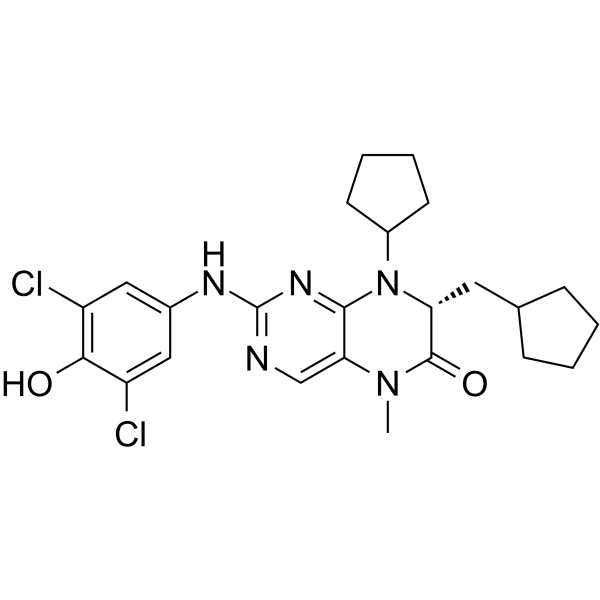
Physicochemical Properties
| Molecular Formula | C24H29CL2N5O2 |
| Molecular Weight | 490.43 |
| Exact Mass | 489.169 |
| CAS # | 2411088-26-9 |
| PubChem CID | 146347307 |
| Appearance | Off-white to gray solid powder |
| LogP | 6.5 |
| Hydrogen Bond Donor Count | 2 |
| Hydrogen Bond Acceptor Count | 6 |
| Rotatable Bond Count | 5 |
| Heavy Atom Count | 33 |
| Complexity | 678 |
| Defined Atom Stereocenter Count | 1 |
| SMILES | N1=C2C(N(C)C(=O)[C@@H](CC3CCCC3)N2C2CCCC2)=CN=C1NC1=CC(Cl)=C(O)C(Cl)=C1 |
| InChi Key | AEZJZTFWCDAUDF-LJQANCHMSA-N |
| InChi Code | InChI=1S/C24H29Cl2N5O2/c1-30-20-13-27-24(28-15-11-17(25)21(32)18(26)12-15)29-22(20)31(16-8-4-5-9-16)19(23(30)33)10-14-6-2-3-7-14/h11-14,16,19,32H,2-10H2,1H3,(H,27,28,29)/t19-/m1/s1 |
| Chemical Name | (7R)-8-cyclopentyl-7-(cyclopentylmethyl)-2-(3,5-dichloro-4-hydroxyanilino)-5-methyl-7H-pteridin-6-one |
| HS Tariff Code | 2934.99.9001 |
| Storage |
Powder-20°C 3 years 4°C 2 years In solvent -80°C 6 months -20°C 1 month |
| Shipping Condition | Room temperature (This product is stable at ambient temperature for a few days during ordinary shipping and time spent in Customs) |
Biological Activity
| Targets | Ki: 40 nM (PI5P4Kα) and 30 nM (PI5P4Kβ)[1] |
| ln Vitro | CC260 (20 μM) reduces S6K phosphorylation (Thr-389) by mTORC1 but increases Insulin-induced Akt phosphorylation at both Thr-308 and Ser-473 in cultured C2C12 myotubes[1]. Acetyl-CoA carboxylase (ACC) phosphorylation is greatly increased by CC260 (2.5 μM, 5 μM, 10 μM, and 20 μM) in a dose-dependent manner[1]. Treatment with CC260 decreases the ability of BT474 cells to withstand serum starvation; however, this ability can be restored by expressing the refractory mutant PI5P4Kβ[1]. Treatment with CC260 increases the generation of glycolytic ATP in BT474 cells[1]. |
| References |
[1]. Pharmacological inhibition of PI5P4Kα/β disrupts cell energy metabolism and selectively kills p53-null tumor cells. Proc Natl Acad Sci U S A. 2021 May 25;118(21):e2002486118. |
Solubility Data
| Solubility (In Vitro) | DMSO: 160 mg/mL (326.24 mM) |
| Solubility (In Vivo) |
Solubility in Formulation 1: 4 mg/mL (8.16 mM) in 10% DMSO + 90% (20% SBE-β-CD in Saline) (add these co-solvents sequentially from left to right, and one by one), suspension solution; with sonication. For example, if 1 mL of working solution is to be prepared, you can add 100 μL of 40.0 mg/mL clear DMSO stock solution to 900 μL of 20% SBE-β-CD physiological saline solution and mix evenly. Preparation of 20% SBE-β-CD in Saline (4°C,1 week): Dissolve 2 g SBE-β-CD in 10 mL saline to obtain a clear solution. Solubility in Formulation 2: ≥ 4 mg/mL (8.16 mM) (saturation unknown) in 10% DMSO + 90% Corn Oil (add these co-solvents sequentially from left to right, and one by one), clear solution. For example, if 1 mL of working solution is to be prepared, you can add 100 μL of 40.0 mg/mL clear DMSO stock solution to 900 μL of corn oil and mix evenly. (Please use freshly prepared in vivo formulations for optimal results.) |
| Preparing Stock Solutions | 1 mg | 5 mg | 10 mg | |
| 1 mM | 2.0390 mL | 10.1951 mL | 20.3903 mL | |
| 5 mM | 0.4078 mL | 2.0390 mL | 4.0781 mL | |
| 10 mM | 0.2039 mL | 1.0195 mL | 2.0390 mL |