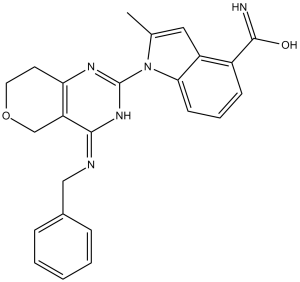
CB-5083 is a novel, potent, selective, first in class and orally bioavailable p97 AAA ATPase inhibitor with potential anticancer activity. Its IC50 value for p97 AAA ATPase inhibition is 11 nM. In hematological and solid models, CB-5083 exhibits antitumor activity and disturbs cellular protein homeostasis. After just one administration, CB-5083 causes poly-ubiquitin to accumulate quickly and persistently in tumor xenografts. Additionally, CB-5083 seems to be more potent than the proteasome inhibitors that are currently on the market, which supports the idea of targeting p97 and protein homeostasis in cancer treatment.
Physicochemical Properties
| Molecular Formula | C24H23N5O2 | |
| Molecular Weight | 413.47 | |
| Exact Mass | 413.185 | |
| Elemental Analysis | C, 69.72; H, 5.61; N, 16.94; O, 7.74 | |
| CAS # | 1542705-92-9 | |
| Related CAS # |
|
|
| PubChem CID | 73051434 | |
| Appearance | White to off-white solid powder | |
| Density | 1.4±0.1 g/cm3 | |
| Boiling Point | 760.5±70.0 °C at 760 mmHg | |
| Flash Point | 413.8±35.7 °C | |
| Vapour Pressure | 0.0±2.6 mmHg at 25°C | |
| Index of Refraction | 1.710 | |
| LogP | 2.61 | |
| Hydrogen Bond Donor Count | 2 | |
| Hydrogen Bond Acceptor Count | 5 | |
| Rotatable Bond Count | 5 | |
| Heavy Atom Count | 31 | |
| Complexity | 627 | |
| Defined Atom Stereocenter Count | 0 | |
| SMILES | O1C([H])([H])C([H])([H])C2=C(C(N([H])C([H])([H])C3C([H])=C([H])C([H])=C([H])C=3[H])=NC(=N2)N2C(C([H])([H])[H])=C([H])C3=C(C(N([H])[H])=O)C([H])=C([H])C([H])=C23)C1([H])[H] |
|
| InChi Key | RDALZZCKQFLGJP-UHFFFAOYSA-N | |
| InChi Code | InChI=1S/C24H23N5O2/c1-15-12-18-17(22(25)30)8-5-9-21(18)29(15)24-27-20-10-11-31-14-19(20)23(28-24)26-13-16-6-3-2-4-7-16/h2-9,12H,10-11,13-14H2,1H3,(H2,25,30)(H,26,27,28) | |
| Chemical Name | 1-[4-(benzylamino)-7,8-dihydro-5H-pyrano[4,3-d]pyrimidin-2-yl]-2-methylindole-4-carboxamide | |
| Synonyms | CB5083; CB-5083; CB 5083 | |
| HS Tariff Code | 2934.99.9001 | |
| Storage |
Powder-20°C 3 years 4°C 2 years In solvent -80°C 6 months -20°C 1 month |
|
| Shipping Condition | Room temperature (This product is stable at ambient temperature for a few days during ordinary shipping and time spent in Customs) |
Biological Activity
| Targets | p97 ( IC50 = 11 nM ) | ||
| ln Vitro |
|
||
| ln Vivo |
|
||
| Enzyme Assay | Starting at 10 μM, compounds are diluted in DMSO using a 3-fold 10-point serial dilution method. The assay is carried out in a 384-well plate, with duplicates of each compound concentration point in each row representing a single dilution series. To initiate the reaction, 20 μM ATP and 20 nM p97 hexameric enzyme are added in a total volume of 5 μL. Once the plate is well mixed in an orbital shaker, it is sealed and incubated for 15 minutes at 37 °C. Compound dilution, ATP addition, and enzyme addition are carried out with the Freedom Evo's automated liquid handling. As directed by the manufacturer, add ADP Glo reagents 1 and 2. As the reaction's end point, the luminescence is measured using an Envision plate reader. The luminescence values of each compound are fitted to a four-parameter sigmoidal curve in order to determine its IC50. | ||
| Cell Assay | The ATCC recommends that A549 and other tumor cell lines be cultured. Stem cells are grown in 384-well plates with a clear bottom and a black or white color. Compound is applied to cells in well duplicates using a 10-point dose titration. The cell viability of the white plates is measured by adding CellTiter-Glo after a 72-hour treatment. Finding IC50 concentrations involves fitting luminosity values to a four-parameter sigmoidal curve. | ||
| Animal Protocol |
|
||
| References |
[1]. J Med Chem . 2015 Dec 24;58(24):9480-97. |
||
| Additional Infomation | p97 Inhibitor CB-5083 is an orally bioavailable inhibitor of valosin-containing protein (VCP) p97, with potential antineoplastic activity. Upon oral administration, CB-5083 specifically binds to and inhibits the activity of p97. This prevents ubiquitin-dependent protein degradation and causes cellular accumulation of poly-ubiquitinated proteins. The inhibition of endoplasmic reticulum (ER)-associated protein degradation activates the ER-dependent stress response pathway, and leads to both an induction of apoptosis and inhibition of cell proliferation in susceptible tumor cells. p97, a type II AAA ATPase, plays a key role in cellular protein homeostasis. Its overexpression in many tumor cell types is associated with increased tumor cell proliferation and survival. |
Solubility Data
| Solubility (In Vitro) |
|
|||
| Solubility (In Vivo) |
Solubility in Formulation 1: ≥ 2.5 mg/mL (6.05 mM) (saturation unknown) in 10% DMSO + 40% PEG300 + 5% Tween80 + 45% Saline (add these co-solvents sequentially from left to right, and one by one), clear solution. For example, if 1 mL of working solution is to be prepared, you can add 100 μL of 25.0 mg/mL clear DMSO stock solution to 400 μL PEG300 and mix evenly; then add 50 μL Tween-80 to the above solution and mix evenly; then add 450 μL normal saline to adjust the volume to 1 mL. Preparation of saline: Dissolve 0.9 g of sodium chloride in 100 mL ddH₂ O to obtain a clear solution. Solubility in Formulation 2: ≥ 2.5 mg/mL (6.05 mM) (saturation unknown) in 10% DMSO + 90% (20% SBE-β-CD in Saline) (add these co-solvents sequentially from left to right, and one by one), clear solution. For example, if 1 mL of working solution is to be prepared, you can add 100 μL of 25.0 mg/mL clear DMSO stock solution to 900 μL of 20% SBE-β-CD physiological saline solution and mix evenly. Preparation of 20% SBE-β-CD in Saline (4°C,1 week): Dissolve 2 g SBE-β-CD in 10 mL saline to obtain a clear solution. Solubility in Formulation 3: ≥ 2.5 mg/mL (6.05 mM) (saturation unknown) in 10% DMSO + 90% Corn Oil (add these co-solvents sequentially from left to right, and one by one), clear solution. For example, if 1 mL of working solution is to be prepared, you can add 100 μL of 25.0 mg/mL clear DMSO stock solution to 900 μL of corn oil and mix evenly. Solubility in Formulation 4: 0.5%CMC Na +5% Tween 80 : 30mg/mL Solubility in Formulation 5: 10 mg/mL (24.19 mM) in 50% PEG300 50% Saline (add these co-solvents sequentially from left to right, and one by one), clear solution; with ultrasonication. Preparation of saline: Dissolve 0.9 g of sodium chloride in 100 mL ddH₂ O to obtain a clear solution. (Please use freshly prepared in vivo formulations for optimal results.) |
| Preparing Stock Solutions | 1 mg | 5 mg | 10 mg | |
| 1 mM | 2.4186 mL | 12.0928 mL | 24.1856 mL | |
| 5 mM | 0.4837 mL | 2.4186 mL | 4.8371 mL | |
| 10 mM | 0.2419 mL | 1.2093 mL | 2.4186 mL |