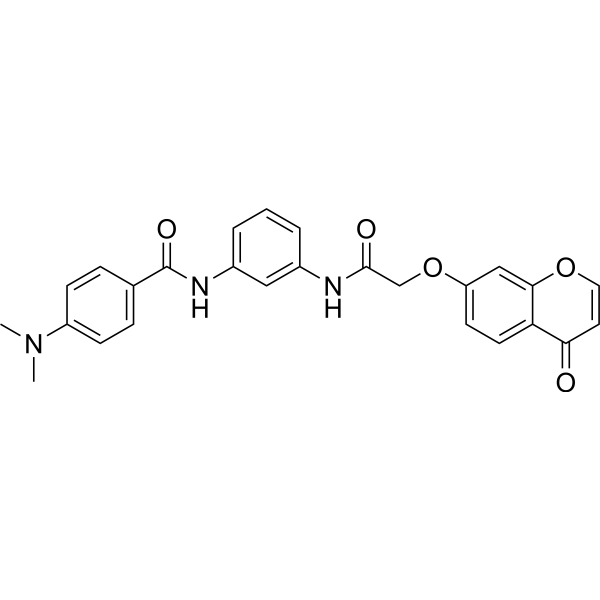
Physicochemical Properties
| Molecular Formula | C26H23N3O5 |
| Molecular Weight | 457.48 |
| Exact Mass | 457.163 |
| CAS # | 2247240-76-0 |
| Appearance | Off-white to light yellow solid powder |
| Density | 1.4±0.1 g/cm3 |
| Boiling Point | 664.2±55.0 °C at 760 mmHg |
| Flash Point | 355.5±31.5 °C |
| Vapour Pressure | 0.0±2.0 mmHg at 25°C |
| Index of Refraction | 1.697 |
| LogP | 3.26 |
| HS Tariff Code | 2934.99.9001 |
| Storage |
Powder-20°C 3 years 4°C 2 years In solvent -80°C 6 months -20°C 1 month |
| Shipping Condition | Room temperature (This product is stable at ambient temperature for a few days during ordinary shipping and time spent in Customs) |
Biological Activity
| Targets | IC50: 0.014 μM (ROCK I); 0.003 μM (ROCK II)[1] |
| ln Vitro | Compound 12j, also known as CAY10746, exhibits inhibitory activity against both ROCK I and II, with IC50 values of 0.014 μM and 0.003 μM, in that order [1]. CAY10746 suppresses ROCK kinase activity in SH-SY5Y cells at concentrations of 0.1, 1, and 10 μM; 0.25, 1, 2, and 4 hours [1]. In vitro, CAY10746 (1 μM; 24 h, 36 h) inhibits the migration of endothelial cells [1]. Retinal neurons are shielded from oxidative stress and cell death caused by apoptosis by CAY10746 (1 μM; 5 days) [1]. Retinal explants grown in a high-glucose milieu show that CAY10746 (1 μM; 5 days) increases vascular degeneration and prevents improper Müller cell proliferation [1]. |
| Cell Assay |
Western Blot Analysis[1] Cell Types: SH-SY5Y cells Tested Concentrations: 0.1, 1 and 10 μM; 10 μM Incubation Duration: 2 h; 0.25, 1, 2 and 4 h Experimental Results: Inhibited the phosphorylation of MYPT1 but did not impact the MYPT1 expression in dose-dependence and time-dependence. Cell Proliferation Assay[1] Cell Types: SH-SY5Y cells Tested Concentrations: 1 μM Incubation Duration: 5 days Experimental Results: Dramatically protected the cells from death. Cell Migration Assay [1] Cell Types: HUVEC cells Tested Concentrations: 1 μM Incubation Duration: 24 h, 36 h Experimental Results: Dramatically decreased migrating cell numbers and Dramatically reduce the rate of wound healing at 24 h and 36 h. Apoptosis Analysis[1] Cell Types: ex vivo DR model Tested Concentrations: 1 μM Incubation Duration: 5 days Experimental Results: Dramatically protected neuronal cells from death. |
| References |
[1]. Discovery of 4 H-Chromen-4-one Derivatives as a New Class of Selective Rho Kinase (ROCK) Inhibitors, which Showed Potent Activity in ex Vivo Diabetic Retinopathy Models. J Med Chem. 2019 Dec 12;62(23):10691-10710. |
Solubility Data
| Solubility (In Vitro) | DMSO : 83.33 mg/mL (182.15 mM) |
| Solubility (In Vivo) |
Solubility in Formulation 1: ≥ 2.08 mg/mL (4.55 mM) (saturation unknown) in 10% DMSO + 40% PEG300 + 5% Tween80 + 45% Saline (add these co-solvents sequentially from left to right, and one by one), clear solution. For example, if 1 mL of working solution is to be prepared, you can add 100 μL of 20.8 mg/mL clear DMSO stock solution to 400 μL PEG300 and mix evenly; then add 50 μL Tween-80 to the above solution and mix evenly; then add 450 μL normal saline to adjust the volume to 1 mL. Preparation of saline: Dissolve 0.9 g of sodium chloride in 100 mL ddH₂ O to obtain a clear solution. Solubility in Formulation 2: ≥ 2.08 mg/mL (4.55 mM) (saturation unknown) in 10% DMSO + 90% Corn Oil (add these co-solvents sequentially from left to right, and one by one), clear solution. For example, if 1 mL of working solution is to be prepared, you can add 100 μL of 20.8 mg/mL clear DMSO stock solution to 900 μL of corn oil and mix evenly. (Please use freshly prepared in vivo formulations for optimal results.) |
| Preparing Stock Solutions | 1 mg | 5 mg | 10 mg | |
| 1 mM | 2.1859 mL | 10.9294 mL | 21.8589 mL | |
| 5 mM | 0.4372 mL | 2.1859 mL | 4.3718 mL | |
| 10 mM | 0.2186 mL | 1.0929 mL | 2.1859 mL |