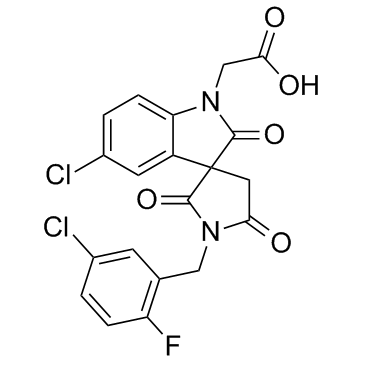
CAY10595 is a novel, selective, potent and orally bioavailable CRTH2/DP2 receptor antagonist with the potential for the treatment of allergic inflammatory diseases. It binds to the human receptor with a Ki of 10 nM. Administration of the DP2 antagonist CAY10595 slightly delays the development of CIA. Treatment with CAY10595 reduces IgG2a anti-CII levels without modification of IgG anti-CII levels.
Physicochemical Properties
| Molecular Formula | C20H13CL2FN2O5 |
| Molecular Weight | 451.232026815414 |
| Exact Mass | 450.018 |
| CAS # | 916047-16-0 |
| PubChem CID | 15949395 |
| Appearance | Typically exists as solid at room temperature |
| Density | 1.7±0.1 g/cm3 |
| Boiling Point | 810.1±65.0 °C at 760 mmHg |
| Flash Point | 443.8±34.3 °C |
| Vapour Pressure | 0.0±3.0 mmHg at 25°C |
| Index of Refraction | 1.705 |
| LogP | 3.37 |
| Hydrogen Bond Donor Count | 1 |
| Hydrogen Bond Acceptor Count | 6 |
| Rotatable Bond Count | 4 |
| Heavy Atom Count | 30 |
| Complexity | 782 |
| Defined Atom Stereocenter Count | 0 |
| SMILES | O=C(CN1C2C(=CC(=CC=2)Cl)C2(CC(=O)N(CC3C(F)=CC=C(Cl)C=3)C2=O)C1=O)O |
| InChi Key | IXKFWNVFUXXEFY-UHFFFAOYSA-N |
| InChi Code | InChI=1S/C20H13Cl2FN2O5/c21-11-1-3-14(23)10(5-11)8-25-16(26)7-20(19(25)30)13-6-12(22)2-4-15(13)24(18(20)29)9-17(27)28/h1-6H,7-9H2,(H,27,28) |
| Chemical Name | 2-[5-chloro-1'-[(5-chloro-2-fluorophenyl)methyl]-2,2',5'-trioxospiro[indole-3,3'-pyrrolidine]-1-yl]acetic acid |
| Synonyms | CAY-10595; CAY10595; CAY 10595 |
| HS Tariff Code | 2934.99.9001 |
| Storage |
Powder-20°C 3 years 4°C 2 years In solvent -80°C 6 months -20°C 1 month |
| Shipping Condition | Room temperature (This product is stable at ambient temperature for a few days during ordinary shipping and time spent in Customs) |
Biological Activity
| Targets |
DP2 receptor (CRTH2) antagonist [2] |
| ln Vitro | CAY10595 (compound 71) is a strong antagonist of the CRTH2/DP2 receptor that has a Ki value of 10 nM for binding to human receptors [1]. |
| ln Vivo |
The DP2 antagonist CAY10595 administration caused a slight delay in the development of CIA. IgG2a anti-CII levels are decreased by CAY10595 treatment, but IgG anti-CII levels remain unchanged [2]. Administration of the DP2 antagonist CAY10595 (5 mg/kg/day, orally) from days 21 to 33 after immunization slightly delayed the development of collagen-induced arthritis (CIA) in DBA/1J mice, but did not significantly modify the final clinical score or histologic severity of arthritis compared to the arthritic control group. Treatment with CAY10595 significantly reduced serum levels of anti-type II collagen (CII) IgG2a antibodies compared to arthritic control mice, without modifying total anti-CII IgG levels. Local levels of IL-6, CXCL-1, TGFβ1, and PGE₂ in paw homogenates were augmented by CAY10595 treatment. It did not modify the levels of Th1 (IFNγ, IL-2) or Th2 (IL-4) cytokines, but showed a tendency to increase IL-17 levels without reaching statistical significance. [2] |
| Animal Protocol |
CAY10595 was dissolved in a vehicle consisting of Tween 80/ethanol/tap water (5/5/90 ratio). In the CIA model in DBA/1J mice, CAY10595 was administered orally at a dose of 5 mg/kg/day, once daily, from day 21 to day 33 after the initial immunization. The control group received the same volume (500 µl) of vehicle. On day 34, serum samples were collected, animals were euthanized, and hind paws were processed for histologic analysis or homogenized for measurement of inflammatory mediators. [2] |
| References |
[1]. Discovery of a new class of potent, selective, and orally bioavailable CRTH2 (DP2) receptor antagonists for the treatment of allergic inflammatory diseases. J Med Chem. 2008 Apr 10;51(7):2227-43. [2]. Prostaglandin D2 regulates joint inflammation and destruction in murine collagen-induced arthritis. Arthritis Rheum. 2012 Jan;64(1):130-40. |
| Additional Infomation |
CAY10595 is a selective antagonist of the DP2 receptor (also known as CRTH2). In the context of murine collagen-induced arthritis, antagonism of the DP2 receptor did not significantly ameliorate disease severity, in contrast to the DP1 receptor antagonist which exacerbated arthritis. This suggests that the anti-inflammatory effects of PGD₂ observed in this model are mediated primarily through the DP1 receptor, not the DP2 receptor. [2] |
Solubility Data
| Solubility (In Vitro) | May dissolve in DMSO (in most cases), if not, try other solvents such as H2O, Ethanol, or DMF with a minute amount of products to avoid loss of samples |
| Solubility (In Vivo) |
Note: Listed below are some common formulations that may be used to formulate products with low water solubility (e.g. < 1 mg/mL), you may test these formulations using a minute amount of products to avoid loss of samples. Injection Formulations (e.g. IP/IV/IM/SC) Injection Formulation 1: DMSO : Tween 80: Saline = 10 : 5 : 85 (i.e. 100 μL DMSO stock solution → 50 μL Tween 80 → 850 μL Saline) *Preparation of saline: Dissolve 0.9 g of sodium chloride in 100 mL ddH ₂ O to obtain a clear solution. Injection Formulation 2: DMSO : PEG300 :Tween 80 : Saline = 10 : 40 : 5 : 45 (i.e. 100 μL DMSO → 400 μLPEG300 → 50 μL Tween 80 → 450 μL Saline) Injection Formulation 3: DMSO : Corn oil = 10 : 90 (i.e. 100 μL DMSO → 900 μL Corn oil) Example: Take the Injection Formulation 3 (DMSO : Corn oil = 10 : 90) as an example, if 1 mL of 2.5 mg/mL working solution is to be prepared, you can take 100 μL 25 mg/mL DMSO stock solution and add to 900 μL corn oil, mix well to obtain a clear or suspension solution (2.5 mg/mL, ready for use in animals). Injection Formulation 4: DMSO : 20% SBE-β-CD in saline = 10 : 90 [i.e. 100 μL DMSO → 900 μL (20% SBE-β-CD in saline)] *Preparation of 20% SBE-β-CD in Saline (4°C,1 week): Dissolve 2 g SBE-β-CD in 10 mL saline to obtain a clear solution. Injection Formulation 5: 2-Hydroxypropyl-β-cyclodextrin : Saline = 50 : 50 (i.e. 500 μL 2-Hydroxypropyl-β-cyclodextrin → 500 μL Saline) Injection Formulation 6: DMSO : PEG300 : castor oil : Saline = 5 : 10 : 20 : 65 (i.e. 50 μL DMSO → 100 μLPEG300 → 200 μL castor oil → 650 μL Saline) Injection Formulation 7: Ethanol : Cremophor : Saline = 10: 10 : 80 (i.e. 100 μL Ethanol → 100 μL Cremophor → 800 μL Saline) Injection Formulation 8: Dissolve in Cremophor/Ethanol (50 : 50), then diluted by Saline Injection Formulation 9: EtOH : Corn oil = 10 : 90 (i.e. 100 μL EtOH → 900 μL Corn oil) Injection Formulation 10: EtOH : PEG300:Tween 80 : Saline = 10 : 40 : 5 : 45 (i.e. 100 μL EtOH → 400 μLPEG300 → 50 μL Tween 80 → 450 μL Saline) Oral Formulations Oral Formulation 1: Suspend in 0.5% CMC Na (carboxymethylcellulose sodium) Oral Formulation 2: Suspend in 0.5% Carboxymethyl cellulose Example: Take the Oral Formulation 1 (Suspend in 0.5% CMC Na) as an example, if 100 mL of 2.5 mg/mL working solution is to be prepared, you can first prepare 0.5% CMC Na solution by measuring 0.5 g CMC Na and dissolve it in 100 mL ddH2O to obtain a clear solution; then add 250 mg of the product to 100 mL 0.5% CMC Na solution, to make the suspension solution (2.5 mg/mL, ready for use in animals). Oral Formulation 3: Dissolved in PEG400 Oral Formulation 4: Suspend in 0.2% Carboxymethyl cellulose Oral Formulation 5: Dissolve in 0.25% Tween 80 and 0.5% Carboxymethyl cellulose Oral Formulation 6: Mixing with food powders Note: Please be aware that the above formulations are for reference only. InvivoChem strongly recommends customers to read literature methods/protocols carefully before determining which formulation you should use for in vivo studies, as different compounds have different solubility properties and have to be formulated differently. (Please use freshly prepared in vivo formulations for optimal results.) |
| Preparing Stock Solutions | 1 mg | 5 mg | 10 mg | |
| 1 mM | 2.2162 mL | 11.0808 mL | 22.1616 mL | |
| 5 mM | 0.4432 mL | 2.2162 mL | 4.4323 mL | |
| 10 mM | 0.2216 mL | 1.1081 mL | 2.2162 mL |