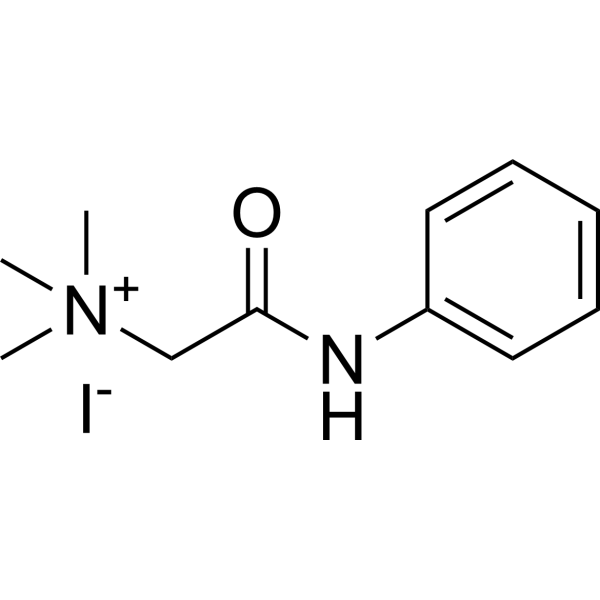
Physicochemical Properties
| Molecular Formula | C11H17IN2O |
| Molecular Weight | 320.17 |
| CAS # | 22913-17-3 |
| PubChem CID | 31569 |
| Appearance | Typically exists as solids at room temperature |
| LogP | 2.852 |
| Hydrogen Bond Donor Count | 1 |
| Hydrogen Bond Acceptor Count | 2 |
| Rotatable Bond Count | 3 |
| Heavy Atom Count | 15 |
| Complexity | 190 |
| Defined Atom Stereocenter Count | 0 |
| SMILES | C[N+](C)(C)CC(=NC1=CC=CC=C1)[O-].I |
| Synonyms | Santinamide; 22913-17-3; CAY10568; (Phenylcarbamylmethyl)-trimethylammonium iodide; (2-anilino-2-oxoethyl)-trimethylazanium;iodide; Santinamide; AMMONIUM, (PHENYLCARBAMYLMETHYL)TRIMETHYL-, IODIDE; |
| HS Tariff Code | 2934.99.9001 |
| Storage |
Powder-20°C 3 years 4°C 2 years In solvent -80°C 6 months -20°C 1 month |
| Shipping Condition | Room temperature (This product is stable at ambient temperature for a few days during ordinary shipping and time spent in Customs) |
Biological Activity
| Targets | QX-314 analog; pain killer |
| Toxicity/Toxicokinetics | mouse LDLo subcutaneous 39 mg/kg Journal of Pharmacology and Experimental Therapeutics., 48(51), 1933 |
| References |
[1]. Inhibition of nociceptors by TRPV1-mediated entry of impermeant sodium channel blockers. Nature. 2007 Oct 4;449(7162):607-10. |
| Additional Infomation | Most local anaesthetics used clinically are relatively hydrophobic molecules that gain access to their blocking site on the sodium channel by diffusing into or through the cell membrane. These anaesthetics block sodium channels and thereby the excitability of all neurons, not just sensory neurons. We tested the possibility of selectively blocking the excitability of primary sensory nociceptor (pain-sensing) neurons by introducing the charged, membrane-impermeant lidocaine derivative QX-314 through the pore of the noxious-heat-sensitive TRPV1 channel. Here we show that charged sodium-channel blockers can be targeted into nociceptors by the application of TRPV1 agonists to produce a pain-specific local anaesthesia. QX-314 applied externally had no effect on the activity of sodium channels in small sensory neurons when applied alone, but when applied in the presence of the TRPV1 agonist capsaicin, QX-314 blocked sodium channels and inhibited excitability. Inhibition by co-applied QX-314 and capsaicin was restricted to neurons expressing TRPV1. Injection of QX-314 together with capsaicin into rat hindpaws produced a long-lasting (more than 2 h) increase in mechanical and thermal nociceptive thresholds. Long-lasting decreases in pain sensitivity were also seen with regional injection of QX-314 and capsaicin near the sciatic nerve; however, in contrast to the effect of lidocaine, the application of QX-314 and capsaicin together was not accompanied by motor or tactile deficits. [1] |
Solubility Data
| Solubility (In Vitro) | May dissolve in DMSO (in most cases), if not, try other solvents such as H2O, Ethanol, or DMF with a minute amount of products to avoid loss of samples |
| Solubility (In Vivo) |
Note: Listed below are some common formulations that may be used to formulate products with low water solubility (e.g. < 1 mg/mL), you may test these formulations using a minute amount of products to avoid loss of samples. Injection Formulations (e.g. IP/IV/IM/SC) Injection Formulation 1: DMSO : Tween 80: Saline = 10 : 5 : 85 (i.e. 100 μL DMSO stock solution → 50 μL Tween 80 → 850 μL Saline) *Preparation of saline: Dissolve 0.9 g of sodium chloride in 100 mL ddH ₂ O to obtain a clear solution. Injection Formulation 2: DMSO : PEG300 :Tween 80 : Saline = 10 : 40 : 5 : 45 (i.e. 100 μL DMSO → 400 μLPEG300 → 50 μL Tween 80 → 450 μL Saline) Injection Formulation 3: DMSO : Corn oil = 10 : 90 (i.e. 100 μL DMSO → 900 μL Corn oil) Example: Take the Injection Formulation 3 (DMSO : Corn oil = 10 : 90) as an example, if 1 mL of 2.5 mg/mL working solution is to be prepared, you can take 100 μL 25 mg/mL DMSO stock solution and add to 900 μL corn oil, mix well to obtain a clear or suspension solution (2.5 mg/mL, ready for use in animals). Injection Formulation 4: DMSO : 20% SBE-β-CD in saline = 10 : 90 [i.e. 100 μL DMSO → 900 μL (20% SBE-β-CD in saline)] *Preparation of 20% SBE-β-CD in Saline (4°C,1 week): Dissolve 2 g SBE-β-CD in 10 mL saline to obtain a clear solution. Injection Formulation 5: 2-Hydroxypropyl-β-cyclodextrin : Saline = 50 : 50 (i.e. 500 μL 2-Hydroxypropyl-β-cyclodextrin → 500 μL Saline) Injection Formulation 6: DMSO : PEG300 : castor oil : Saline = 5 : 10 : 20 : 65 (i.e. 50 μL DMSO → 100 μLPEG300 → 200 μL castor oil → 650 μL Saline) Injection Formulation 7: Ethanol : Cremophor : Saline = 10: 10 : 80 (i.e. 100 μL Ethanol → 100 μL Cremophor → 800 μL Saline) Injection Formulation 8: Dissolve in Cremophor/Ethanol (50 : 50), then diluted by Saline Injection Formulation 9: EtOH : Corn oil = 10 : 90 (i.e. 100 μL EtOH → 900 μL Corn oil) Injection Formulation 10: EtOH : PEG300:Tween 80 : Saline = 10 : 40 : 5 : 45 (i.e. 100 μL EtOH → 400 μLPEG300 → 50 μL Tween 80 → 450 μL Saline) Oral Formulations Oral Formulation 1: Suspend in 0.5% CMC Na (carboxymethylcellulose sodium) Oral Formulation 2: Suspend in 0.5% Carboxymethyl cellulose Example: Take the Oral Formulation 1 (Suspend in 0.5% CMC Na) as an example, if 100 mL of 2.5 mg/mL working solution is to be prepared, you can first prepare 0.5% CMC Na solution by measuring 0.5 g CMC Na and dissolve it in 100 mL ddH2O to obtain a clear solution; then add 250 mg of the product to 100 mL 0.5% CMC Na solution, to make the suspension solution (2.5 mg/mL, ready for use in animals). Oral Formulation 3: Dissolved in PEG400 Oral Formulation 4: Suspend in 0.2% Carboxymethyl cellulose Oral Formulation 5: Dissolve in 0.25% Tween 80 and 0.5% Carboxymethyl cellulose Oral Formulation 6: Mixing with food powders Note: Please be aware that the above formulations are for reference only. InvivoChem strongly recommends customers to read literature methods/protocols carefully before determining which formulation you should use for in vivo studies, as different compounds have different solubility properties and have to be formulated differently. (Please use freshly prepared in vivo formulations for optimal results.) |
| Preparing Stock Solutions | 1 mg | 5 mg | 10 mg | |
| 1 mM | 3.1233 mL | 15.6167 mL | 31.2334 mL | |
| 5 mM | 0.6247 mL | 3.1233 mL | 6.2467 mL | |
| 10 mM | 0.3123 mL | 1.5617 mL | 3.1233 mL |