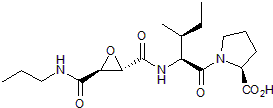
CA-074 (CA074) is a novel and potent inhibitor of cathepsin B with anticancer activity. It inhibits cathepsin B with a Ki of 2-5 nM.
Physicochemical Properties
| Molecular Formula | C18H29N3O6 |
| Molecular Weight | 383.45 |
| Exact Mass | 383.206 |
| Elemental Analysis | C, 56.38; H, 7.62; N, 10.96; O, 25.03 |
| CAS # | 134448-10-5 |
| Related CAS # | 147859-80-1 |
| PubChem CID | 9821383 |
| Appearance | White to yellow solid |
| Density | 1.267g/cm3 |
| Boiling Point | 728.9ºC at 760mmHg |
| Flash Point | 394.7ºC |
| Vapour Pressure | 0mmHg at 25°C |
| Index of Refraction | 1.539 |
| LogP | 0.606 |
| Hydrogen Bond Donor Count | 3 |
| Hydrogen Bond Acceptor Count | 6 |
| Rotatable Bond Count | 9 |
| Heavy Atom Count | 27 |
| Complexity | 596 |
| Defined Atom Stereocenter Count | 5 |
| SMILES | O=C(N1[C@@H](CCC1)C(O)=O)[C@@]([C@@H](C)CC)([H])NC([C@@H]2[C@@H](C(NCCC)=O)O2)=O |
| InChi Key | ZEZGJKSEBRELAS-PEDHHIEDSA-N |
| InChi Code | InChI=1S/C18H29N3O6/c1-4-8-19-15(22)13-14(27-13)16(23)20-12(10(3)5-2)17(24)21-9-6-7-11(21)18(25)26/h10-14H,4-9H2,1-3H3,(H,19,22)(H,20,23)(H,25,26)/t10-,11-,12-,13-,14-/m0/s1 |
| Chemical Name | (2S-trans)-1-(N-((3-((Propylamino)carbonyl)oxiranyl)carbonyl)-L-isoleucyl)-L-proline; (2S)-1-[(2S,3S)-3-Methyl-2-[[(3S)-3-(propylcarbamoyl)oxirane-2-carbonyl]amino]pentanoyl]pyrrolidine-2-carboxylic acid |
| Synonyms | CA 074; CA074; 134448-10-5; MFCD00797531; CHEMBL490920; Cathepsin B Inhibitor III; (2S)-1-[(2S,3S)-3-methyl-2-{[(2S,3S)-3-(propylcarbamoyl)oxiran-2-yl]formamido}pentanoyl]pyrrolidine-2-carboxylic acid; PrNH-tES-Ile-Pro-OH; CA 074 TFA; CA-074 |
| HS Tariff Code | 2934.99.03.00 |
| Storage |
Powder-20°C 3 years 4°C 2 years In solvent -80°C 6 months -20°C 1 month |
| Shipping Condition | Room temperature (This product is stable at ambient temperature for a few days during ordinary shipping and time spent in Customs) |
Biological Activity
| Targets | Cathepsin B (Ki = 2 ~ 5 nM ) |
| ln Vitro | Through clever drug design, CA-074 is a synthetic analogue of E-64, a naturally occurring peptidyl epoxide that irreversibly blocks the majority of known lysosomal cysteine proteases. created by making use of cathepsin B's dipeptidyl carboxypeptidase activity. In living cells, CA-074 can be used to specifically inhibit cathepsin B, provided that the settings of the experiment permit a substantial amount of liquid-phase drug endocytosis [2]. Cathepsin B is inhibited by CA-074 at a Ki of 2 to 5 nM, while the initial Kis of cathepsins H and L range from 40 to 200 μM. When it comes to purified rat cathepsin B, CA-074 has an inhibitory impact that is 10,000–30,000 times stronger than it is on cathepsins H and L [1]. |
| ln Vivo | Rats' cathepsin B activity can be effectively and selectively inhibited by injecting compound CA-074 intraperitoneally [1]. Eight monkeys with cerebral ischemia lasting 20 minutes were given intravenous CA-074 immediately after the injury, which prevented 67% of CA1 neurons from dying later on day five. Of the eight monkeys, three had very good inhibition levels and five had good inhibition [3]. |
| Enzyme Assay | New derivatives of E-64 (compound CA-030 and CA-074) were tested in vitro and in vivo for selective inhibition of cathepsin B. They exhibited 10,000-30,000 times greater inhibitory effects on purified rat cathepsin B than on cathepsin H and L: their initial Ki values for cathepsin B were about 2-5 nM, like that of E-64-c, whereas their initial Ki values for cathepsins H and L were about 40 200 microM [1]. |
| Cell Assay | Studies using inhibitors that reportedly discriminate between cathepsin B and related lysosomal cysteine proteinases have implicated the enzyme in a wide range of physiological and pathological processes. The most popular substance to selectively inhibit cathepsin B in vivo is CA-074Me, the methyl ester of the E-64 derivative CA-074. However, we now have found that CA-074Me inactivates both cathepsin B and cathepsin L within murine fibroblasts. In contrast, exposure of these cells to the parental compound CA 074 leads to the selective inhibition of endogenous cathepsin B, while intracellular cathepsin L remains unaffected. These results indicate that CA-074 rather than CA-074Me should be used to specifically inactivate cathepsin B within living cells [2]. |
| Animal Protocol | Although Cornu Ammonis (CA) 1 neurons of the hippocampus are known to be vulnerable to transient ischaemia, the mechanism of ischaemic neuronal death is still unknown, and there are very few strategies to prevent neuronal death at present. In a previous report we demonstrated micro-calpain activation at the disrupted lysosomal membrane of postischaemic CA1 neurons in the monkey undergoing a complete 20 min whole brain ischaemia. Using the same experimental paradigm, we observed that the enzyme activity of the lysosomal protease cathepsin B increased throughout the hippocampus on days 3-5 after the transient ischaemia. Furthermore, by immunocytochemistry cathepsin B showed presence of extralysosomal immunoreactivity with specific localization to the cytoplasm of CA1 neurons and the neuropil of the vulnerable CA1 sector. When a specific inhibitor of cathepsin B, the epoxysuccinyl peptide CA-074 (C18H29N3O6) was intravenously administered immediately after the ischaemic insult, approximately 67% of CA1 neurons were saved from delayed neuronal death on day 5 in eight monkeys undergoing 20 min brain ischaemia: the extent of inhibition was excellent in three of eight and good in five of eight monkeys. The surviving neurons rescued by blockade of lysosomal activity, showed mild central chromatolysis and were associated with the decreased immunoreactivity for cathepsin B. These observations indicate that calpain-induced cathepsin B release is crucial for the development of the ischaemic neuronal death, and that a specific inhibitor of cathepsin B is of potential therapeutic utility in ischaemic injuries to the human CNS [3]. |
| References |
[1]. Novel epoxysuccinyl peptides. A selective inhibitor of cathepsin B, in vivo. FEBS Lett. 1991 Mar 25;280(2):311-5. [2]. CA-074, but not its methyl ester CA-074Me, is a selective inhibitor of cathepsin B within living cells. Biol Chem. 2002 Jul-Aug;383(7-8):1305-8. [3]. Inhibition of ischaemic hippocampal neuronal death in primates with cathepsin B inhibitor CA-074: a novel strategy for neuroprotection based on 'calpain-cathepsin hypothesis'. Eur J Neurosci. 1998 May;10(5):1723-33. |
| Additional Infomation |
New derivatives of E-64 (compound CA-030 and CA-074) were tested in vitro and in vivo for selective inhibition of cathepsin B. They exhibited 10,000-30,000 times greater inhibitory effects on purified rat cathepsin B than on cathepsin H and L: their initial Ki values for cathepsin B were about 2-5 nM, like that of E-64-c, whereas their initial Ki values for cathepsins H and L were about 40 200 microM. In in vivo conditions, such as intraperitoneal injection of compound CA-030 or CA-074 into rats, compound CA-074 is an especially potent selective inhibitor of cathepsin B, whereas compound CA-030 does not show selectivity for cathepsin B, although both compounds CA-030 and CA-074 show complete selectivity for cathepsin B in vitro.[1] Studies using inhibitors that reportedly discriminate between cathepsin B and related lysosomal cysteine proteinases have implicated the enzyme in a wide range of physiological and pathological processes. The most popular substance to selectively inhibit cathepsin B in vivo is CA-074Me, the methyl ester of the E-64 derivative CA-074. However, we now have found that CA-074Me inactivates both cathepsin B and cathepsin L within murine fibroblasts. In contrast, exposure of these cells to the parental compound CA-074 leads to the selective inhibition of endogenous cathepsin B, while intracellular cathepsin L remains unaffected. These results indicate that CA-074 rather than CA-074Me should be used to specifically inactivate cathepsin B within living cells.[2] Although Cornu Ammonis (CA) 1 neurons of the hippocampus are known to be vulnerable to transient ischaemia, the mechanism of ischaemic neuronal death is still unknown, and there are very few strategies to prevent neuronal death at present. In a previous report we demonstrated micro-calpain activation at the disrupted lysosomal membrane of postischaemic CA1 neurons in the monkey undergoing a complete 20 min whole brain ischaemia. Using the same experimental paradigm, we observed that the enzyme activity of the lysosomal protease cathepsin B increased throughout the hippocampus on days 3-5 after the transient ischaemia. Furthermore, by immunocytochemistry cathepsin B showed presence of extralysosomal immunoreactivity with specific localization to the cytoplasm of CA1 neurons and the neuropil of the vulnerable CA1 sector. When a specific inhibitor of cathepsin B, the epoxysuccinyl peptide CA-074 (C18H29N3O6) was intravenously administered immediately after the ischaemic insult, approximately 67% of CA1 neurons were saved from delayed neuronal death on day 5 in eight monkeys undergoing 20 min brain ischaemia: the extent of inhibition was excellent in three of eight and good in five of eight monkeys. The surviving neurons rescued by blockade of lysosomal activity, showed mild central chromatolysis and were associated with the decreased immunoreactivity for cathepsin B. These observations indicate that calpain-induced cathepsin B release is crucial for the development of the ischaemic neuronal death, and that a specific inhibitor of cathepsin B is of potential therapeutic utility in ischaemic injuries to the human CNS.[3] |
Solubility Data
| Solubility (In Vitro) | DMSO : ~125 mg/mL (~326.00 mM) |
| Solubility (In Vivo) |
Solubility in Formulation 1: ≥ 2.08 mg/mL (5.42 mM) (saturation unknown) in 10% DMSO + 40% PEG300 + 5% Tween80 + 45% Saline (add these co-solvents sequentially from left to right, and one by one), clear solution. For example, if 1 mL of working solution is to be prepared, you can add 100 μL of 20.8 mg/mL clear DMSO stock solution to 400 μL PEG300 and mix evenly; then add 50 μL Tween-80 to the above solution and mix evenly; then add 450 μL normal saline to adjust the volume to 1 mL. Preparation of saline: Dissolve 0.9 g of sodium chloride in 100 mL ddH₂ O to obtain a clear solution. Solubility in Formulation 2: ≥ 2.08 mg/mL (5.42 mM) (saturation unknown) in 10% DMSO + 90% (20% SBE-β-CD in Saline) (add these co-solvents sequentially from left to right, and one by one), clear solution. For example, if 1 mL of working solution is to be prepared, you can add 100 μL of 20.8 mg/mL clear DMSO stock solution to 900 μL of 20% SBE-β-CD physiological saline solution and mix evenly. Preparation of 20% SBE-β-CD in Saline (4°C,1 week): Dissolve 2 g SBE-β-CD in 10 mL saline to obtain a clear solution. Solubility in Formulation 3: ≥ 2.08 mg/mL (5.42 mM) (saturation unknown) in 10% DMSO + 90% Corn Oil (add these co-solvents sequentially from left to right, and one by one), clear solution. For example, if 1 mL of working solution is to be prepared, you can add 100 μL of 20.8 mg/mL clear DMSO stock solution to 900 μL of corn oil and mix evenly. (Please use freshly prepared in vivo formulations for optimal results.) |
| Preparing Stock Solutions | 1 mg | 5 mg | 10 mg | |
| 1 mM | 2.6079 mL | 13.0395 mL | 26.0790 mL | |
| 5 mM | 0.5216 mL | 2.6079 mL | 5.2158 mL | |
| 10 mM | 0.2608 mL | 1.3040 mL | 2.6079 mL |