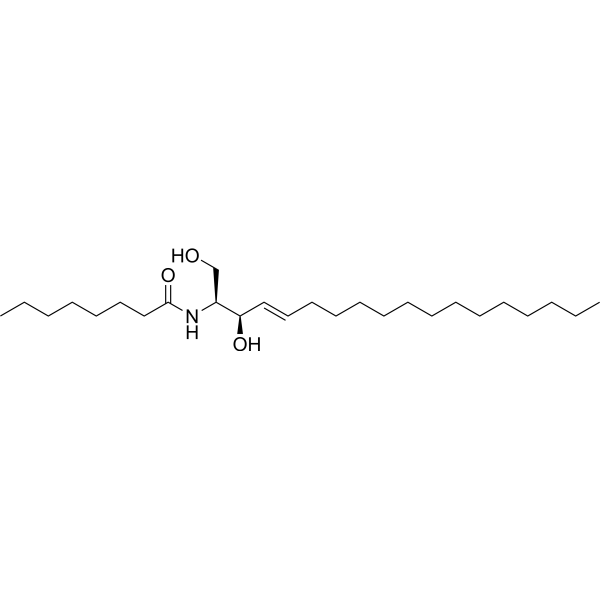
Physicochemical Properties
| Molecular Formula | C26H51NO3 |
| Molecular Weight | 425.69 |
| Exact Mass | 425.386 |
| CAS # | 74713-59-0 |
| PubChem CID | 5702614 |
| Appearance | White to off-white solid powder |
| Density | 0.9±0.1 g/cm3 |
| Boiling Point | 595.5±50.0 °C at 760 mmHg |
| Melting Point | 68-70°C |
| Flash Point | 313.9±30.1 °C |
| Vapour Pressure | 0.0±3.8 mmHg at 25°C |
| Index of Refraction | 1.482 |
| LogP | 9.09 |
| Hydrogen Bond Donor Count | 3 |
| Hydrogen Bond Acceptor Count | 3 |
| Rotatable Bond Count | 22 |
| Heavy Atom Count | 30 |
| Complexity | 398 |
| Defined Atom Stereocenter Count | 2 |
| SMILES | CCCCCCCCCCCCC/C=C/[C@H]([C@H](CO)NC(=O)CCCCCCC)O |
| InChi Key | APDLCSPGWPLYEQ-WRBRXSDHSA-N |
| InChi Code | InChI=1S/C26H51NO3/c1-3-5-7-9-10-11-12-13-14-15-16-18-19-21-25(29)24(23-28)27-26(30)22-20-17-8-6-4-2/h19,21,24-25,28-29H,3-18,20,22-23H2,1-2H3,(H,27,30)/b21-19+/t24-,25+/m0/s1 |
| Chemical Name | N-[(E,2S,3R)-1,3-dihydroxyoctadec-4-en-2-yl]octanamide |
| Synonyms | N-Octanoyl-D-erythro-Sphingosine; C8-Ceramide; C8 Ceramide |
| HS Tariff Code | 2934.99.9001 |
| Storage |
Powder-20°C 3 years 4°C 2 years In solvent -80°C 6 months -20°C 1 month Note: Please store this product in a sealed and protected environment (e.g. under nitrogen), avoid exposure to moisture. |
| Shipping Condition | Room temperature (This product is stable at ambient temperature for a few days during ordinary shipping and time spent in Customs) |
Biological Activity
| ln Vitro | Tumor cell growth is irreversibly reduced and morphological alterations are induced by C8-ceramide (3 μM; 48 hours) [1]. In human cervical carcinoma cells, C8-ceramide can cause necrosis-like cell death, but it does not cause the molecular marker of apoptosis, PARP, to be cleaved in a caspase-dependent manner [1]. In NSCLC H1299 cells, C8-ceramide may elevate endogenous ROS levels (10-30 µM; 24 hours), inhibit proliferation (10-50 µM; 24 hours), and therefore induce apoptosis (10-50 µM; 48 hours) [2]. |
| ln Vivo | In mice infected with a virus, C8-ceramide (0.1 mg/kg; administered intravenously) increases CD8+ and CD4+ T cell responses to infection [3]. |
| Cell Assay |
Cell viability assay [1] Cell Types: CALO cells, INBL cells, HeLa cells Tested Concentrations: 3 μM Incubation Duration: 48 hrs (hours) Experimental Results: The number of tumor cells was Dramatically diminished. Cell proliferation assay[2] Cell Types: H1299 Cell Tested Concentrations: 10 µM, 20 µM, 30 µM, 40 µM, 50 µM Incubation Duration: 24 hrs (hours) Experimental Results: diminished cell proliferation rate in a dose-dependent manner, IC50 22.9 µM. Cell cycle analysis[2] Cell Types: H1299 Cell Tested Concentrations: 10 µM, 20 µM, 30 µM, 40 µM, 50 µM Incubation Duration: 24 hrs (hours) Experimental Results: Causes G1 arrest. Apoptosis analysis[2] Cell Types: H1299 Cell Tested Concentrations: 10 µM, 20 µM, 30 µM Incubation Duration: 24 hrs (hours), 48 hrs (hours) Experimental Results: Increased levels of cleaved caspase-3. |
| Animal Protocol |
Animal/Disease Models: C57BL/6 mice, lymphocytic choriomeningitis virus infection [3] Doses: 0.1 mg/kg Route of Administration: Intranasal administration Experimental Results: Enhanced lung CD8+ T cell response to influenza. |
| References |
[1]. Ceramide promotes the death of human cervical tumor cells in the absence of biochemical and morphological markers of apoptosis. Biochem Biophys Res Commun. 2002 May 10;293(3):1028-36. [2]. Exogenous C8-Ceramide Induces Apoptosis by Overproduction of ROS and the Switch of Superoxide Dismutases SOD1 to SOD2 in Human Lung Cancer Cells. Int J Mol Sci. 2018 Oct; 19(10): 3010. [3]. A ceramide analogue stimulates dendritic cells to promote T cell responses upon virus infections. J Immunol. 2015 May 1; 194(9): 4339-4349. [4]. Ceramides modulate protein kinase C activity and perturb the structure of Phosphatidylcholine/Phosphatidylserine bilayers. Biophys J. 1999 Sep; 77(3): 1489-1497. [5]. Ceramide contributes to pathogenesis and may be targeted for therapy in VCP inclusion body myopathy. Hum Mol Genet. 2021 Jan 7;ddaa248. |
| Additional Infomation | N-octanoylsphingosine is an N-acylsphingosine in which the ceramide N-acyl group is specified as octanoyl. It is functionally related to an octanoic acid. |
Solubility Data
| Solubility (In Vitro) | DMSO : ≥ 100 mg/mL (~234.91 mM) |
| Solubility (In Vivo) |
Note: Listed below are some common formulations that may be used to formulate products with low water solubility (e.g. < 1 mg/mL), you may test these formulations using a minute amount of products to avoid loss of samples. Injection Formulations (e.g. IP/IV/IM/SC) Injection Formulation 1: DMSO : Tween 80: Saline = 10 : 5 : 85 (i.e. 100 μL DMSO stock solution → 50 μL Tween 80 → 850 μL Saline) *Preparation of saline: Dissolve 0.9 g of sodium chloride in 100 mL ddH ₂ O to obtain a clear solution. Injection Formulation 2: DMSO : PEG300 :Tween 80 : Saline = 10 : 40 : 5 : 45 (i.e. 100 μL DMSO → 400 μLPEG300 → 50 μL Tween 80 → 450 μL Saline) Injection Formulation 3: DMSO : Corn oil = 10 : 90 (i.e. 100 μL DMSO → 900 μL Corn oil) Example: Take the Injection Formulation 3 (DMSO : Corn oil = 10 : 90) as an example, if 1 mL of 2.5 mg/mL working solution is to be prepared, you can take 100 μL 25 mg/mL DMSO stock solution and add to 900 μL corn oil, mix well to obtain a clear or suspension solution (2.5 mg/mL, ready for use in animals). Injection Formulation 4: DMSO : 20% SBE-β-CD in saline = 10 : 90 [i.e. 100 μL DMSO → 900 μL (20% SBE-β-CD in saline)] *Preparation of 20% SBE-β-CD in Saline (4°C,1 week): Dissolve 2 g SBE-β-CD in 10 mL saline to obtain a clear solution. Injection Formulation 5: 2-Hydroxypropyl-β-cyclodextrin : Saline = 50 : 50 (i.e. 500 μL 2-Hydroxypropyl-β-cyclodextrin → 500 μL Saline) Injection Formulation 6: DMSO : PEG300 : castor oil : Saline = 5 : 10 : 20 : 65 (i.e. 50 μL DMSO → 100 μLPEG300 → 200 μL castor oil → 650 μL Saline) Injection Formulation 7: Ethanol : Cremophor : Saline = 10: 10 : 80 (i.e. 100 μL Ethanol → 100 μL Cremophor → 800 μL Saline) Injection Formulation 8: Dissolve in Cremophor/Ethanol (50 : 50), then diluted by Saline Injection Formulation 9: EtOH : Corn oil = 10 : 90 (i.e. 100 μL EtOH → 900 μL Corn oil) Injection Formulation 10: EtOH : PEG300:Tween 80 : Saline = 10 : 40 : 5 : 45 (i.e. 100 μL EtOH → 400 μLPEG300 → 50 μL Tween 80 → 450 μL Saline) Oral Formulations Oral Formulation 1: Suspend in 0.5% CMC Na (carboxymethylcellulose sodium) Oral Formulation 2: Suspend in 0.5% Carboxymethyl cellulose Example: Take the Oral Formulation 1 (Suspend in 0.5% CMC Na) as an example, if 100 mL of 2.5 mg/mL working solution is to be prepared, you can first prepare 0.5% CMC Na solution by measuring 0.5 g CMC Na and dissolve it in 100 mL ddH2O to obtain a clear solution; then add 250 mg of the product to 100 mL 0.5% CMC Na solution, to make the suspension solution (2.5 mg/mL, ready for use in animals). Oral Formulation 3: Dissolved in PEG400 Oral Formulation 4: Suspend in 0.2% Carboxymethyl cellulose Oral Formulation 5: Dissolve in 0.25% Tween 80 and 0.5% Carboxymethyl cellulose Oral Formulation 6: Mixing with food powders Note: Please be aware that the above formulations are for reference only. InvivoChem strongly recommends customers to read literature methods/protocols carefully before determining which formulation you should use for in vivo studies, as different compounds have different solubility properties and have to be formulated differently. (Please use freshly prepared in vivo formulations for optimal results.) |
| Preparing Stock Solutions | 1 mg | 5 mg | 10 mg | |
| 1 mM | 2.3491 mL | 11.7456 mL | 23.4913 mL | |
| 5 mM | 0.4698 mL | 2.3491 mL | 4.6983 mL | |
| 10 mM | 0.2349 mL | 1.1746 mL | 2.3491 mL |