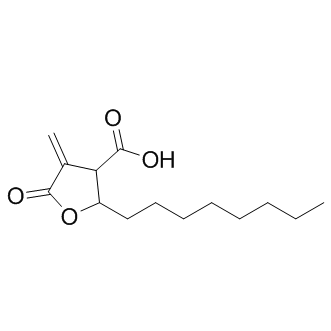
C75 is a novel and potent fatty-acid synthase (FASN) inhibitor used as a tool compound to study fatty acid synthesis in metabolic disorders and cancer.
Physicochemical Properties
| Molecular Formula | C14H22O4 |
| Molecular Weight | 254.32208 |
| Exact Mass | 254.151 |
| CAS # | 218137-86-1 |
| Related CAS # | trans-C75;191282-48-1;(−)-C75;1234694-22-4 |
| PubChem CID | 4248455 |
| Appearance | White to off-white solid powder |
| Density | 1.1±0.1 g/cm3 |
| Boiling Point | 432.1±45.0 °C at 760 mmHg |
| Flash Point | 159.2±22.2 °C |
| Vapour Pressure | 0.0±2.2 mmHg at 25°C |
| Index of Refraction | 1.489 |
| LogP | 3.65 |
| Hydrogen Bond Donor Count | 1 |
| Hydrogen Bond Acceptor Count | 4 |
| Rotatable Bond Count | 8 |
| Heavy Atom Count | 18 |
| Complexity | 322 |
| Defined Atom Stereocenter Count | 0 |
| InChi Key | VCWLZDVWHQVAJU-UHFFFAOYSA-N |
| InChi Code | InChI=1S/C14H22O4/c1-3-4-5-6-7-8-9-11-12(13(15)16)10(2)14(17)18-11/h11-12H,2-9H2,1H3,(H,15,16) |
| Chemical Name | 4-methylidene-2-octyl-5-oxooxolane-3-carboxylic acid |
| HS Tariff Code | 2934.99.9001 |
| Storage |
Powder-20°C 3 years 4°C 2 years In solvent -80°C 6 months -20°C 1 month |
| Shipping Condition | Room temperature (This product is stable at ambient temperature for a few days during ordinary shipping and time spent in Customs) |
Biological Activity
| Targets |
C75 targets fatty acid synthase (FASN) with an IC50 of 3.8 μM (recombinant FASN) [2] C75 targets carnitine palmitoyltransferase 1A (CPT1A) [5] |
| ln Vitro |
PC3 cell growth is inhibited by C75, with an IC50 of 35 μM after 24 hours. With an IC50 of 50 μM, C75 (10-50 μM) still inhibits the development of LNCaP spheroids in a concentration-dependent way [1]. With harmful effects, (-)-C75 suppresses FAS activity in most tumor cell lines without influencing meal intake. The anorexic effects of C75 are dependent on central inhibition of CPT1, as (+)-C75 inhibits CPT1, which causes anorexia. Novel cancer and chemotherapy medications may be developed as a result of the distinct actions of C75 enantiomers [2]. C75 (5 μM–20 μM) dose-dependently inhibited the proliferation of human prostate cancer cells (LNCaP, PC-3): IC50 values were 8.2 μM (LNCaP) and 10.5 μM (PC-3) after 72 hours; it also enhanced radiotherapy sensitivity, reducing the surviving fraction by 45% (LNCaP) and 52% (PC-3) when combined with 4 Gy radiation [1] (-)-C75 (1 μM–10 μM) exhibited stronger antitumor activity than (+)-C75 against human breast cancer MCF-7 cells: (-)-C75 IC50 = 4.1 μM, (+)-C75 IC50 > 20 μM [2] C75 (10 μM) inhibited FASN activity in LNCaP cells by 78%, reducing intracellular fatty acid accumulation by 65% and increasing reactive oxygen species (ROS) levels by 2.3-fold [1] C75 (5 μM–15 μM) inhibited CPT1A activity in human hepatoma HepG2 cells, reducing palmitate oxidation by 58% (10 μM) and promoting mitochondrial permeability transition (MPT) pore opening [5] C75 (10 μM) induced apoptosis in PC-3 cells via the intrinsic pathway: apoptotic rate increased to 42% (Annexin V+/PI+) after 48 hours, accompanied by caspase-9/caspase-3 activation [1] |
| ln Vivo |
The paraventricular nucleus (PVN), hypothalamic lesion area (LHA), and arcuate nucleus (Arc) all showed increased expression of C-Fos 10–24 hours following intraperitoneal injection due to C75-like distention fasting? Over 95% of the mouse body weight can be absorbed in 2 hours by intraperitoneal injection of C75 at a dose of 30 mg/kg body weight [3]. Because of medium oxidation, DIO mice administered with C75 boosted their energy output by 32.9 percent and lost 50% of their body weight. Even in the presence of high malonyl-CoA concentrations, C75 treatment of odontozoan adipocytes, hepatocytes, and human breast cancer cells boosts medium oxidation and ATP levels through boosting CPT-1 activity [4]. In nude mice bearing LNCaP prostate cancer xenografts, intraperitoneal administration of C75 (20 mg/kg, q.o.d.) for 21 days inhibited tumor growth by 63% and enhanced the efficacy of radiotherapy (4 Gy, weekly × 3): combined treatment achieved 87% tumor growth inhibition [1] In diet-induced obese (DIO) C57BL/6 mice, intraperitoneal administration of C75 (5 mg/kg, q.d.) for 14 days reduced body weight by 18%, decreased fat mass by 25%, and increased fatty acid oxidation in skeletal muscle by 3.1-fold [4] (+)-C75 (10 mg/kg, i.p., q.d.) induced anorexia in C57BL/6 mice, reducing food intake by 40% within 7 days without significant weight loss in lean mice [2,3] In a mouse liver transplantation model, C75 (15 mg/kg, i.p.) administered 24 hours before transplantation aggravated fatty liver graft injury: serum ALT/AST levels increased by 2.8-fold, and hepatocyte necrosis rate increased by 55% via inhibiting CPT1A [5] (-)-C75 (25 mg/kg, i.p., q.d.) inhibited MCF-7 breast cancer xenograft growth in nude mice by 58%, while (+)-C75 (25 mg/kg) showed no significant antitumor effect [2] |
| Enzyme Assay |
FASN inhibitory activity assay: Recombinant human FASN enzyme was incubated with C75 (0.1 μM–20 μM) in assay buffer containing acetyl-CoA, malonyl-CoA, and NADPH. The reaction was conducted at 37°C for 60 minutes, and NADPH oxidation was monitored by absorbance at 340 nm. IC50 values were calculated by fitting dose-response curves [2] CPT1A inhibitory activity assay: Mitochondrial fractions from HepG2 cells were incubated with C75 (1 μM–20 μM) in assay buffer containing palmitoyl-CoA and L-carnitine. The formation of palmitoyl-L-carnitine was quantified by liquid chromatography-tandem mass spectrometry (LC-MS/MS) to determine CPT1A inhibition rate [5] |
| Cell Assay |
Prostate cancer cell proliferation and radiosensitization assay: LNCaP/PC-3 cells were seeded in 96-well plates (5 × 10³ cells/well) and treated with C75 (5 μM–20 μM) for 24 hours, followed by 0–8 Gy radiation. Cell viability was assessed by CCK-8 assay 72 hours post-radiation; surviving fractions were calculated to evaluate radiosensitization [1] FASN activity and fatty acid metabolism assay: LNCaP cells were treated with C75 (10 μM) for 48 hours. FASN activity was measured by NADPH oxidation assay; intracellular fatty acids were extracted and quantified by gas chromatography (GC); ROS levels were detected by fluorescent probe and flow cytometry [1] CPT1A inhibition and mitochondrial function assay: HepG2 cells were treated with C75 (5 μM–15 μM) for 24 hours. Palmitate oxidation rate was measured by ¹⁴C-palmitate incorporation; MPT pore opening was detected by calcein-AM/CoCl₂ staining and fluorescence microscopy [5] Breast cancer cell proliferation assay: MCF-7 cells were seeded in 96-well plates (5 × 10³ cells/well) and treated with (-)-C75 or (+)-C75 (1 μM–20 μM) for 72 hours. Cell viability was assessed by MTT assay, and IC50 values were calculated [2] |
| Animal Protocol |
Prostate cancer xenograft and radiosensitization model: Nude mice were subcutaneously inoculated with 5 × 10⁶ LNCaP cells. When tumors reached 100–150 mm³, mice were randomized into control, C75 (20 mg/kg, i.p., q.o.d.), radiation (4 Gy, weekly × 3), and combined groups (n=8/group). C75 was dissolved in 10% DMSO + 90% corn oil. Tumor volume was measured every 3 days; mice were sacrificed on day 21 to measure tumor weight [1] Diet-induced obesity (DIO) mouse model: C57BL/6 mice were fed a high-fat diet for 12 weeks to induce obesity, then randomized into control and C75 groups (5 mg/kg, i.p., q.d., n=10/group). C75 was dissolved in saline. Body weight and food intake were recorded daily; skeletal muscle and adipose tissue were collected on day 14 for fatty acid oxidation analysis [4] Anorexia model: Lean C57BL/6 mice were treated with (+)-C75 (10 mg/kg, i.p., q.d., n=6/group) for 7 days. Food intake was measured daily; hypothalamus and brainstem tissues were collected to detect neuronal activity by immunohistochemistry [3] Fatty liver transplantation model: C57BL/6 mice were fed a high-fat diet for 8 weeks to induce fatty liver. Donor mice were treated with C75 (15 mg/kg, i.p.) 24 hours before liver transplantation. Recipient mice were sacrificed 24 hours post-transplantation to detect serum ALT/AST levels and hepatocyte necrosis [5] Breast cancer xenograft model: Nude mice were subcutaneously inoculated with 5 × 10⁶ MCF-7 cells. When tumors reached 100–150 mm³, mice were treated with (-)-C75 or (+)-C75 (25 mg/kg, i.p., q.d., n=8/group) for 21 days. Tumor volume and weight were measured to evaluate antitumor efficacy [2] |
| Toxicity/Toxicokinetics |
Anorexia is a dose-dependent side effect of (+)-C75: doses ≥10 mg/kg (i.p.) in mice caused significant food intake reduction without lethal toxicity [2,3] C75 (15 mg/kg, i.p.) aggravated hepatocyte necrosis and increased serum liver enzyme (ALT/AST) levels in fatty liver transplant models, indicating hepatotoxicity in the context of fatty liver [5] In subchronic toxicity testing (21 days, 20 mg/kg, i.p.) in nude mice, C75 did not cause significant changes in body weight, hematological parameters, or histopathological lesions in heart, kidney, or spleen [1] |
| References |
[1]. Inhibition of Fatty Acid Synthase Sensitizes Prostate Cancer Cells to Radiotherapy. [2]. Differential pharmacologic properties of the two C75 enantiomers: (+)-C75 is a strong anorectic drug; (-)-C75 has antitumor activity. Chirality. 2013 May;25(5):281-7. [3]. Effect of the anorectic fatty acid synthase inhibitor C75 on neuronal activity in the hypothalamus and brainstem. Proc Natl Acad Sci U S A. 2003 May 13;100(10):5628-33. [4]. C75 increases peripheral energy utilization and fatty acid oxidation in diet-induced obesity. Proc Natl Acad Sci U S A. 2002 Jul 9;99(14):9498-502. [5]. Inhibition of Carnitine Palmitoyltransferase 1A Aggravates Fatty Liver Graft Injury via Promoting Mitochondrial Permeability Transition. Transplantation. 2021 Mar 1;105(3):550-560. |
| Additional Infomation |
4-methylene-2-octyl-5-oxo-3-oxolanecarboxylic acid is a gamma-lactone. C75 is a synthetic small-molecule inhibitor of FASN, with two enantiomers exhibiting distinct pharmacologic properties: (+)-C75 acts as an anorectic agent, while (-)-C75 possesses potent antitumor activity [2] Its antitumor mechanism involves FASN inhibition, leading to intracellular fatty acid depletion, ROS accumulation, and activation of the intrinsic apoptotic pathway; it also sensitizes cancer cells to radiotherapy by impairing DNA repair [1,2] C75 exerts anti-obesity effects by increasing peripheral energy utilization and fatty acid oxidation, reducing adipose tissue mass [4] The hepatotoxicity of C75 in fatty liver transplantation is mediated by CPT1A inhibition, which disrupts fatty acid oxidation and promotes mitochondrial permeability transition [5] C75 has potential applications in cancer therapy (as a monotherapy or radiosensitizer) and obesity management, but its anorectic side effect and hepatotoxicity in fatty liver contexts require careful dose optimization [1,2,4,5] |
Solubility Data
| Solubility (In Vitro) |
DMSO : ≥ 83.3 mg/mL (~327.54 mM) H2O : < 0.1 mg/mL |
| Solubility (In Vivo) |
Solubility in Formulation 1: ≥ 2.5 mg/mL (9.83 mM) (saturation unknown) in 10% DMSO + 40% PEG300 + 5% Tween80 + 45% Saline (add these co-solvents sequentially from left to right, and one by one), clear solution. For example, if 1 mL of working solution is to be prepared, you can add 100 μL of 25.0 mg/mL clear DMSO stock solution to 400 μL PEG300 and mix evenly; then add 50 μL Tween-80 to the above solution and mix evenly; then add 450 μL normal saline to adjust the volume to 1 mL. Preparation of saline: Dissolve 0.9 g of sodium chloride in 100 mL ddH₂ O to obtain a clear solution. Solubility in Formulation 2: ≥ 2.5 mg/mL (9.83 mM) (saturation unknown) in 10% DMSO + 90% (20% SBE-β-CD in Saline) (add these co-solvents sequentially from left to right, and one by one), clear solution. For example, if 1 mL of working solution is to be prepared, you can add 100 μL of 25.0 mg/mL clear DMSO stock solution to 900 μL of 20% SBE-β-CD physiological saline solution and mix evenly. Preparation of 20% SBE-β-CD in Saline (4°C,1 week): Dissolve 2 g SBE-β-CD in 10 mL saline to obtain a clear solution. Solubility in Formulation 3: ≥ 2.5 mg/mL (9.83 mM) (saturation unknown) in 10% DMSO + 90% Corn Oil (add these co-solvents sequentially from left to right, and one by one), clear solution. For example, if 1 mL of working solution is to be prepared, you can add 100 μL of 25.0 mg/mL clear DMSO stock solution to 900 μL of corn oil and mix evenly. Solubility in Formulation 4: ≥ 1.25 mg/mL (4.92 mM) (saturation unknown) in 5% DMSO + 40% PEG300 + 5% Tween80 + 50% Saline (add these co-solvents sequentially from left to right, and one by one), clear solution. Preparation of saline: Dissolve 0.9 g of sodium chloride in 100 mL ddH₂ O to obtain a clear solution. Solubility in Formulation 5: ≥ 1.25 mg/mL (4.92 mM) (saturation unknown) in 5% DMSO + 95% (20% SBE-β-CD in Saline) (add these co-solvents sequentially from left to right, and one by one), clear solution. Preparation of 20% SBE-β-CD in Saline (4°C,1 week): Dissolve 2 g SBE-β-CD in 10 mL saline to obtain a clear solution. Solubility in Formulation 6: ≥ 1.25 mg/mL (4.92 mM) (saturation unknown) in 5% DMSO + 95% Corn Oil (add these co-solvents sequentially from left to right, and one by one), clear solution. (Please use freshly prepared in vivo formulations for optimal results.) |
| Preparing Stock Solutions | 1 mg | 5 mg | 10 mg | |
| 1 mM | 3.9321 mL | 19.6603 mL | 39.3205 mL | |
| 5 mM | 0.7864 mL | 3.9321 mL | 7.8641 mL | |
| 10 mM | 0.3932 mL | 1.9660 mL | 3.9321 mL |