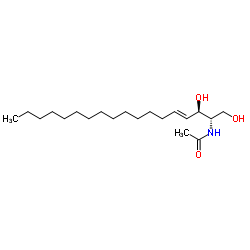
C2 Ceramide is a novel and potent protein phosphatase 1 (PP1) activator. It is the main lipid of the stratum corneum that activates PP2A and ceramide-activated protein phosphatase (CAPP). C2 Ceramide is also a skin conditioning agent that protects the epidermal barrier from water loss.
Physicochemical Properties
| Molecular Formula | C₂₀H₃₉NO₃ |
| Molecular Weight | 341.53 |
| Exact Mass | 341.292 |
| CAS # | 3102-57-6 |
| PubChem CID | 5497136 |
| Appearance | White to off-white solid powder |
| Density | 1.0±0.1 g/cm3 |
| Boiling Point | 532.4±50.0 °C at 760 mmHg |
| Melting Point | 93-96ºC |
| Flash Point | 275.8±30.1 °C |
| Vapour Pressure | 0.0±3.2 mmHg at 25°C |
| Index of Refraction | 1.485 |
| LogP | 5.9 |
| Hydrogen Bond Donor Count | 3 |
| Hydrogen Bond Acceptor Count | 3 |
| Rotatable Bond Count | 16 |
| Heavy Atom Count | 24 |
| Complexity | 318 |
| Defined Atom Stereocenter Count | 2 |
| SMILES | CCCCCCCCCCCCC/C=C/[C@H]([C@H](CO)NC(=O)C)O |
| InChi Key | BLTCBVOJNNKFKC-QUDYQQOWSA-N |
| InChi Code | InChI=1S/C20H39NO3/c1-3-4-5-6-7-8-9-10-11-12-13-14-15-16-20(24)19(17-22)21-18(2)23/h15-16,19-20,22,24H,3-14,17H2,1-2H3,(H,21,23)/b16-15+/t19-,20+/m0/s1 |
| Chemical Name | N-[(E,2S,3R)-1,3-dihydroxyoctadec-4-en-2-yl]acetamide |
| Synonyms | C 2 Ceramide C-2 Ceramide |
| HS Tariff Code | 2934.99.9001 |
| Storage |
Powder-20°C 3 years 4°C 2 years In solvent -80°C 6 months -20°C 1 month Note: Please store this product in a sealed and protected environment, avoid exposure to moisture. |
| Shipping Condition | Room temperature (This product is stable at ambient temperature for a few days during ordinary shipping and time spent in Customs) |
Biological Activity
| ln Vitro | Osteoblast viability was found to be positively correlated with C2 ceramide (5 nM-200 µM; 24-hour treatment; primary mouse osteoblasts) at concentrations ≤500 nM, whereas concentrations ≥2 µM dramatically lowered it in a dose- and time-dependent manner Osteoblast viability[1]. At 50 µM and 100 µM C2 ceramide concentrations, respectively, there was a 5.7-fold and an 11.2-fold increase in cytoplasmic histone-associated DNA fragments in osteoblasts. C2 ceramide is a strong inducer of osteoblast apoptosis at these higher concentrations [1]. While PP1 small interfering RNA exhibits the opposite effect, C2 ceramide enhances endothelial cell migration and capillary formation in human dental pulp cells (HDPC) by upregulating the mRNA expression of angiogenic genes. Bone morphogenetic protein 2 levels, Smad 1/5/8 phosphorylation, and the mRNA expression of osterix and runt-related transcription factor 2 are all increased by human dental pulp cells (HDPC) [2]. |
| ln Vivo | Alkaline phosphatase activity, mineralized nodule development, and dentin matrix protein 1 and dentin sialophosphoprotein mRNA expression are all increased by the PP1 activator C2 ceramide. On the other hand, odontoblast development is inhibited by PP1 small interfering RNA knockdown [2]. |
| Cell Assay |
Cell viability assay[1] Cell Types: Primary mouse osteoblasts Tested Concentrations: 5 nM-200 µM Incubation Duration: 24 hrs (hours) Experimental Results: When exposed to low concentrations of 5-500 nM, the survival rate of mouse osteoblasts was Dose-dependent increase. Increasing the concentration to 20-200 μM resulted in a dose-dependent decrease in mitochondrial succinate dehydrogenase activity and osteoblast survival. |
| References |
[1]. Ceramide-induced Cell Death/Survival in Murine Osteoblasts. J Endocrinol. 2010 Aug;206(2):225-33. [2]. Role of Protein Phosphatase 1 in Angiogenesis and Odontoblastic Differentiation of Human Dental Pulp Cells. J Endod. 2017 Mar;43(3):417-424. [3]. Ceramide Stimulates a Cytosolic Protein Phosphatase. J Biol Chem. 1992 Mar 15;267(8):5048-51. [4]. Ceramide Activates Heterotrimeric Protein Phosphatase 2A. J Biol Chem. 1993 Jul 25;268(21):15523-30. [5]. Influence of ceramide 2 on in vitro skin permeation and retention of 5-ALA and its ester derivatives, for Photodynamic Therapy. Brazilian Journal of Pharmaceutical Sciences. 2009, 45(1), 109-116. [6]. C2-ceramide induces cell death and protective autophagy in head and neck squamous cell carcinoma cells. Int J Mol Sci. 2014 Feb 21;15(2):3336-55. |
| Additional Infomation | N-acetylsphingosine is a N-acylsphingosine that has an acetamido group at position 2. |
Solubility Data
| Solubility (In Vitro) |
DMSO : ~20 mg/mL (~58.56 mM) Ethanol : ~17 mg/mL (~49.78 mM) |
| Solubility (In Vivo) |
Note: Listed below are some common formulations that may be used to formulate products with low water solubility (e.g. < 1 mg/mL), you may test these formulations using a minute amount of products to avoid loss of samples. Injection Formulations (e.g. IP/IV/IM/SC) Injection Formulation 1: DMSO : Tween 80: Saline = 10 : 5 : 85 (i.e. 100 μL DMSO stock solution → 50 μL Tween 80 → 850 μL Saline) *Preparation of saline: Dissolve 0.9 g of sodium chloride in 100 mL ddH ₂ O to obtain a clear solution. Injection Formulation 2: DMSO : PEG300 :Tween 80 : Saline = 10 : 40 : 5 : 45 (i.e. 100 μL DMSO → 400 μLPEG300 → 50 μL Tween 80 → 450 μL Saline) Injection Formulation 3: DMSO : Corn oil = 10 : 90 (i.e. 100 μL DMSO → 900 μL Corn oil) Example: Take the Injection Formulation 3 (DMSO : Corn oil = 10 : 90) as an example, if 1 mL of 2.5 mg/mL working solution is to be prepared, you can take 100 μL 25 mg/mL DMSO stock solution and add to 900 μL corn oil, mix well to obtain a clear or suspension solution (2.5 mg/mL, ready for use in animals). Injection Formulation 4: DMSO : 20% SBE-β-CD in saline = 10 : 90 [i.e. 100 μL DMSO → 900 μL (20% SBE-β-CD in saline)] *Preparation of 20% SBE-β-CD in Saline (4°C,1 week): Dissolve 2 g SBE-β-CD in 10 mL saline to obtain a clear solution. Injection Formulation 5: 2-Hydroxypropyl-β-cyclodextrin : Saline = 50 : 50 (i.e. 500 μL 2-Hydroxypropyl-β-cyclodextrin → 500 μL Saline) Injection Formulation 6: DMSO : PEG300 : castor oil : Saline = 5 : 10 : 20 : 65 (i.e. 50 μL DMSO → 100 μLPEG300 → 200 μL castor oil → 650 μL Saline) Injection Formulation 7: Ethanol : Cremophor : Saline = 10: 10 : 80 (i.e. 100 μL Ethanol → 100 μL Cremophor → 800 μL Saline) Injection Formulation 8: Dissolve in Cremophor/Ethanol (50 : 50), then diluted by Saline Injection Formulation 9: EtOH : Corn oil = 10 : 90 (i.e. 100 μL EtOH → 900 μL Corn oil) Injection Formulation 10: EtOH : PEG300:Tween 80 : Saline = 10 : 40 : 5 : 45 (i.e. 100 μL EtOH → 400 μLPEG300 → 50 μL Tween 80 → 450 μL Saline) Oral Formulations Oral Formulation 1: Suspend in 0.5% CMC Na (carboxymethylcellulose sodium) Oral Formulation 2: Suspend in 0.5% Carboxymethyl cellulose Example: Take the Oral Formulation 1 (Suspend in 0.5% CMC Na) as an example, if 100 mL of 2.5 mg/mL working solution is to be prepared, you can first prepare 0.5% CMC Na solution by measuring 0.5 g CMC Na and dissolve it in 100 mL ddH2O to obtain a clear solution; then add 250 mg of the product to 100 mL 0.5% CMC Na solution, to make the suspension solution (2.5 mg/mL, ready for use in animals). Oral Formulation 3: Dissolved in PEG400 Oral Formulation 4: Suspend in 0.2% Carboxymethyl cellulose Oral Formulation 5: Dissolve in 0.25% Tween 80 and 0.5% Carboxymethyl cellulose Oral Formulation 6: Mixing with food powders Note: Please be aware that the above formulations are for reference only. InvivoChem strongly recommends customers to read literature methods/protocols carefully before determining which formulation you should use for in vivo studies, as different compounds have different solubility properties and have to be formulated differently. (Please use freshly prepared in vivo formulations for optimal results.) |
| Preparing Stock Solutions | 1 mg | 5 mg | 10 mg | |
| 1 mM | 2.9280 mL | 14.6400 mL | 29.2800 mL | |
| 5 mM | 0.5856 mL | 2.9280 mL | 5.8560 mL | |
| 10 mM | 0.2928 mL | 1.4640 mL | 2.9280 mL |