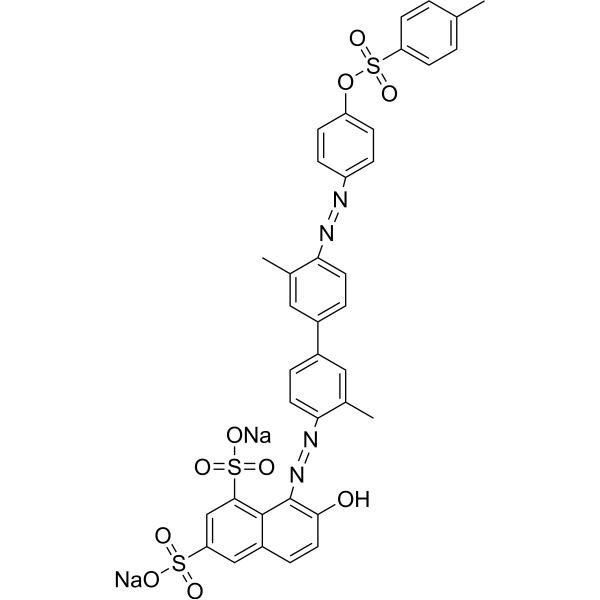
Physicochemical Properties
| Molecular Formula | C37H28N4NA2O10S3 |
| Molecular Weight | 830.81 |
| Exact Mass | 830.076 |
| CAS # | 6459-94-5 |
| Related CAS # | 25317-45-7 (Parent) |
| PubChem CID | 22960 |
| Appearance |
Red powder Dark maroon powder /Dye content 45%/ |
| Melting Point | 200-300 °C (decomposes) |
| LogP | 11.786 |
| Hydrogen Bond Donor Count | 1 |
| Hydrogen Bond Acceptor Count | 14 |
| Rotatable Bond Count | 8 |
| Heavy Atom Count | 56 |
| Complexity | 1620 |
| Defined Atom Stereocenter Count | 0 |
| SMILES | S(C1C([H])=C(C([H])=C2C([H])=C([H])C(=C(C2=1)/N=N/C1C([H])=C([H])C(=C([H])C=1C([H])([H])[H])C1C([H])=C([H])C(=C(C([H])([H])[H])C=1[H])/N=N/C1C([H])=C([H])C(=C([H])C=1[H])OS(C1C([H])=C([H])C(C([H])([H])[H])=C([H])C=1[H])(=O)=O)O[H])S(=O)(=O)[O-])(=O)(=O)[O-].[Na+].[Na+] |
| InChi Key | HNBQFKZSMFFZQY-UHFFFAOYSA-L |
| InChi Code | InChI=1S/C37H30N4O10S3.2Na/c1-22-4-13-30(14-5-22)54(49,50)51-29-11-9-28(10-12-29)38-39-32-15-6-25(18-23(32)2)26-7-16-33(24(3)19-26)40-41-37-34(42)17-8-27-20-31(52(43,44)45)21-35(36(27)37)53(46,47)48;;/h4-21,42H,1-3H3,(H,43,44,45)(H,46,47,48);;/q;2*+1/p-2 |
| Chemical Name | disodium;7-hydroxy-8-[[2-methyl-4-[3-methyl-4-[[4-(4-methylphenyl)sulfonyloxyphenyl]diazenyl]phenyl]phenyl]diazenyl]naphthalene-1,3-disulfonate |
| HS Tariff Code | 2934.99.9001 |
| Storage |
Powder-20°C 3 years 4°C 2 years In solvent -80°C 6 months -20°C 1 month Note: Please store this product in a sealed and protected environment, avoid exposure to moisture. |
| Shipping Condition | Room temperature (This product is stable at ambient temperature for a few days during ordinary shipping and time spent in Customs) |
Biological Activity
| ADME/Pharmacokinetics |
Absorption, Distribution and Excretion CI Acid Red 114 (100 mg/kg) containing less than 1% 3,3'-dimethylbenzidine as an impurity was administered once in the diet to two female mongrel dogs weighing 15 kg, and 48-hr urine was analyzed for 3,3' -dimethylbenzidine, the potential metabolic product. Excretion was found to be 0.04% of the dose of dye administered, which is in excess of what would be expected from the level of impurity; para-aminophenyl-paratoluenesulfonate was also identified as a urinary metabolite. The same dose of CI Acid Red 114 was also administered once to four male Sprague- Dawley rats by intragastric intubation; after 72 hr, only 0.01 % of the dose could be identified as 3,3'-dimethylbenzidine. |
| References |
[1]. Adsorption of acid dye onto organobentonite[J]. Journal of hazardous materials, 2006, 128(2-3): 138-144. |
| Additional Infomation |
C.I. Acid Red 114 can cause cancer according to The National Toxicology Program. C.i. acid red 114 is a dark red powder. (NTP, 1992) CI Acid red 114 is an organic molecular entity. Mechanism of Action 3,3'-Dimethoxybenzidine is structurally similar to benzidine, a known human carcinogen, and 3,3'- dimethylbenzidine, which is reasonably anticipated to be a human carcinogen. Like benzidine and 3,3'-dimethylbenzidine, 3,3'-dimethoxybenzidine is used to synthesize many dyes, by linking of various chromophores to the base chemical by azo linkages. The azo bonds of 3,3'-dimethoxybenzidine-based dyes are chemically similar regardless of the chromophore used, and they are easily broken by chemicals or enzymes via reduction to form free 3,3'- dimethoxybenzidine and free chromophore. A number of bacteria catalyze this process, including Escherichia coli, found in the human gastrointestinal tract. This reductive process also has been found in rats and dogs ... Quantitative evidence /showed/ that the two 3,3'-dimethoxybenzidine-based dyes studied both were nearly completely metabolized to free 3,3'-dimethoxybenzidine. Bacteria in the animals' gastrointestinal tract are thought to be the primary agents of this metabolism. 3,3'-Dimethoxybenzidine-based dyes are mutagenic in bacteria when tested with metabolic activation and an azo-reductive preincubation protocol. It is assumed that the reductive breakdown process forms 3,3'-dimethoxybenzidine, which is known to cause mutations in bacteria |
Solubility Data
| Solubility (In Vitro) | May dissolve in DMSO (in most cases), if not, try other solvents such as H2O, Ethanol, or DMF with a minute amount of products to avoid loss of samples |
| Solubility (In Vivo) |
Note: Listed below are some common formulations that may be used to formulate products with low water solubility (e.g. < 1 mg/mL), you may test these formulations using a minute amount of products to avoid loss of samples. Injection Formulations (e.g. IP/IV/IM/SC) Injection Formulation 1: DMSO : Tween 80: Saline = 10 : 5 : 85 (i.e. 100 μL DMSO stock solution → 50 μL Tween 80 → 850 μL Saline) *Preparation of saline: Dissolve 0.9 g of sodium chloride in 100 mL ddH ₂ O to obtain a clear solution. Injection Formulation 2: DMSO : PEG300 :Tween 80 : Saline = 10 : 40 : 5 : 45 (i.e. 100 μL DMSO → 400 μLPEG300 → 50 μL Tween 80 → 450 μL Saline) Injection Formulation 3: DMSO : Corn oil = 10 : 90 (i.e. 100 μL DMSO → 900 μL Corn oil) Example: Take the Injection Formulation 3 (DMSO : Corn oil = 10 : 90) as an example, if 1 mL of 2.5 mg/mL working solution is to be prepared, you can take 100 μL 25 mg/mL DMSO stock solution and add to 900 μL corn oil, mix well to obtain a clear or suspension solution (2.5 mg/mL, ready for use in animals). Injection Formulation 4: DMSO : 20% SBE-β-CD in saline = 10 : 90 [i.e. 100 μL DMSO → 900 μL (20% SBE-β-CD in saline)] *Preparation of 20% SBE-β-CD in Saline (4°C,1 week): Dissolve 2 g SBE-β-CD in 10 mL saline to obtain a clear solution. Injection Formulation 5: 2-Hydroxypropyl-β-cyclodextrin : Saline = 50 : 50 (i.e. 500 μL 2-Hydroxypropyl-β-cyclodextrin → 500 μL Saline) Injection Formulation 6: DMSO : PEG300 : castor oil : Saline = 5 : 10 : 20 : 65 (i.e. 50 μL DMSO → 100 μLPEG300 → 200 μL castor oil → 650 μL Saline) Injection Formulation 7: Ethanol : Cremophor : Saline = 10: 10 : 80 (i.e. 100 μL Ethanol → 100 μL Cremophor → 800 μL Saline) Injection Formulation 8: Dissolve in Cremophor/Ethanol (50 : 50), then diluted by Saline Injection Formulation 9: EtOH : Corn oil = 10 : 90 (i.e. 100 μL EtOH → 900 μL Corn oil) Injection Formulation 10: EtOH : PEG300:Tween 80 : Saline = 10 : 40 : 5 : 45 (i.e. 100 μL EtOH → 400 μLPEG300 → 50 μL Tween 80 → 450 μL Saline) Oral Formulations Oral Formulation 1: Suspend in 0.5% CMC Na (carboxymethylcellulose sodium) Oral Formulation 2: Suspend in 0.5% Carboxymethyl cellulose Example: Take the Oral Formulation 1 (Suspend in 0.5% CMC Na) as an example, if 100 mL of 2.5 mg/mL working solution is to be prepared, you can first prepare 0.5% CMC Na solution by measuring 0.5 g CMC Na and dissolve it in 100 mL ddH2O to obtain a clear solution; then add 250 mg of the product to 100 mL 0.5% CMC Na solution, to make the suspension solution (2.5 mg/mL, ready for use in animals). Oral Formulation 3: Dissolved in PEG400 Oral Formulation 4: Suspend in 0.2% Carboxymethyl cellulose Oral Formulation 5: Dissolve in 0.25% Tween 80 and 0.5% Carboxymethyl cellulose Oral Formulation 6: Mixing with food powders Note: Please be aware that the above formulations are for reference only. InvivoChem strongly recommends customers to read literature methods/protocols carefully before determining which formulation you should use for in vivo studies, as different compounds have different solubility properties and have to be formulated differently. (Please use freshly prepared in vivo formulations for optimal results.) |
| Preparing Stock Solutions | 1 mg | 5 mg | 10 mg | |
| 1 mM | 1.2036 mL | 6.0182 mL | 12.0364 mL | |
| 5 mM | 0.2407 mL | 1.2036 mL | 2.4073 mL | |
| 10 mM | 0.1204 mL | 0.6018 mL | 1.2036 mL |