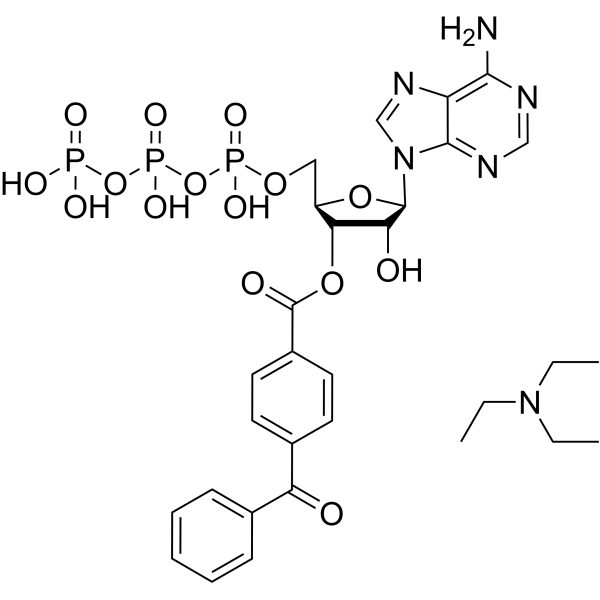
Physicochemical Properties
| Molecular Formula | C30H39N6O15P3 |
| Molecular Weight | 816.58 |
| Exact Mass | 816.168625 |
| CAS # | 112898-15-4 |
| PubChem CID | 71308559 |
| Appearance | Typically exists as White to off-white solids at room temperature |
| LogP | 3.396 |
| SMILES | C1=CC=C(C=C1)C(=O)C2=CC=C(C=C2)C(=O)O[C@@H]3[C@@H](COP(=O)(O)OP(=O)(O)OP(=O)(O)O)O[C@H]([C@@H]3O)N4C=NC5=C(N)N=CN=C54.CCN(CC)CC |
| InChi Key | HVOVBTNCGADRTH-WBLDMZOZSA-N |
| InChi Code | InChI=1S/C24H24N5O15P3.C6H15N/c25-21-17-22(27-11-26-21)29(12-28-17)23-19(31)20(16(41-23)10-40-46(36,37)44-47(38,39)43-45(33,34)35)42-24(32)15-8-6-14(7-9-15)18(30)13-4-2-1-3-5-13;1-4-7(5-2)6-3/h1-9,11-12,16,19-20,23,31H,10H2,(H,36,37)(H,38,39)(H2,25,26,27)(H2,33,34,35);4-6H2,1-3H3/t16-,19-,20-,23-;/m1./s1 |
| Chemical Name | [(2R,3S,4R,5R)-5-(6-aminopurin-9-yl)-4-hydroxy-2-[[hydroxy-[hydroxy(phosphonooxy)phosphoryl]oxyphosphoryl]oxymethyl]oxolan-3-yl] 4-benzoylbenzoate;N,N-diethylethanamine |
| Synonyms | Benzoylbenzoyl-ATP triethylammonium; BzATP triethylammonium salt; 112898-15-4; benzoylbenzoyl-ATP; [(2R,3S,4R,5R)-5-(6-aminopurin-9-yl)-4-hydroxy-2-[[hydroxy-[hydroxy(phosphonooxy)phosphoryl]oxyphosphoryl]oxymethyl]oxolan-3-yl] 4-benzoylbenzoate;N,N-diethylethanamine; 2/'- AND 3/'-O-(4-BENZOYLBENZOYL)-ADENOSINE 5/'-TRIPHOSPHATE TRIETHYLAMMONIUM SALT; bbATP triethylammonium salt; Benzoylbenzoic adenosine 5'-triphosphate; CHEMBL4226675; |
| HS Tariff Code | 2934.99.9001 |
| Storage |
Powder-20°C 3 years 4°C 2 years In solvent -80°C 6 months -20°C 1 month Note: (1). This product requires protection from light (avoid light exposure) during transportation and storage. |
| Shipping Condition | Room temperature (This product is stable at ambient temperature for a few days during ordinary shipping and time spent in Customs) |
Biological Activity
| Targets | pEC50: 8.74 (P2X1), 5.26 (P2X2), 7.10 (P2X3), 6.19 (P2X2/3), 6.31 (P2X4), 5.33 (P2X7)[1] EC50 3.6 μM (rat P2X7); 285 μM (mouse P2X7)[2] |
| ln Vitro | BzATP (10-1000 μM; 24 hours) triethylammonium promotes the proliferation and migration of U87 and U251 glioma cells [3]. BzATP (100 μM; 6-48 hours) triethylammonium induces P2X7R protein expression in human glioma cells. |
| ln Vivo | BzATP (5 mg/kg) triethylammonium significantly promoted the expression of P2X7R in the intestine after cecal ligation and puncture (CLP) induction compared with the sham and control groups [4]. |
| Enzyme Assay |
Activation of rat P2X3 and P2X2/3 receptors in vitro [https://pubmed.ncbi.nlm.nih.gov/11156585/] The recombinant rat P2X3 and rat P2X2/3 receptor cDNAs were identical to the previously published sequences used in the in vitro characterization of the pharmacology of the rat homomeric and heteromeric P2X3 receptors (Bianchi et al., 1999). 1321N1 human astrocytoma cells stably expressing rat P2X3, or rat P2X2/3 receptors were constructed using standard lipid-mediated transfection methods. All cell lines were maintained in D-MEM containing 10% FBS and antibiotics as follows: 300 μg ml−1 G418 for rat P2X3 containing cells; and 75 μg ml−1 hygromycin and 150 μg ml−1 G418 for rat P2X2/3 containing cells. Cells were grown at 37°C in a humidified atmosphere containing 5% CO2. P2X receptor function was determined on the basis of agonist-mediated increases in cytosolic Ca2+ concentration as previously described (Bianchi et al., 1999). BzATP (10 μM) and α,β-meATP (10 μM) were used to activate rat P2X3 and P2X2/3 receptors, respectively. Briefly, a fluorescent Ca2+ chelating dye (Fluo-4) was used as an indicator of the relative levels of intracellular Ca2+ in a 96-well format using a Fluorescence Imaging Plate Reader (FLIPR). Cells were grown to confluence in 96-well black-walled tissue culture plates and loaded with the acetoxymethylester (AM) form of Fluo-4 (1 μM) in D-PBS for 1 – 2 h at 23°C. Fluorescence data was collected at 1 – 5 s intervals throughout each experimental run. Concentration response data were analysed using a four-parameter logistic Hill equation in GraphPad Prism.https://pubmed.ncbi.nlm.nih.gov/11156585/ |
| Cell Assay |
Cell Proliferation Assay[3] Cell Types: U87 and U251 glioma Tested Concentrations: 5, 10, 50, 100, 500 and 1000 μM Incubation Duration: 2, 6, 12, 24, 48 and 72 hours Experimental Results: The proliferation of U87 and U251 glioma cell lines was significantly increased in the presence of 10-1000 uM and 100-1000 μM, respectively. The peak of cell proliferation of both U87 and U251 cell lines was at 100 μM. The optimal incubation time is 24 hours in both U87 and U251 cells lines. Western Blot Analysis[3] Cell Types: U87 and U251 glioma Tested Concentrations: 100 μM Incubation Duration: 6-48 hours Experimental Results: Induced the upregulation of P2X7R. |
| Animal Protocol |
Animal/Disease Models: Male 2-month-old C57BL/6 mice (each weighing between 20 and 25 g)[4] Doses: 5 mg/kg Route of Administration: Injected through the intraperitoneal route Experimental Results: At 48 hours, mice in the treated group and control group exhibited mortalities of 91% and 86%, respectively. |
| References |
[1]. Pharmacological characterization of recombinant human and rat P2X receptor subtypes. Eur J Pharmacol. 1999 Jul 2;376(1-2):127-38. [2]. Amino acid residues in the P2X7 receptor that mediate differential sensitivity to ATP and BzATP. Mol Pharmacol. 2007 Jan;71(1):92-100. [3]. Involvement of P2X 7 Receptor in Proliferation and Migration of Human Glioma Cells. Biomed Res Int. 2018 Jan 9;2018:8591397. [4]. Systemic blockade of P2X7 receptor protects against sepsis-induced intestinal barrier disruption. Sci Rep. 2017 Jun 29;7(1):4364. |
| Additional Infomation |
ATP functions as a fast neurotransmitter through the specific activation of a family of ligand-gated ion channels termed P2X receptors. In this report, six distinct recombinant P2X receptor subtypes were pharmacologically characterized in a heterologous expression system devoid of endogenous P2 receptor activity. cDNAs encoding four human P2X receptor subtypes (hP2X1, hP2X3, hP2X4, and hP2X7), and two rat P2X receptor subtypes (rP2X2 and rP2X3), were stably expressed in 1321N1 human astrocytoma cells. Furthermore, the rP2X2 and rP2X3 receptor subtypes were co-expressed in these same cells to form heteromultimeric receptors. Pharmacological profiles were determined for each receptor subtype, based on the activity of putative P2 ligands to stimulate Ca2+ influx. The observed potency and kinetics of each response was receptor subtype-specific and correlated with their respective electrophysiological properties. Each receptor subtype exhibited a distinct pharmacological profile, based on its respective sensitivity to nucleotide analogs, diadenosine polyphosphates and putative P2 receptor antagonists. Alphabeta-methylene ATP (alphabeta-meATP), a putative P2X receptor-selective agonist, was found to exhibit potent agonist activity only at the hP2X1, hP2X3 and rP2X3 receptor subtypes. Benzoylbenzoic ATP (BzATP, 2' and 3' mixed isomers), which has been reported to act as a P2X7 receptor-selective agonist, was least active at the rat and human P2X7 receptors, but was a potent (nM) agonist at hP2X1, rP2X3 and hP2X3 receptors. These data comprise a systematic examination of the functional pharmacology of P2X receptor activation. [1] Agonist properties of the P2X7 receptor (P2X7R) differ strikingly from other P2X receptors in two main ways: high concentrations of ATP (> 100 microM) are required to activate the receptor, and the ATP analog 2',3'-O-(4-benzoyl-benzoyl)ATP (BzATP) is both more potent than ATP and evokes a higher maximum current. However, there are striking species differences in these properties. We sought to exploit the large differences in ATP and BzATP responses between rat and mouse P2X7R to delineate regions or specific residues that may be responsible for the unique actions of these agonists at the P2X7R. We measured membrane currents in response to ATP and BzATP at wild-type rat and mouse P2X7R, at chimeric P2X7Rs, and at mouse P2X7Rs bearing point mutations. Wild-type rat P2X7R was 10 times more sensitive to ATP and 100 times more sensitive to BzATP than wild-type mouse P2X7R. We found that agonist EC50 values were determined solely by the ectodomain of the P2X7R. Two segments (residues 115-136 and 282-288), when transposed together, converted mouse sensitivities to those of rat. Point mutations through these regions revealed a single residue, asparagine284, in the rat P2X7R that fully accounted for the 10-fold difference in ATP sensitivity, whereas the 100-fold difference in BzATP sensitivity required the transfer of both Lys127 and Asn284 from rat to mouse. Thus, single amino acid differences between species can account for large changes in agonist effectiveness and differentiate between the two widely used agonists at P2X7 receptors.[2] Previous studies have demonstrated that activation of P2X7 receptors (P2X7R) results in the proliferation and migration of some types of tumor. Here, we asked whether and how the activated P2X7R contribute to proliferation and migration of human glioma cells. Results showed that the number of P2X7R positive cells was increasing with grade of tumor. In U87 and U251 human glioma cell lines, both expressed P2X7R and the expression was enhanced by 3'-O-(4-benzoylbenzoyl) ATP (BzATP), the agonist of P2X7R, and siRNA. Our results also showed that 10 μM BzATP was sufficient to induce the proliferation of glioma cell significantly, while the cell proliferation reached the peak with 100 μM BzATP. Also, the migration of U87 and U251 cells was significantly increased upon BzATP treatment. However, the number of apoptotic cells of U87 and U251 was not significantly changed by BzATP. In addition, the expression of ERK, p-ERK, and proliferating cell nuclear antigen (PCNA) protein was increased in BzATP-treated U87 and U251 glioma cells. PD98059, an inhibitor of the MEK/ERK pathway, blocked the increased proliferation and migration of glioma cells activated by BzATP. These results suggest that ERK pathway is involved in the proliferation and migration of glioma cells induced by P2X7R activation.[3] |
Solubility Data
| Solubility (In Vitro) | May dissolve in DMSO (in most cases), if not, try other solvents such as H2O, Ethanol, or DMF with a minute amount of products to avoid loss of samples |
| Solubility (In Vivo) |
Note: Listed below are some common formulations that may be used to formulate products with low water solubility (e.g. < 1 mg/mL), you may test these formulations using a minute amount of products to avoid loss of samples. Injection Formulations (e.g. IP/IV/IM/SC) Injection Formulation 1: DMSO : Tween 80: Saline = 10 : 5 : 85 (i.e. 100 μL DMSO stock solution → 50 μL Tween 80 → 850 μL Saline) *Preparation of saline: Dissolve 0.9 g of sodium chloride in 100 mL ddH ₂ O to obtain a clear solution. Injection Formulation 2: DMSO : PEG300 :Tween 80 : Saline = 10 : 40 : 5 : 45 (i.e. 100 μL DMSO → 400 μLPEG300 → 50 μL Tween 80 → 450 μL Saline) Injection Formulation 3: DMSO : Corn oil = 10 : 90 (i.e. 100 μL DMSO → 900 μL Corn oil) Example: Take the Injection Formulation 3 (DMSO : Corn oil = 10 : 90) as an example, if 1 mL of 2.5 mg/mL working solution is to be prepared, you can take 100 μL 25 mg/mL DMSO stock solution and add to 900 μL corn oil, mix well to obtain a clear or suspension solution (2.5 mg/mL, ready for use in animals). Injection Formulation 4: DMSO : 20% SBE-β-CD in saline = 10 : 90 [i.e. 100 μL DMSO → 900 μL (20% SBE-β-CD in saline)] *Preparation of 20% SBE-β-CD in Saline (4°C,1 week): Dissolve 2 g SBE-β-CD in 10 mL saline to obtain a clear solution. Injection Formulation 5: 2-Hydroxypropyl-β-cyclodextrin : Saline = 50 : 50 (i.e. 500 μL 2-Hydroxypropyl-β-cyclodextrin → 500 μL Saline) Injection Formulation 6: DMSO : PEG300 : castor oil : Saline = 5 : 10 : 20 : 65 (i.e. 50 μL DMSO → 100 μLPEG300 → 200 μL castor oil → 650 μL Saline) Injection Formulation 7: Ethanol : Cremophor : Saline = 10: 10 : 80 (i.e. 100 μL Ethanol → 100 μL Cremophor → 800 μL Saline) Injection Formulation 8: Dissolve in Cremophor/Ethanol (50 : 50), then diluted by Saline Injection Formulation 9: EtOH : Corn oil = 10 : 90 (i.e. 100 μL EtOH → 900 μL Corn oil) Injection Formulation 10: EtOH : PEG300:Tween 80 : Saline = 10 : 40 : 5 : 45 (i.e. 100 μL EtOH → 400 μLPEG300 → 50 μL Tween 80 → 450 μL Saline) Oral Formulations Oral Formulation 1: Suspend in 0.5% CMC Na (carboxymethylcellulose sodium) Oral Formulation 2: Suspend in 0.5% Carboxymethyl cellulose Example: Take the Oral Formulation 1 (Suspend in 0.5% CMC Na) as an example, if 100 mL of 2.5 mg/mL working solution is to be prepared, you can first prepare 0.5% CMC Na solution by measuring 0.5 g CMC Na and dissolve it in 100 mL ddH2O to obtain a clear solution; then add 250 mg of the product to 100 mL 0.5% CMC Na solution, to make the suspension solution (2.5 mg/mL, ready for use in animals). Oral Formulation 3: Dissolved in PEG400 Oral Formulation 4: Suspend in 0.2% Carboxymethyl cellulose Oral Formulation 5: Dissolve in 0.25% Tween 80 and 0.5% Carboxymethyl cellulose Oral Formulation 6: Mixing with food powders Note: Please be aware that the above formulations are for reference only. InvivoChem strongly recommends customers to read literature methods/protocols carefully before determining which formulation you should use for in vivo studies, as different compounds have different solubility properties and have to be formulated differently. (Please use freshly prepared in vivo formulations for optimal results.) |
| Preparing Stock Solutions | 1 mg | 5 mg | 10 mg | |
| 1 mM | 1.2246 mL | 6.1231 mL | 12.2462 mL | |
| 5 mM | 0.2449 mL | 1.2246 mL | 2.4492 mL | |
| 10 mM | 0.1225 mL | 0.6123 mL | 1.2246 mL |