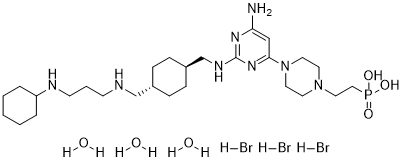
Burixafor HBr, the hydrobromide salt of Burixafor (TG-0054), is a novel, potent and orally bioavailable antagonist of CXCR4 (CXC chemokine receptor 4) with potential anti-inflammatory activity. It is an anti-angiogenic medication that dissolves in water well and may be useful in the treatment of choroid neovascularization. Burixafor, also called TG-0054, is an orally bioavailable inhibitor that binds to the CXC chemokine receptor 4 (CXCR4) and has the ability to mobilize hematopoietic stem cells. In order to stop stromal derived factor-1 (SDF-1 or CXCL12) from binding to the CXCR4 receptor and subsequent receptor activation, burixafor binds to the chemokine receptor CXCR4. This may prevent the mobilization of hematopoietic stem and progenitor cells from the bone marrow into blood.
Physicochemical Properties
| Molecular Formula | C27H52BRN8O3P |
| Molecular Weight | 647.631345748901 |
| Exact Mass | 646.31 |
| Elemental Analysis | C, 37.56; H, 7.00; Br, 27.76; N, 12.98; O, 11.12; P, 3.59 |
| CAS # | 1191450-19-7 |
| Related CAS # | 1191450-19-7 (HBr); 1191448-17-5 (free acid) |
| PubChem CID | 154575080 |
| Appearance | White to off-white solid powder |
| Hydrogen Bond Donor Count | 7 |
| Hydrogen Bond Acceptor Count | 11 |
| Rotatable Bond Count | 14 |
| Heavy Atom Count | 40 |
| Complexity | 724 |
| Defined Atom Stereocenter Count | 0 |
| InChi Key | ZXUVXYNBMUFEMK-UHFFFAOYSA-N |
| InChi Code | InChI=1S/C27H51N8O3P.BrH/c28-25-19-26(35-15-13-34(14-16-35)17-18-39(36,37)38)33-27(32-25)31-21-23-9-7-22(8-10-23)20-29-11-4-12-30-24-5-2-1-3-6-24;/h19,22-24,29-30H,1-18,20-21H2,(H2,36,37,38)(H3,28,31,32,33);1H |
| Chemical Name | 2-[4-[6-amino-2-[[4-[[3-(cyclohexylamino)propylamino]methyl]cyclohexyl]methylamino]pyrimidin-4-yl]piperazin-1-yl]ethylphosphonic acid;hydrobromide |
| Synonyms | TG-0054; Burixafor; TG0054; Burixafor HBr; TG 0054; Burixafor HBr hydrate; Burixafor trihydrobromide trihydrate |
| HS Tariff Code | 2934.99.03.00 |
| Storage |
Powder-20°C 3 years 4°C 2 years In solvent -80°C 6 months -20°C 1 month Note: Please store this product in a sealed and protected environment (e.g. under nitrogen), avoid exposure to moisture. |
| Shipping Condition | Room temperature (This product is stable at ambient temperature for a few days during ordinary shipping and time spent in Customs) |
Biological Activity
| Targets | CXCR4 |
| ln Vitro | TG-0054, a well water soluble anti-angiogenic drug that is of potential value in treating choroid neovascularization. After determining the influence of process parameters on particle size and drug loading, spherical microparticles syringeable through a 27 G needle, with a mean diameter of 7.6 μm, 10% w/w TG-0054 loading, sustained in vitro drug release for at least 6 months, and low residual organic solvent content (~ 1 ppb/mg) were prepared. |
| ln Vivo | Microparticles as well as drug solution were assessed for their in vivo drug delivery over 3 months following intravitreal injection in New Zealand white rabbits. Drug levels in the microparticle dosed eyes at 3 months were 43.7 ± 16.2, 243 ± 42.6, 62.8 ± 22.6 μg/g vitreous, retina, and choroid-RPE, respectively, and similar to levels at one month. Intravitreal injection of plain drug solution resulted in significantly lower amounts of drug in the dosed eye, with the levels being 0.8 ± 0.5, 2.7 ± 2.8, and 4.9± 4.2 μg/g in vitreous, retina, and choroid-RPE, respectively, at one month, with no detectable drug at three months. Although surface degradation was evident, microparticles maintained their spherical structure during the 6 months in vitro study and the 3 months in vivo study, with the vitreal particle retention at 1 and 3 months being 60% and 27%, respectively. |
| Cell Assay | Weighed amount (5 to 10 mg) of TG-0054 loaded microparticles were dispersed in 1 ml of phosphate buffered saline (PBS, pH 7.4) containing 0.05% sodium azide. Sodium azide serves as a preservative to prevent the microbial degradation of the microparticle formulation. These dispersed microparticles were added to a dialysis bag (7Spectra/por®, MWCO 25 kDa) presealed at one end with a clip. After the addition of microparticle dispersion, the other side of the dialysis bag was closed. Dialysis bag containing the dispersion of microparticles was placed in drug release medium (10 ml PBS at pH 7.4 containing 0.05 % sodium azide) in a tube. The tubes were incubated at 37 °C while stirring the contents at 200 rpm. At discrete time intervals including 0.5 hr, 1 hr, 2 hr, 4 hr, 8 hr, 16 hr, 1 day, 2 days and every week thereafter, the entire release medium was replaced with fresh medium maintained at 37°C. The dissolution medium removed at each time interval was analyzed using a UV spectrophotometer and the amount of TG-0054 in the release medium was determined. All in vitro studies were carried out in triplicates.[1] |
| Animal Protocol | The in vivo intravitreal delivery of TG-0054 from microparticle formulation was tested in male New Zealand white rabbits and compared with TG-0054 solution. Male New Zealand white rabbits weighing 2-3 kg were assigned to two groups. Group 1 (n = 6) received TG-0054-PLA microparticles intravitreally in one eye. Group 2 (n = 6) received TG-0054 solution intravitreally in both eyes. The rabbits were anaesthetized by intramuscular injection of ketamine : xyalazine mixture (50:10 v/v) in the hind limb of rabbits (400 μl/rabbit). Once the rabbits were in deep anesthesia, betadine solution was applied on eye surface and intravitreal injections were made using a 27G needle. Group 1 animals received 50 microliters of 300 mg microparticles/ml PBS (pH 7.4) [TG-0054-PLA microparticles with 10% drug loading; 15mg microparticles containing 1.5mg TG-0054/ 50μl] in the vitreal cavity of the right eye while the left eye was not dosed. Group 2 animals received 50 microliters of 20 mg TG-0054/ml PBS (pH 7.4) [1 mg/50 μl] in both eyes. After intravitreal injection, gentamicin ointment was applied at the injection site to prevent infections. The animals were regularly monitored for any abnormal signs. Three rabbits from each group were sacrificed at the end of 1 or 3 months post-dosing, in order to compare drug delivery between the formulations at the end of 1 and 3 months. Animals were euthanized by intravenous injection of sodium pentobarbital (150 mg/kg), and both eyes were enucleated and blood was collected. The eyes were immediately frozen in isopentane : dry ice bath and stored at −80 °C until further analysis.[1] |
| References |
[1]. Intravitreal Poly(L-lactide) Microparticles Sustain Retinal and Choroidal Delivery of TG-0054, a Hydrophilic Drug Intended for Neovascular Diseases. Drug Deliv Transl Res. 2011 Feb;1(1):76-90. [2]. CXCR4 Antagonist TG-0054 Mobilizes Mesenchymal Stem Cells, Attenuates Inflammation, and Preserves Cardiac Systolic Function in a Porcine Model of Myocardial Infarction. Cell Transplant. 2015;24(7):1313-28. |
| Additional Infomation | Burixafor Hydrobromide is the hydrobromide salt form of burixafor, an orally bioavailable inhibitor of CXC chemokine receptor 4 (CXCR4) with hematopoietic stem cell (HSC)-mobilization and chemosensitizing activities. Upon administration, burixafor binds to the chemokine receptor CXCR4, thereby preventing the binding of stromal cell-derived factor-1 (SDF-1 or CXCL12) to the CXCR4 receptor and subsequent receptor activation. This may induce the mobilization of hematopoietic stem and progenitor cells from the bone marrow into the peripheral circulation. Additionally, burixafor-mediated mobilization of disseminated tumor cells (DTCs) from the bone marrow into the blood may make these metastatic tumor cells more susceptible to the actions of chemotherapeutic agents. CXCR4, a chemokine receptor belonging to the G protein-coupled receptor (GPCR) gene family, plays an important role in chemotaxis and angiogenesis and is upregulated in several tumor cell types. CXCL12/CXCR4 interaction induces retention of hematopoietic cells in the bone marrow. |
Solubility Data
| Solubility (In Vitro) | H2O: ~50 mg/mL (~65.0 mM) |
| Solubility (In Vivo) |
Solubility in Formulation 1: 20 mg/mL (26.01 mM) in PBS (add these co-solvents sequentially from left to right, and one by one), clear solution; with sonication. (Please use freshly prepared in vivo formulations for optimal results.) |
| Preparing Stock Solutions | 1 mg | 5 mg | 10 mg | |
| 1 mM | 1.5441 mL | 7.7205 mL | 15.4409 mL | |
| 5 mM | 0.3088 mL | 1.5441 mL | 3.0882 mL | |
| 10 mM | 0.1544 mL | 0.7720 mL | 1.5441 mL |