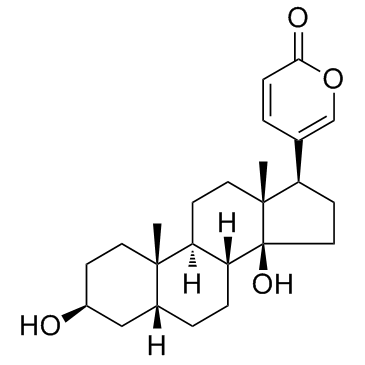
Bufalin is a novel and potent inhibitor of steroid receptor coactivator 3 (SRC-3) with anticancer, anti-inflammatory and antinociceptive activity. It is a naturally occurring digoxin-like immunoreactive component isolated from the Chinese medicine Chan Su. It exerts anticancer activity by inducing cell death through the ROS-mediated RIP1/RIP3/PARP-1 pathways.
Physicochemical Properties
| Molecular Formula | C24H34O4 |
| Molecular Weight | 386.53 |
| Exact Mass | 386.245 |
| CAS # | 465-21-4 |
| PubChem CID | 9547215 |
| Appearance | White to off-white solid powder |
| Density | 1.2±0.1 g/cm3 |
| Boiling Point | 556.6±50.0 °C at 760 mmHg |
| Melting Point | 242 - 243ºC |
| Flash Point | 189.0±23.6 °C |
| Vapour Pressure | 0.0±3.4 mmHg at 25°C |
| Index of Refraction | 1.594 |
| LogP | 3.42 |
| Hydrogen Bond Donor Count | 2 |
| Hydrogen Bond Acceptor Count | 4 |
| Rotatable Bond Count | 1 |
| Heavy Atom Count | 28 |
| Complexity | 741 |
| Defined Atom Stereocenter Count | 8 |
| SMILES | O([H])[C@]12C([H])([H])C([H])([H])[C@]([H])(C3=C([H])OC(C([H])=C3[H])=O)[C@@]1(C([H])([H])[H])C([H])([H])C([H])([H])[C@]1([H])[C@@]3(C([H])([H])[H])C([H])([H])C([H])([H])[C@@]([H])(C([H])([H])[C@@]3([H])C([H])([H])C([H])([H])[C@@]21[H])O[H] |
| InChi Key | QEEBRPGZBVVINN-BMPKRDENSA-N |
| InChi Code | InChI=1S/C24H34O4/c1-22-10-7-17(25)13-16(22)4-5-20-19(22)8-11-23(2)18(9-12-24(20,23)27)15-3-6-21(26)28-14-15/h3,6,14,16-20,25,27H,4-5,7-13H2,1-2H3/t16-,17+,18-,19+,20-,22+,23-,24+/m1/s1 |
| Chemical Name | 5-[(3S,5R,8R,9S,10S,13R,14S,17R)-3,14-dihydroxy-10,13-dimethyl-1,2,3,4,5,6,7,8,9,11,12,15,16,17-tetradecahydrocyclopenta[a]phenanthren-17-yl]pyran-2-one |
| HS Tariff Code | 2934.99.9001 |
| Storage |
Powder-20°C 3 years 4°C 2 years In solvent -80°C 6 months -20°C 1 month |
| Shipping Condition | Room temperature (This product is stable at ambient temperature for a few days during ordinary shipping and time spent in Customs) |
Biological Activity
| ln Vitro | In NCI-H460 cells, bufalin (0, 1, 2, 4 μM) reduces cell viability for 48 hours[2]. Bufalin (2 μM) decreases the expression of GRP78 mRNA while increasing that of caspae-3, Endo G, and GADD153 mRNA[2]. |
| ln Vivo | Mice harboring NCI-H460 cells demonstrated notable antitumor activity when bufalin (0.1, 0.2, or 0.4 mg/kg, intraperitoneally injected once daily for 14 days) was administered [2]. |
| Cell Assay |
Cell viability assay[2] Cell Types: NCI-H460 Cell Tested Concentrations: 0, 1, 2, 4 μM Incubation Duration: 48 hrs (hours) Experimental Results: The viability of NCI-H460 cells was diminished in a dose-dependent manner. |
| Animal Protocol |
Animal/Disease Models: 40 male athymic BALB/c nu/nu (nude) mice (6-8 weeks old) [2] Doses: 0.1, 0.2 or 0.4 mg/kg Route of Administration: Daily intraperitoneal (ip) injection until 14 days Experimental Results: Dose dependent Inhibit tumor growth. |
| References |
[1]. Selectivity of digitalis glycosides for isoforms of human Na,K-ATPase. J Biol Chem. 2010 Jun 18;285(25):19582-92. [2]. Bufalin induces apoptosis in vitro and has Antitumor activity against human lung cancer xenografts in vivo. Environ Toxicol. 2017 Apr;32(4):1305-1317. |
| Additional Infomation |
Bufalin is a 14beta-hydroxy steroid that is bufan-20,22-dienolide having hydroxy substituents at the 5beta- and 14beta-positions. It has been isolated from the skin of the toad Bufo bufo. It has a role as an antineoplastic agent, a cardiotonic drug, an anti-inflammatory agent and an animal metabolite. It is a 3beta-hydroxy steroid and a 14beta-hydroxy steroid. It is functionally related to a bufanolide. Bufalin has been reported in Phrynoidis asper, Bufo gargarizans, and other organisms with data available. Bufalin is an active ingredient and one of the glycosides in the traditional Chinese medicine ChanSu; it is also a bufadienolide toxin originally isolated from the venom of the Chinese toad Bufo gargarizans, with potential cardiotonic and antineoplastic activity. Although the mechanism of action of bufalin is still under investigation, this agent is a specific Na+/K+-ATPase inhibitor and can induce apoptosis in cancer cell lines through the activation of the transcription factor AP-1 via a mitogen activated protein kinase (MAPK) pathway. |
Solubility Data
| Solubility (In Vitro) | DMSO : ~100 mg/mL (~258.72 mM) |
| Solubility (In Vivo) |
Solubility in Formulation 1: ≥ 2.5 mg/mL (6.47 mM) (saturation unknown) in 10% DMSO + 90% (20% SBE-β-CD in Saline) (add these co-solvents sequentially from left to right, and one by one), clear solution. For example, if 1 mL of working solution is to be prepared, you can add 100 μL of 25.0 mg/mL clear DMSO stock solution to 900 μL of 20% SBE-β-CD physiological saline solution and mix evenly. Preparation of 20% SBE-β-CD in Saline (4°C,1 week): Dissolve 2 g SBE-β-CD in 10 mL saline to obtain a clear solution. Solubility in Formulation 2: ≥ 2.5 mg/mL (6.47 mM) (saturation unknown) in 10% DMSO + 90% Corn Oil (add these co-solvents sequentially from left to right, and one by one), clear solution. For example, if 1 mL of working solution is to be prepared, you can add 100 μL of 25.0 mg/mL clear DMSO stock solution to 900 μL of corn oil and mix evenly. Solubility in Formulation 3: ≥ 2.08 mg/mL (5.38 mM) (saturation unknown) in 10% DMSO + 40% PEG300 + 5% Tween80 + 45% Saline (add these co-solvents sequentially from left to right, and one by one), clear solution. For example, if 1 mL of working solution is to be prepared, you can add 100 μL of 20.8 mg/mL clear DMSO stock solution to 400 μL PEG300 and mix evenly; then add 50 μL Tween-80 to the above solution and mix evenly; then add 450 μL normal saline to adjust the volume to 1 mL. Preparation of saline: Dissolve 0.9 g of sodium chloride in 100 mL ddH₂ O to obtain a clear solution. (Please use freshly prepared in vivo formulations for optimal results.) |
| Preparing Stock Solutions | 1 mg | 5 mg | 10 mg | |
| 1 mM | 2.5871 mL | 12.9356 mL | 25.8712 mL | |
| 5 mM | 0.5174 mL | 2.5871 mL | 5.1742 mL | |
| 10 mM | 0.2587 mL | 1.2936 mL | 2.5871 mL |