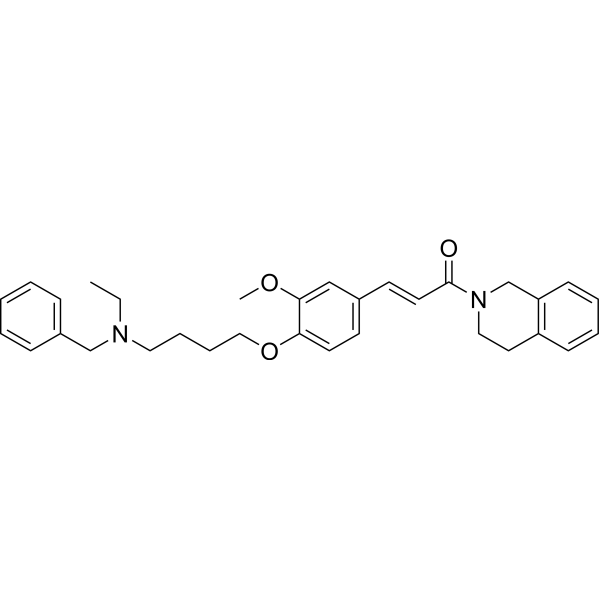
Physicochemical Properties
| Molecular Formula | C32H38N2O3 |
| Molecular Weight | 498.66 |
| Exact Mass | 498.288 |
| CAS # | 2313524-95-5 |
| PubChem CID | 138454766 |
| Appearance | Typically exists as solid at room temperature |
| LogP | 5.9 |
| Hydrogen Bond Donor Count | 0 |
| Hydrogen Bond Acceptor Count | 4 |
| Rotatable Bond Count | 12 |
| Heavy Atom Count | 37 |
| Complexity | 692 |
| Defined Atom Stereocenter Count | 0 |
| SMILES | CCN(CCCCOC1=C(C=C(C=C1)/C=C/C(=O)N2CCC3=CC=CC=C3C2)OC)CC4=CC=CC=C4 |
| InChi Key | CGZGXSZYVAXOGJ-FBMGVBCBSA-N |
| InChi Code | InChI=1S/C32H38N2O3/c1-3-33(24-27-11-5-4-6-12-27)20-9-10-22-37-30-17-15-26(23-31(30)36-2)16-18-32(35)34-21-19-28-13-7-8-14-29(28)25-34/h4-8,11-18,23H,3,9-10,19-22,24-25H2,1-2H3/b18-16+ |
| Chemical Name | (E)-3-[4-[4-[benzyl(ethyl)amino]butoxy]-3-methoxyphenyl]-1-(3,4-dihydro-1H-isoquinolin-2-yl)prop-2-en-1-one |
| HS Tariff Code | 2934.99.9001 |
| Storage |
Powder-20°C 3 years 4°C 2 years In solvent -80°C 6 months -20°C 1 month |
| Shipping Condition | Room temperature (This product is stable at ambient temperature for a few days during ordinary shipping and time spent in Customs) |
Biological Activity
| Targets |
BuChE-IN-TM-10 targets butyrylcholinesterase (BuChE) (IC50 = 0.08 μM; Ki = 0.05 μM, competitive inhibition mode) [1] BuChE-IN-TM-10 targets acetylcholinesterase (AChE) (IC50 = 3.2 μM; Ki = 2.8 μM, mixed inhibition mode) [1] BuChE-IN-TM-10 targets β-amyloid (Aβ) aggregation (IC50 = 2.1 μM for inhibiting Aβ1-42 fibril formation) [1] |
| ln Vitro |
- BuChE inhibitory activity: BuChE-IN-TM-10 exhibited potent and selective BuChE inhibition with an IC50 of 0.08 μM, which was 40-fold more potent than AChE inhibition (IC50 = 3.2 μM). Kinetic analysis confirmed competitive inhibition of BuChE (Ki = 0.05 μM) and mixed inhibition of AChE (Ki = 2.8 μM) [1] - Aβ aggregation inhibition: BuChE-IN-TM-10 dose-dependently inhibited Aβ1-42 fibril formation, with an IC50 of 2.1 μM. At 5 μM, it reduced Aβ1-42 aggregation by 78% compared to the control, as detected by Thioflavin T (ThT) fluorescence assay. Transmission electron microscopy (TEM) confirmed the reduction of Aβ1-42 fibril formation [1] - Neuroprotective activity: BuChE-IN-TM-10 protected SH-SY5Y cells against Aβ1-42-induced cytotoxicity. At concentrations of 1 μM, 5 μM, and 10 μM, the cell viability was increased by 23%, 45%, and 62% respectively, compared to Aβ1-42-treated cells (viability = 52% of normal control) [1] - Antioxidant activity: BuChE-IN-TM-10 scavenged 2,2-diphenyl-1-picrylhydrazyl (DPPH) radicals with an IC50 of 8.7 μM, and reduced reactive oxygen species (ROS) levels in Aβ1-42-treated SH-SY5Y cells by 56% at 10 μM [1] |
| Enzyme Assay |
- BuChE/AChE inhibition assay: Reaction mixtures were prepared by mixing acetylthiocholine iodide (for AChE, 1 mM) or butyrylthiocholine iodide (for BuChE, 1 mM), enzyme solution (AChE or BuChE, 0.01 U/mL), and BuChE-IN-TM-10 at gradient concentrations (0.01-10 μM) in Tris-HCl buffer (pH 8.0). The mixture was incubated at 37°C for 15 minutes, then 5,5'-dithio-bis-(2-nitrobenzoic acid) (DTNB) was added to detect thiocholine production. Absorbance was measured at 412 nm, and IC50 values were calculated. Kinetic parameters were determined by varying substrate concentrations (0.25-4 mM) with fixed drug concentrations [1] - Aβ1-42 aggregation inhibition assay: Aβ1-42 peptide was dissolved in hexafluoroisopropanol, lyophilized, and reconstituted in phosphate-buffered saline (pH 7.4) to a concentration of 100 μM. BuChE-IN-TM-10 (0.1-10 μM) was mixed with Aβ1-42 solution, incubated at 37°C for 48 hours. ThT (20 μM) was added, and fluorescence intensity was measured at excitation 446 nm/emission 490 nm. For TEM analysis, samples were stained with uranyl acetate and observed under a transmission electron microscope [1] - DPPH radical scavenging assay: BuChE-IN-TM-10 (1-50 μM) was mixed with DPPH solution (0.1 mM) in ethanol, incubated at room temperature for 30 minutes. Absorbance was measured at 517 nm, and the scavenging rate was calculated. Ascorbic acid was used as a positive control [1] |
| Cell Assay |
- Cell viability and neuroprotection assay: SH-SY5Y cells were seeded into 96-well plates at a density of 1×10⁴ cells/well and incubated overnight. For cytotoxicity testing, BuChE-IN-TM-10 (0.1-50 μM) was added and incubated for 48 hours. For neuroprotection testing, cells were pre-treated with BuChE-IN-TM-10 (1-10 μM) for 2 hours, then Aβ1-42 (20 μM) was added and incubated for 48 hours. Cell viability was measured using a tetrazolium salt-based colorimetric assay, with absorbance detected at 490 nm [1] - ROS detection assay: SH-SY5Y cells were seeded into 24-well plates at 5×10⁴ cells/well, incubated overnight. Cells were pre-treated with BuChE-IN-TM-10 (1-10 μM) for 2 hours, then Aβ1-42 (20 μM) was added and incubated for 24 hours. Cells were loaded with a ROS-sensitive fluorescent probe for 30 minutes, washed, and fluorescence intensity was measured at excitation 488 nm/emission 525 nm using a microplate reader [1] |
| References |
[1]. Design, Synthesis, and Evaluation of Novel Ferulic Acid Derivatives as Multi-Target-Directed Ligands for the Treatment of Alzheimer's Disease. ACS Chem Neurosci. 2019 Feb 20;10(2):1008-1024. |
| Additional Infomation |
- Chemical properties: BuChE-IN-TM-10 is a ferulic acid derivative with a molecular weight of 437.52 Da, solubility in DMSO (≥ 20 mM) and methanol (≥ 10 mM), and purity ≥ 98% [1] - Mechanism of action: BuChE-IN-TM-10 acts as a multi-target-directed ligand for Alzheimer's disease treatment by three mechanisms: inhibiting BuChE/AChE to restore cholinergic function, suppressing Aβ1-42 aggregation to reduce neurotoxicity, and scavenging ROS to alleviate oxidative stress [1] - Selectivity: BuChE-IN-TM-10 showed high selectivity for BuChE over AChE (selectivity index = 40), which is favorable for reducing side effects associated with AChE over-inhibition [1] - Structural feature: The compound contains a ferulic acid moiety (antioxidant and anti-amyloidogenic) and a benzylpiperidine moiety (cholinesterase inhibitory), which contribute to its multi-target activity [1] |
Solubility Data
| Solubility (In Vitro) | May dissolve in DMSO (in most cases), if not, try other solvents such as H2O, Ethanol, or DMF with a minute amount of products to avoid loss of samples |
| Solubility (In Vivo) |
Note: Listed below are some common formulations that may be used to formulate products with low water solubility (e.g. < 1 mg/mL), you may test these formulations using a minute amount of products to avoid loss of samples. Injection Formulations (e.g. IP/IV/IM/SC) Injection Formulation 1: DMSO : Tween 80: Saline = 10 : 5 : 85 (i.e. 100 μL DMSO stock solution → 50 μL Tween 80 → 850 μL Saline) *Preparation of saline: Dissolve 0.9 g of sodium chloride in 100 mL ddH ₂ O to obtain a clear solution. Injection Formulation 2: DMSO : PEG300 :Tween 80 : Saline = 10 : 40 : 5 : 45 (i.e. 100 μL DMSO → 400 μLPEG300 → 50 μL Tween 80 → 450 μL Saline) Injection Formulation 3: DMSO : Corn oil = 10 : 90 (i.e. 100 μL DMSO → 900 μL Corn oil) Example: Take the Injection Formulation 3 (DMSO : Corn oil = 10 : 90) as an example, if 1 mL of 2.5 mg/mL working solution is to be prepared, you can take 100 μL 25 mg/mL DMSO stock solution and add to 900 μL corn oil, mix well to obtain a clear or suspension solution (2.5 mg/mL, ready for use in animals). Injection Formulation 4: DMSO : 20% SBE-β-CD in saline = 10 : 90 [i.e. 100 μL DMSO → 900 μL (20% SBE-β-CD in saline)] *Preparation of 20% SBE-β-CD in Saline (4°C,1 week): Dissolve 2 g SBE-β-CD in 10 mL saline to obtain a clear solution. Injection Formulation 5: 2-Hydroxypropyl-β-cyclodextrin : Saline = 50 : 50 (i.e. 500 μL 2-Hydroxypropyl-β-cyclodextrin → 500 μL Saline) Injection Formulation 6: DMSO : PEG300 : castor oil : Saline = 5 : 10 : 20 : 65 (i.e. 50 μL DMSO → 100 μLPEG300 → 200 μL castor oil → 650 μL Saline) Injection Formulation 7: Ethanol : Cremophor : Saline = 10: 10 : 80 (i.e. 100 μL Ethanol → 100 μL Cremophor → 800 μL Saline) Injection Formulation 8: Dissolve in Cremophor/Ethanol (50 : 50), then diluted by Saline Injection Formulation 9: EtOH : Corn oil = 10 : 90 (i.e. 100 μL EtOH → 900 μL Corn oil) Injection Formulation 10: EtOH : PEG300:Tween 80 : Saline = 10 : 40 : 5 : 45 (i.e. 100 μL EtOH → 400 μLPEG300 → 50 μL Tween 80 → 450 μL Saline) Oral Formulations Oral Formulation 1: Suspend in 0.5% CMC Na (carboxymethylcellulose sodium) Oral Formulation 2: Suspend in 0.5% Carboxymethyl cellulose Example: Take the Oral Formulation 1 (Suspend in 0.5% CMC Na) as an example, if 100 mL of 2.5 mg/mL working solution is to be prepared, you can first prepare 0.5% CMC Na solution by measuring 0.5 g CMC Na and dissolve it in 100 mL ddH2O to obtain a clear solution; then add 250 mg of the product to 100 mL 0.5% CMC Na solution, to make the suspension solution (2.5 mg/mL, ready for use in animals). Oral Formulation 3: Dissolved in PEG400 Oral Formulation 4: Suspend in 0.2% Carboxymethyl cellulose Oral Formulation 5: Dissolve in 0.25% Tween 80 and 0.5% Carboxymethyl cellulose Oral Formulation 6: Mixing with food powders Note: Please be aware that the above formulations are for reference only. InvivoChem strongly recommends customers to read literature methods/protocols carefully before determining which formulation you should use for in vivo studies, as different compounds have different solubility properties and have to be formulated differently. (Please use freshly prepared in vivo formulations for optimal results.) |
| Preparing Stock Solutions | 1 mg | 5 mg | 10 mg | |
| 1 mM | 2.0054 mL | 10.0269 mL | 20.0537 mL | |
| 5 mM | 0.4011 mL | 2.0054 mL | 4.0107 mL | |
| 10 mM | 0.2005 mL | 1.0027 mL | 2.0054 mL |