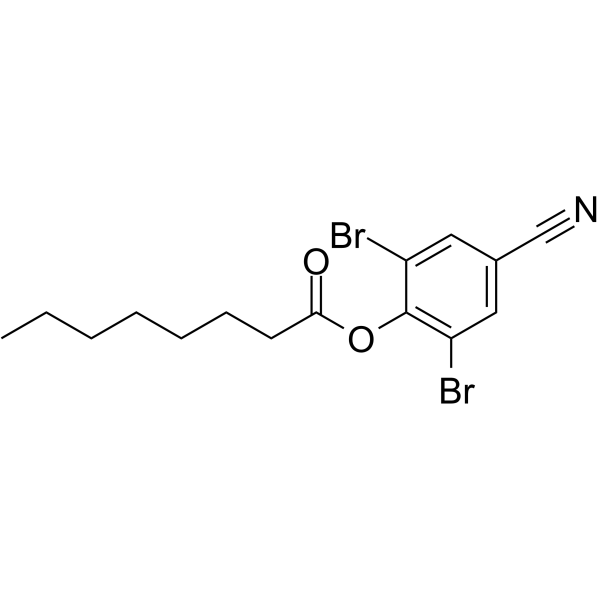
Physicochemical Properties
| Molecular Formula | C15H17BR2NO2 |
| Molecular Weight | 403.11 |
| Exact Mass | 400.962 |
| CAS # | 1689-99-2 |
| PubChem CID | 15533 |
| Appearance | White to off-white solid powder |
| Density | 1.5±0.1 g/cm3 |
| Boiling Point | 424.6±45.0 °C at 760 mmHg |
| Melting Point | 45-46°C |
| Flash Point | 210.6±28.7 °C |
| Vapour Pressure | 0.0±1.0 mmHg at 25°C |
| Index of Refraction | 1.573 |
| LogP | 5.19 |
| Hydrogen Bond Donor Count | 0 |
| Hydrogen Bond Acceptor Count | 3 |
| Rotatable Bond Count | 8 |
| Heavy Atom Count | 20 |
| Complexity | 341 |
| Defined Atom Stereocenter Count | 0 |
| InChi Key | DQKWXTIYGWPGOO-UHFFFAOYSA-N |
| InChi Code | InChI=1S/C15H17Br2NO2/c1-2-3-4-5-6-7-14(19)20-15-12(16)8-11(10-18)9-13(15)17/h8-9H,2-7H2,1H3 |
| Chemical Name | (2,6-dibromo-4-cyanophenyl) octanoate |
| HS Tariff Code | 2934.99.9001 |
| Storage |
Powder-20°C 3 years 4°C 2 years In solvent -80°C 6 months -20°C 1 month |
| Shipping Condition | Room temperature (This product is stable at ambient temperature for a few days during ordinary shipping and time spent in Customs) |
Biological Activity
| ADME/Pharmacokinetics |
Absorption, Distribution and Excretion The absorption, distribution, excretion and metabolism of bromoxynil octanoate were studied in male and female Sprague Dawley rats given single oral doses of 14C-bromoxynil octanoate by gavage at dose levels of 2 or 20 mg/kg or at a dose level of 2 mg/kg following 14 days of unlabeled bromoxynil octanoate administered by oral gavage at a dose level of 2 mg/kg/day. Results were similar regardless of the dosing regimen. The rate of absorption was moderate in both males and females. Peak plasma concentrations of radioactivity were not reached until 7-10 hours after dosing. Radioactivity was widely distributed in most tissues. The highest concentrations were observed in blood, plasma, liver, kidneys and thyroid (especially in females). Levels of radioactivity in tissues were generally higher in females than in males. Most radioactivity was excreted in the urine (about 84-89% in males and 76-80% in females at 7 days) and considerably lesser amounts in the feces (about 6-10% in both males and females at 7 days). Excretion was more rapid in males than in females. Retention of radioactivity in tissues after 7 days was about 2-3% in males and 7-9% in females. 14C-Bromoxynil octanoate, incorporated into the end-use product Buctril, which contained 33.4% bromoxynil octanoate as the active ingredient, was topically applied to the skin of male Sprague Dawley rats at doses of 0.08, 0.4 or 3.4 mg/rat for durations of exposure of 0.5, 1, 2, 4, 10 or 24 hours (4 rats/dose/duration of exposure). The quantity of radioactivity absorbed increased with dose and duration of exposure. Percent dermal absorption at 10 hours was 10.32%, 7.07% and 4.51% for doses of 0.08, 0.4 and 3.4 mg/rat respectively. Following a soap and water wash (at 10 hours), 6.46%, 8.06% and 6.13% of the respective doses remained in/on the skin. Percent dermal absorption at 24 hours was 17.58%, 18.43% and 10.88% for doses of 0.08, 0.4 and 3.4 mg/rat respectively. Following a soap and water wash (at 24 hours), 7.91%, 9.50% and 4.97% of the respective doses remained in/on the skin. A study with the octanoate ester in rats showed that after an oral dose, uptake was moderate. Peak plasma levels were attained 7 to 10 hours after dosing. Most of the dose was eliminated within 7 days, primarily in the urine. Dermal uptake studies in rats show an absorption in 24 hr of 11 to 18 % for the octanoate ester depending on concentration... Metabolism / Metabolites The absorption, distribution, excretion and metabolism of bromoxynil octanoate were studied in male and female Sprague Dawley rats given single oral doses of 14C-bromoxynil octanoate by gavage at dose levels of 2 or 20 mg/kg or at a dose level of 2 mg/kg following 14 days of unlabeled bromoxynil octanoate administered by oral gavage at a dose level of 2 mg/kg/day. Results were similar regardless of the dosing regimen. ...Essentially all bromoxynil octanoate was rapidly and nearly completely converted to bromoxynil phenol via ester hydrolysis. In special studies, the only chemical species identified in tissues was bromoxynil phenol per se; no bromoxynil octanoate was identified in tissues. In urine, the only major species was free and conjugated bromoxynil phenol with no bromoxynil octanoate present. In feces, however, some bromoxynil octanoate was identified. The octanoate ester was rapidly and completely converted to the phenol and excreted in the urine as either the phenol or it conjugates. |
| Toxicity/Toxicokinetics |
Toxicity Data LC50 (rat) = 720 mg/m3; Non-Human Toxicity Values LD50 Mouse oral 245 mg/kg LD50 Rat oral 250 mg/kg LD50 Rat (male) oral 400 mg/kg /Technical/ /from table/ LD50 Rat (female) oral 238 mg/kg /Technical/ /from table/ For more Non-Human Toxicity Values (Complete) data for BROMOXYNIL OCTANOATE (8 total), please visit the HSDB record page. |
| References |
[1]. Degradation of bromoxynil octanoate by strain Acinetobacter sp. XB2 isolated from contaminated soil. Curr Microbiol. 2011;63(2):218-225. |
| Additional Infomation |
Bromoxynil Octanoate can cause developmental toxicity according to The Environmental Protection Agency (EPA). Bromoxynil octanoate, [solid] appears as a solid. Used as a selective contact herbicide. Mechanism of Action The pricipal action of the benzonitriles is to uncouple oxidative phosphorylation. Bromoxynil octanoate is a fairly potent mitochondrial uncoupler in vitro with a UC50 value in rat liver mitochondria of 3.2 to 5 micro molar... The signs and symptoms of acute poisoning in vertebrates (including humans) are in reasonable accord with uncoupling being the primary mechanism of toxic action. |
Solubility Data
| Solubility (In Vitro) | May dissolve in DMSO (in most cases), if not, try other solvents such as H2O, Ethanol, or DMF with a minute amount of products to avoid loss of samples |
| Solubility (In Vivo) |
Note: Listed below are some common formulations that may be used to formulate products with low water solubility (e.g. < 1 mg/mL), you may test these formulations using a minute amount of products to avoid loss of samples. Injection Formulations (e.g. IP/IV/IM/SC) Injection Formulation 1: DMSO : Tween 80: Saline = 10 : 5 : 85 (i.e. 100 μL DMSO stock solution → 50 μL Tween 80 → 850 μL Saline) *Preparation of saline: Dissolve 0.9 g of sodium chloride in 100 mL ddH ₂ O to obtain a clear solution. Injection Formulation 2: DMSO : PEG300 :Tween 80 : Saline = 10 : 40 : 5 : 45 (i.e. 100 μL DMSO → 400 μLPEG300 → 50 μL Tween 80 → 450 μL Saline) Injection Formulation 3: DMSO : Corn oil = 10 : 90 (i.e. 100 μL DMSO → 900 μL Corn oil) Example: Take the Injection Formulation 3 (DMSO : Corn oil = 10 : 90) as an example, if 1 mL of 2.5 mg/mL working solution is to be prepared, you can take 100 μL 25 mg/mL DMSO stock solution and add to 900 μL corn oil, mix well to obtain a clear or suspension solution (2.5 mg/mL, ready for use in animals). Injection Formulation 4: DMSO : 20% SBE-β-CD in saline = 10 : 90 [i.e. 100 μL DMSO → 900 μL (20% SBE-β-CD in saline)] *Preparation of 20% SBE-β-CD in Saline (4°C,1 week): Dissolve 2 g SBE-β-CD in 10 mL saline to obtain a clear solution. Injection Formulation 5: 2-Hydroxypropyl-β-cyclodextrin : Saline = 50 : 50 (i.e. 500 μL 2-Hydroxypropyl-β-cyclodextrin → 500 μL Saline) Injection Formulation 6: DMSO : PEG300 : castor oil : Saline = 5 : 10 : 20 : 65 (i.e. 50 μL DMSO → 100 μLPEG300 → 200 μL castor oil → 650 μL Saline) Injection Formulation 7: Ethanol : Cremophor : Saline = 10: 10 : 80 (i.e. 100 μL Ethanol → 100 μL Cremophor → 800 μL Saline) Injection Formulation 8: Dissolve in Cremophor/Ethanol (50 : 50), then diluted by Saline Injection Formulation 9: EtOH : Corn oil = 10 : 90 (i.e. 100 μL EtOH → 900 μL Corn oil) Injection Formulation 10: EtOH : PEG300:Tween 80 : Saline = 10 : 40 : 5 : 45 (i.e. 100 μL EtOH → 400 μLPEG300 → 50 μL Tween 80 → 450 μL Saline) Oral Formulations Oral Formulation 1: Suspend in 0.5% CMC Na (carboxymethylcellulose sodium) Oral Formulation 2: Suspend in 0.5% Carboxymethyl cellulose Example: Take the Oral Formulation 1 (Suspend in 0.5% CMC Na) as an example, if 100 mL of 2.5 mg/mL working solution is to be prepared, you can first prepare 0.5% CMC Na solution by measuring 0.5 g CMC Na and dissolve it in 100 mL ddH2O to obtain a clear solution; then add 250 mg of the product to 100 mL 0.5% CMC Na solution, to make the suspension solution (2.5 mg/mL, ready for use in animals). Oral Formulation 3: Dissolved in PEG400 Oral Formulation 4: Suspend in 0.2% Carboxymethyl cellulose Oral Formulation 5: Dissolve in 0.25% Tween 80 and 0.5% Carboxymethyl cellulose Oral Formulation 6: Mixing with food powders Note: Please be aware that the above formulations are for reference only. InvivoChem strongly recommends customers to read literature methods/protocols carefully before determining which formulation you should use for in vivo studies, as different compounds have different solubility properties and have to be formulated differently. (Please use freshly prepared in vivo formulations for optimal results.) |
| Preparing Stock Solutions | 1 mg | 5 mg | 10 mg | |
| 1 mM | 2.4807 mL | 12.4036 mL | 24.8071 mL | |
| 5 mM | 0.4961 mL | 2.4807 mL | 4.9614 mL | |
| 10 mM | 0.2481 mL | 1.2404 mL | 2.4807 mL |