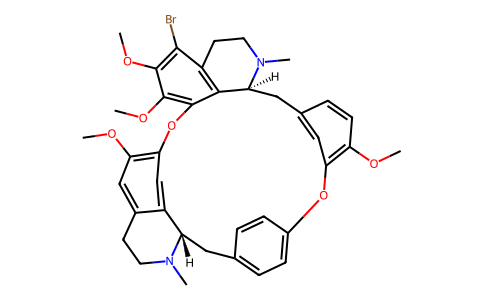
Physicochemical Properties
| Molecular Formula | C38H41BRN2O6 |
| Molecular Weight | 701.658 |
| Exact Mass | 700.215 |
| Elemental Analysis | C, 65.05; H, 5.89; Br, 11.39; N, 3.99; O, 13.68 |
| CAS # | 62067-29-2 |
| PubChem CID | 9831563 |
| Appearance | Typically exists as solid at room temperature |
| LogP | 7.8 |
| Hydrogen Bond Donor Count | 0 |
| Hydrogen Bond Acceptor Count | 8 |
| Rotatable Bond Count | 4 |
| Heavy Atom Count | 47 |
| Complexity | 1020 |
| Defined Atom Stereocenter Count | 2 |
| SMILES | CN1CCC2=CC(=C3C=C2[C@@H]1CC4=CC=C(C=C4)OC5=C(C=CC(=C5)C[C@H]6C7=C(CCN6C)C(=C(C(=C7O3)OC)OC)Br)OC)OC |
| InChi Key | ANJMFZGRGHQXMA-VMPREFPWSA-N |
| InChi Code | InChI=1S/C38H41BrN2O6/c1-40-15-13-24-20-31(43-4)33-21-27(24)28(40)17-22-7-10-25(11-8-22)46-32-19-23(9-12-30(32)42-3)18-29-34-26(14-16-41(29)2)35(39)37(44-5)38(45-6)36(34)47-33/h7-12,19-21,28-29H,13-18H2,1-6H3/t28-,29-/m0/s1 |
| Chemical Name | (1S,14S)-19-bromo-9,20,21,25-tetramethoxy-15,30-dimethyl-7,23-dioxa-15,30-diazaheptacyclo[22.6.2.23,6.18,12.114,18.027,31.022,33]hexatriaconta-3(36),4,6(35),8,10,12(34),18(33),19,21,24,26,31-dodecaene |
| Synonyms | W-198; BrTet; bromotetrandrine; 5-Bromotetrandrine; 62067-29-2; V3ORV27YJY; W-198; UNII-V3ORV27YJY; (11S,31S)-35-bromo-16,36,37,54-tetramethoxy-12,32-dimethyl-11,12,13,14,31,32,33,34-octahydro-2,6-dioxa-1(7,1),3(8,1)-diisoquinolina-5(1,3),7(1,4)-dibenzenacyclooctaphane; (1S,14S)-19-bromo-9,20,21,25-tetramethoxy-15,30-dimethyl-7,23-dioxa-15,30-diazaheptacyclo[22.6.2.23,6.18,12.114,18.027,31.022,33]hexatriaconta-3(36),4,6(35),8,10,12(34),18(33),19,21,24,26,31-dodecaene; Bromotetrandrine |
| HS Tariff Code | 2934.99.9001 |
| Storage |
Powder-20°C 3 years 4°C 2 years In solvent -80°C 6 months -20°C 1 month |
| Shipping Condition | Room temperature (This product is stable at ambient temperature for a few days during ordinary shipping and time spent in Customs) |
Biological Activity
| Targets | P-glycoprotein (P-gp) |
| ln Vitro | BrTet (bromotetrandrine (BrTet)) at 0.25, 0.5 and 1 micro M reversed Dox resistance in MDR human breast cancer MCF-7/Dox cells dose-dependently and its potency was greater than that of Tet at the same concentrations. BrTet reversed vincristine (VCR), Dox and paclitaxel resistance in MDR human oral epidermoid carcinoma KBv200 cells as well as innate VCR and Dox resistance in human hepatocellular carcinoma Bel(7402) cells. However, BrTet showed no effect on the IC(50) values of the above-mentioned anticancer drugs in sensitive MCF-7 and KB cells. No reversal effect of BrTet on the cytotoxicity of 5-fluorouracil and cisplatin, non-P-gp substrates, was observed [2]. |
| ln Vivo | In nude mice bearing KBv200 xenografts on the left flank and KB xenografts on the right flank, i.p. injection of 5 mg/kg and 10 mg/kg BrTet (bromotetrandrine (BrTet)) significantly enhanced the antitumor activity of Dox against KBv200 xenografts with inhibitory rates of 33.0% and 39.2%, while Dox alone inhibited the growth of KBv200 xenografts by only 11.6%. No enhancement by BrTet was seen in KB xenografts. Moreover, BrTet at 5 mg/kg reversed paclitaxel resistance in KBv200 xenografts. Fluorospectrophotometric assay showed that BrTet significantly increased the intracellular accumulation of Dox in MCF-7/Dox cells in a dose-dependent manner. BrTet also inhibited the overexpression of P-gp in MCF-7/Dox cells, but had no effect on mdr1 expression. Conclusions: BrTet showed significant MDR reversal activity in vitro and in vivo. Its activity may be related to the inhibition of P-gp overexpression and the increase in intracellular accumulation of anticancer drugs. BrTet may be a promising MDR modulator for eventual assessment in the clinic[1]. |
| Enzyme Assay |
Bromotetrandrine assay[1] Plasma and urine were collected and analysed for BrTet concentrations by using a validated liquid chromatography-tandem mass spectrometry (LC/MS/MS) method. Briefly, the internal standard (Aripiprazole, 156 ng/mL, 100 μL) was spiked to 0·5 mL of plasma or urine samples. Then 100 μL of 1 mol/L NaOH, and 3·5 mL of N-hexane including 2% isoamyl alcohol was added to the tube. The tube was vortexed for 6 min and then centrifuged at 3000 g for 7 min. The clear supernatants were evaporated under nitrogen in 40 °C water bath and reconstituted in 100 μL of mobile phase, and then 70 μL of the solution was injected into a Diamonsil C18 (150 × 4·6 mm, 5 μm), using a mobile phase of methanol–water–triethylamine (70 : 30 : 0·02, v/v/v) with a flow rate of 0·7 mL/min. The column temperature was 30 °C. An API3000 system (Applied Biosystems, Vernon Hills, IL, USA) equipped with an electrospray ionization source was used for the mass analysis and detection. Mass spectrometry detection occurred on a tandem mass spectrometer operating in multiple reaction monitoring mode, with the mass transitions 703 m/z→461 m/z (BrTet) and 448·3 m/z→285·3 m/z (aripiprazole) respectively. The retention times of BrTet and the internal standard were 4·3 and 4 min respectively. A weighted (1/C) linear regression algorithm was applied using the peak area ratios of the analyte to the internal standard. The lower limit of quantification for the plasma assay was 1 μg/mL and the linear calibration range was 1·0 to 128 μg/mL. The lower limit of quantification for the urine assay was 0·25 μg/mL and the linear calibration range was 0·25 to 256 μg/mL. The method recovery rate of BrTet in plasma and urine was 92–115%.The RSD of inter- and intra-day accuracy of the plasma quality control samples was less than 5·2% and 2·9% respectively. The RSD of inter- and intra-day accuracy of the urine quality control samples was less than 5·6% and 5·9% respectively. |
| Cell Assay | The present study aimed to evaluate the MDR reversal activity of bromotetrandrine (BrTet), a bromized derivative of tetrandrine (Tet), in vitro. Methods: Drug sensitivity was determined using the MTT assay. Doxorubicin (Dox) accumulation was analyzed by fluorospectrophotometry and the protein and mRNA levels of P-glycoprotein (P-gp) were determined by immunocytochemistry and RT-PCR, respectively [2]. |
| Animal Protocol |
The in vivo effect of Tet was investigated using nude mice grafted with sensitive and resistant KB human epidermoid cancer cells. Doxorubicin (Dox) accumulation was analyzed by fluorospectrophotometry and the protein and mRNA levels of P-glycoprotein (P-gp) were determined by immunocytochemistry and RT-PCR, respectively [2]. Pharmacokinetics analysis[1] The distribution and elimination phases of each single dose plasma concentration profile were fitted to a biexponential equation (concentration = Ae−αt+Be−βt), using the Gauss-Newton minimization method and a weighting of 1/predicted concentration. Onset of the α-phase was determined by inspection. Half-life (t1/2) for each were calculated as the quotient of ln (2) and α or β. AUC to the last point with a detectable plasma concentration (AUC0-last)was calculated using the linear trapezoidal method for ascending concentrations and the log trapezoidal method for descending concentrations. AUC0–∞ was estimated as the sum of AUC0-last and the extrapolated area given by the quotient of the last measured concentration and β. Cmax, Tmax, apparent clearance (Cl), and volume of distribution (Vd) were obtained by inspection of the plasma concentration data. Bromotetrandrine urine concentrations, urine volumes from individual collection intervals, and nominal times of collection intervals were used to calculate urinary pharmacokinetic parameters. The amount of BrTet excreted unchanged in urine in each collection interval was determined by the product of the urine concentration and the urine volume. The percent of the BrTet dose that was excreted unchanged in urine over the collection interval (ƒe, 0-t) was determined by the quotient of the sum of BrTet collected over all collection intervals and the dose administered, with the result multiplied by 100. t represents the nominal stop time of the final urine collection interval (96 h).The Drug and Statistics Software (das, version 2·0; Mathematical Pharmacology Professional Committee of China) was used. Safety assessment[1] In this study, clinical safety assessments included: physical examination, vital signs (blood pressure, pulse rate, oral temperature and respiratory rate), 12-lead ECG, cardiac monitoring (starting 30 min prior to study drug administration and for 4 h post dose) and recording of adverse events. Adverse experiences were monitored throughout the study. Clinical laboratory tests (blood count, blood chemistry, coagulation tests and urinalysis) were made at day 9 after dosing. Investigators evaluated all clinical adverse experiences in terms intensity (mild, moderate or severe), duration, severity, outcome and relationship to study drug. To investigate the safety and pharmacokinetics of bromotetrandrine (BrTet, W198), a novel inhibitor of P-glycoprotein (P-gp), after single-dose i.v. infusion in healthy Chinese volunteers. Methods: We conducted a randomized, dose-escalating, phase I clinical study for that purpose. Thirty healthy subjects received BrTet at the doses of 10, 20 or 30 mg/m(2) by i.v. infusion. Plasma and urine concentrations of bromotetrandrine were determined by using a liquid chromatography-tandem mass spectrometric (LC/MS/MS) method. AUC was calculated by the trapezoidal rule extrapolation method. C(max), T(max), t(1/2alpha), t(1/2beta), Cl and V(d) were compiled from the plasma concentration-time data.[1] |
| ADME/Pharmacokinetics |
Mean plasma concentration–time profiles after single-dose i.v. infusion of BrTet are shown in Fig. 2. The mean values for the pharmacokinetic parameters are presented in Table 1.BrTet appears to be rapidly absorbed, with median values of time to peak plasma concentration (Tmax) in the fasted 1·5 h in average. BrTet concentration decline from the mean peak plasma concentration (Cmax) in a biphasic manner, with t1/2α approximately 0·3 h and t1/2β 52–62 h. In creases in area under the curve (AUC) and peak plasma concentration (Cmax) were performed approximately dose-proportional over the dose range of 10 mg/m2 to 30 mg/m2. Cl values following the single intravenous dose were 23·68, 25·69, and 25·66 L h/m2 for the 10, 20, and 30 mg/m2 dose levels respectively. No significant (P > 0·05) differences were observed in Cl among the three groups. The mean Vd values after single-dose 10–30 mg/m2 i.v. infusion of BrTet were about 150 L/m2 despite different dose levels. Approximately 0·6% of the intravenous BrTet dose was excreted unchanged in urine. There were no significant (P > 0·05) differences in the pharmacokinetic parameters between female and male subjects on each groups (Table 2).
[1] Bromotetrandrine was generally well tolerated at all doses. No serious or severe adverse events were found in the study. The pharmacokinetic parameters of BrTet after single i.v. infusion doses of BrTet 10, 20 and 30 mg/m(2) were as follows: T(max) were 1.5 h in three groups, C(max) were 24.79, 39.59 and 64.31 microg/L, t(1/2alpha) were 0.37, 0.29 and 0.30 h, t(1/2beta) were 62.88, 56.45 and 52.20 h. AUC(0-194h) were 345.83, 688.15 and 1096.28 microg h/L, Cl were 23.68, 25.69 and 25.66 L h/m(2), V(d) were 157.73,156.96 and 140.73 L/m(2). In urine, the total eliminate rate of originate compound was 0.61 +/- 0.19%. Conclusions: This study suggested that bromotetrandrine was well tolerated in healthy volunteers within the dose range evaluated. The pharmacokinetics parameters of bromotetrandrine indicated that the compound was rapidly distributed and accumulated in the tissues, and slowly cleared from plasma, which supported the use of BrTet for a once or twice dosing per chemotherapy cycle.[1] |
| Toxicity/Toxicokinetics | BrTet was generally well tolerated. No serious clinical or laboratory adverse experiences were reported and no subject discontinued because of an adverse experience. In this study, two cases of mild intensity phlebitis were found in the 30 mg/m2 group, lasting 5–10 min after administration, and resolving without treatment. No clinically significant abnormalities in other volunteers were observed in physical examination, vital signs and laboratory parameter throughout the study.[1] |
| References |
[1]. Pharmacokinetics and safety of bromotetrandrine (BrTet, W198) after single-dose intravenous administration in healthy Chinese volunteers. J Clin Pharm Ther. 2010 Feb;35(1):113-9. [2]. Reversal of multidrug resistance of cancer through inhibition of P-glycoprotein by 5-bromotetrandrine. Cancer Chemother Pharmacol. 2005 Feb;55(2):179-88. |
| Additional Infomation |
In the initial single-dose escalation study, plasma concentration course of BrTet could be best described by an open two-compartment model, with a short t1/2α of approximately 0·3 h for the distribution phase and a long t1/2β of approximately 52–62 h for the elimination phase. Over the dose range studied, Cmax levels and AUC values of BrTet increased in an approximately linear dose-dependent manner. The assessed pharmacokinetic parameters showed relatively low inter individual variation. The t1/2β of BrTet of about 60 h supported of administration of one or two doses co-administration with anticancer drugs (e.g., Dox) in one chemotherapy cycle.
Approximately 0·61% of the BrTet dose was excreted unchanged in urine, and the apparent clearance was 23–25 L h/m2. The amount of BrTet excreted unchanged in urine is similar to that found in an animal study with 0·15% of the total dose excreted in the urine as the parent compound. Based on the low percent of dose excreted unchanged in urine, renal clearance probably plays a fairly minor role in the overall elimination of BrTet. BrTet pharmacokinetics was evaluated in female and male subjects. There was no gender difference in the overall exposure to BrTet. Hence, no adjustment of dosage on the basis of sex appears needed. After single-dose intravenous administration in human volunteers as well as in animals (rats or beagle dogs), BrTet was characterized by very similar pharmacokinetic parameters, (e.g. short t1/2α, long t1/2β and low plasma concentration), rapid and with wide distribution tissue with very large Vd (in human: 150 L/m2, in rats: 4–7 L/kg). These observations indicate that BrTet distributes to and accumulates in visceral tissue or organs. Xiao et al. reported that after a single i.v. dose of BrTet in rats, the parent drug concentration in tissues (e.g. lung, liver, kidney, fat, etc.) were higher than those in blood at the corresponding times. Within the time period 25 to 2 h after dosing, the peak concentrations of BrTet in lung, liver, kidney and fat were approximately 170, 28, 40, and 5-fold higher than the correspond serum concentrations. In vitro investigations indicated that BrTet at non-cytotoxic dosea of 0·25, 0·5 and 1 μmol/L (equal to 175·5, 351 and 702 μg/L respectively) can effectively reverse MDR of tumour cells, such as MCF-7/Dox cells, KBv200 cells and Bel7402 cells. In the present study, after single-dose of 30 mg/m2 by i.v. infusion, the mean peak plasma concentration of BrTet was 64·3 μg/L. For obvious reasons, we have no direct measurements of BrTet concentration in human visceral organs after i.v. administration. Based on the relationship between visceral tissue concentration and serum concentration of BrTet in rats, and the pharmacokinetics parameters performed in this study, we estimate that in humans after i.v. administration of BrTet, the drug concentration in lung, liver and kidney etc. would be higher than that in serum concentration by as much as 5–10-fold. This is likely to be sufficient to reverse MDR tumour cells. Based on the present data with the highest dose set at 30 mg/m2,, and other safety data indicating a dose-limiting toxicity (DLT) of BrTet were 60 mg/m2 (Li L, Hou M, unpublished data), higher plasma and tissue concentration may be achieved, than were observed. Despite the calcium blocking activity of BrTet, no adverse effects were seen in cardiovascular parameters, sensitive to alterations in extracellular calcium levels, were seen in any subject. In conclusion, BrTet was well tolerated in healthy Chinese subjects. The compound accumulates in visceral tissues and is slowly cleared from plasma. The data support the administration of BrTet once or twice per anticancer chemotherapy cycle.[1] In conclusion, BrTet is a potent inhibitor of P-gp-mediated MDR in vitro and in vivo, and its active mechanism to reverse MDR is associated with an increase in the intracellular drug accumulation through inhibiting the overexpression of P-gp. Our study provides pharmacodynamic evidence to support the clinical evaluation of BrTet in combination with antitumor drugs especially with Dox in patients whose tumors are identified as P-gp-positive.[2] |
Solubility Data
| Solubility (In Vitro) | May dissolve in DMSO (in most cases), if not, try other solvents such as H2O, Ethanol, or DMF with a minute amount of products to avoid loss of samples |
| Solubility (In Vivo) |
Note: Listed below are some common formulations that may be used to formulate products with low water solubility (e.g. < 1 mg/mL), you may test these formulations using a minute amount of products to avoid loss of samples. Injection Formulations (e.g. IP/IV/IM/SC) Injection Formulation 1: DMSO : Tween 80: Saline = 10 : 5 : 85 (i.e. 100 μL DMSO stock solution → 50 μL Tween 80 → 850 μL Saline) *Preparation of saline: Dissolve 0.9 g of sodium chloride in 100 mL ddH ₂ O to obtain a clear solution. Injection Formulation 2: DMSO : PEG300 :Tween 80 : Saline = 10 : 40 : 5 : 45 (i.e. 100 μL DMSO → 400 μLPEG300 → 50 μL Tween 80 → 450 μL Saline) Injection Formulation 3: DMSO : Corn oil = 10 : 90 (i.e. 100 μL DMSO → 900 μL Corn oil) Example: Take the Injection Formulation 3 (DMSO : Corn oil = 10 : 90) as an example, if 1 mL of 2.5 mg/mL working solution is to be prepared, you can take 100 μL 25 mg/mL DMSO stock solution and add to 900 μL corn oil, mix well to obtain a clear or suspension solution (2.5 mg/mL, ready for use in animals). Injection Formulation 4: DMSO : 20% SBE-β-CD in saline = 10 : 90 [i.e. 100 μL DMSO → 900 μL (20% SBE-β-CD in saline)] *Preparation of 20% SBE-β-CD in Saline (4°C,1 week): Dissolve 2 g SBE-β-CD in 10 mL saline to obtain a clear solution. Injection Formulation 5: 2-Hydroxypropyl-β-cyclodextrin : Saline = 50 : 50 (i.e. 500 μL 2-Hydroxypropyl-β-cyclodextrin → 500 μL Saline) Injection Formulation 6: DMSO : PEG300 : castor oil : Saline = 5 : 10 : 20 : 65 (i.e. 50 μL DMSO → 100 μLPEG300 → 200 μL castor oil → 650 μL Saline) Injection Formulation 7: Ethanol : Cremophor : Saline = 10: 10 : 80 (i.e. 100 μL Ethanol → 100 μL Cremophor → 800 μL Saline) Injection Formulation 8: Dissolve in Cremophor/Ethanol (50 : 50), then diluted by Saline Injection Formulation 9: EtOH : Corn oil = 10 : 90 (i.e. 100 μL EtOH → 900 μL Corn oil) Injection Formulation 10: EtOH : PEG300:Tween 80 : Saline = 10 : 40 : 5 : 45 (i.e. 100 μL EtOH → 400 μLPEG300 → 50 μL Tween 80 → 450 μL Saline) Oral Formulations Oral Formulation 1: Suspend in 0.5% CMC Na (carboxymethylcellulose sodium) Oral Formulation 2: Suspend in 0.5% Carboxymethyl cellulose Example: Take the Oral Formulation 1 (Suspend in 0.5% CMC Na) as an example, if 100 mL of 2.5 mg/mL working solution is to be prepared, you can first prepare 0.5% CMC Na solution by measuring 0.5 g CMC Na and dissolve it in 100 mL ddH2O to obtain a clear solution; then add 250 mg of the product to 100 mL 0.5% CMC Na solution, to make the suspension solution (2.5 mg/mL, ready for use in animals). Oral Formulation 3: Dissolved in PEG400 Oral Formulation 4: Suspend in 0.2% Carboxymethyl cellulose Oral Formulation 5: Dissolve in 0.25% Tween 80 and 0.5% Carboxymethyl cellulose Oral Formulation 6: Mixing with food powders Note: Please be aware that the above formulations are for reference only. InvivoChem strongly recommends customers to read literature methods/protocols carefully before determining which formulation you should use for in vivo studies, as different compounds have different solubility properties and have to be formulated differently. (Please use freshly prepared in vivo formulations for optimal results.) |
| Preparing Stock Solutions | 1 mg | 5 mg | 10 mg | |
| 1 mM | 1.4252 mL | 7.1260 mL | 14.2519 mL | |
| 5 mM | 0.2850 mL | 1.4252 mL | 2.8504 mL | |
| 10 mM | 0.1425 mL | 0.7126 mL | 1.4252 mL |