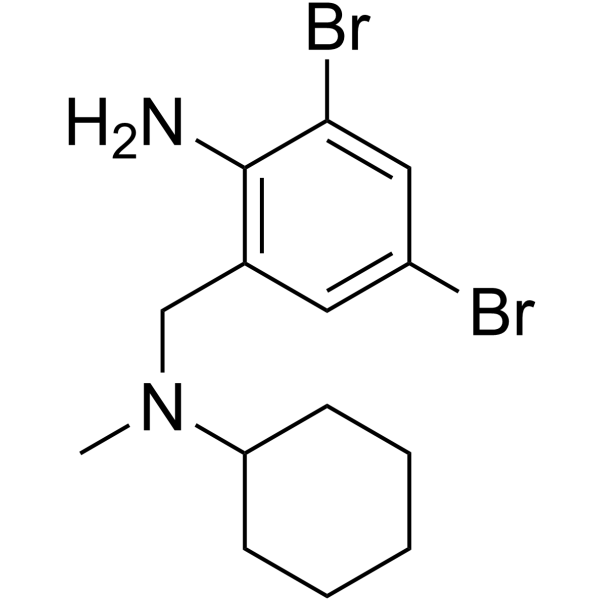
Physicochemical Properties
| Molecular Formula | C14H20N2BR2 |
| Molecular Weight | 376.13 |
| Exact Mass | 373.999 |
| CAS # | 3572-43-8 |
| Related CAS # | 611-75-6 (mono-hydrochloride) |
| PubChem CID | 2442 |
| Appearance | Typically exists as solid at room temperature |
| Density | 1.57 g/cm3 |
| Boiling Point | 413.8ºC at 760 mmHg |
| Melting Point | 238℃ |
| Flash Point | 204.1ºC |
| Index of Refraction | 1.626 |
| LogP | 5.139 |
| Hydrogen Bond Donor Count | 1 |
| Hydrogen Bond Acceptor Count | 2 |
| Rotatable Bond Count | 3 |
| Heavy Atom Count | 18 |
| Complexity | 256 |
| Defined Atom Stereocenter Count | 0 |
| SMILES | NC1=C(CN(C2CCCCC2)C)C=C(Br)C=C1Br |
| InChi Key | OJGDCBLYJGHCIH-UHFFFAOYSA-N |
| InChi Code | InChI=1S/C14H20Br2N2/c1-18(12-5-3-2-4-6-12)9-10-7-11(15)8-13(16)14(10)17/h7-8,12H,2-6,9,17H2,1H3 |
| Chemical Name | 2,4-dibromo-6-[[cyclohexyl(methyl)amino]methyl]aniline |
| HS Tariff Code | 2934.99.9001 |
| Storage |
Powder-20°C 3 years 4°C 2 years In solvent -80°C 6 months -20°C 1 month |
| Shipping Condition | Room temperature (This product is stable at ambient temperature for a few days during ordinary shipping and time spent in Customs) |
Biological Activity
| ADME/Pharmacokinetics |
Absorption, Distribution and Excretion After oral administration, bromhexine demonstrates linear pharmacokinetics when given in doses of 8-32 mg. Bromhexine is readily absorbed in the gastrointestinal tract at a rapid rate. This drug undergoes extensive first-pass effect in the range of 75-80%. The bioavailability is therefore reduced to approximately 22-27%. After a dose of bromhexine was administered during a pharmacokinetic study, approximately 97% of the radiolabeled dose was detected in the urine; under 1% was detected as the parent drug. After intravenous administration in a pharmacokinetic study, bromhexine was found to be widely distributed. Bromhexine is known to cross the blood-brain barrier; small concentrations may cross the placenta. The average volume of distribution of bromhexine was 1209 ± 206 L (19 L/kg). Lung tissue concentrations of bromhexine two hours after a dose were 1.5 to 3.2 times higher in bronchial tissues than plasma concentrations. Pulmonary parynchema concentrations were 3.4 to 5.9 times higher when compared to plasma concentrations. The clearance of bromhexine ranges from 843-1073 mL/min, within the range of the hepatic circulation. Metabolism / Metabolites Bromhexine is almost completely metabolized to a variety of hydroxylated metabolites in addition to dibromanthranilic acid. Ambroxol is a known metabolite of bromhexine. In one study of human plasma, (E)-4-hydroxydemethylbromhexine (E-4-HDMB) and (E)-3-hydroxydemethylbromhexine (E-3-HDMB) were quantified as major metabolites of ambroxol, and (Z)-4-hydroxydemethylbromhexine and (Z)-3-hydroxydemethylbromhexine were quantified as minor metabolites. Biological Half-Life Following single oral doses ranging from 8 and 32 mg, the terminal half-life of bromhexine has been measured between 6.6 and 31.4 hours. |
| Toxicity/Toxicokinetics |
Protein Binding Bromhexine is approximately 95% bound to plasma proteins. |
| References | [1]. Zanasi A, et al. A reappraisal of the mucoactive activity and clinical efficacy of bromhexine. Multidiscip Respir Med. 2017 Mar 20;12:7. |
| Additional Infomation |
Bromhexine is a substituted aniline that is 2,4-dibromoaniline which is substituted at position 6 by a [cyclohexyl(methyl)amino]methyl group. It is used (as the monohydrochloride salt) as a mucolytic for the treatment of respiratory disorders associated with productive cough (i.e. a cough characterised by the production of sputum). It has a role as a mucolytic. It is a substituted aniline, a tertiary amino compound and an organobromine compound. It is a conjugate base of a bromhexine(1+). Bromhexine is mucolytic agent used for a variety of respiratory conditions associated with increased mucus secretion. It is derived from the Adhatoda vasica plant and aids in the clearance of excess mucus, improving breathing and reducing cough. It was introduced into the market in 1963, and is widely available as an over-the-counter drug in many countries. Recently, bromhexine and its metabolite [ambroxol] have garnered interest for the potential prevention and treatment of COVID-19 due to their interactions with cell receptors in the lungs. Bromhexine has been reported in Justicia adhatoda with data available. Bromhexine is a secretolytic, with mucolytic activity. Upon administration, bromhexine increases lysosomal activity and enhances hydrolysis of acid mucopolysaccharide polymers in the respiratory tract. This increases the production of serous mucus in the respiratory tract, which makes the phlegm thinner and decreases mucus viscosity. This contributes to its secretomotoric effect, and allows the cilia to more easily transport the phlegm out of the lungs. This clears mucus from the respiratory tract and may aid in the treatment of respiratory disorders associated with abnormal viscid mucus, excessive mucus secretion and impaired mucus transport. A mucolytic agent used in the treatment of respiratory disorders associated with viscid or excessive mucus. (From Martindale, The Extra Pharmacopoeia, 30th ed, p744) See also: Bromhexine Hydrochloride (active moiety of). Drug Indication Bromohexine is used alone or with other ingredients such as [diphenhydramine], [dextromethorphan], and [guaifenesin] to reduce mucus viscosity and clear mucus in conditions associated with mucus hypersecretion, including the common cold, influenza, respiratory tract infections, or other conditions. Mechanism of Action Inflammation of the airways, increased mucus secretion, and altered mucociliary clearance are the hallmarks of various diseases of the respiratory tract. Mucus clearance is necessary for lung health; bromhexine aids in mucus clearance by reducing the viscosity of mucus and activating the ciliary epithelium, allowing secretions to be expelled from the respiratory tract. Recent have studies have demonstrated that bromhexine inhibits the transmembrane serine protease 2 receptor (TMPRSS2) in humans. Activation of TMPRSS2 plays an important role in viral respiratory diseases such as influenza A and Middle East Respiratory Syndrome (MERS). Inhibition of receptor activation and viral entry by bromhexine may be effective in preventing or treating various respiratory illnesses, including COVID-19. In vitro studies have suggested the action of ambroxol (a metabolite of bromhexine) on the angiogensin-converting enzyme receptor 2 (ACE2), prevents entry of the viral envelope-anchored spike glycoprotein of SARS-Cov-2 into alveolar cells or increases the secretion of surfactant, preventing viral entry. |
Solubility Data
| Solubility (In Vitro) | May dissolve in DMSO (in most cases), if not, try other solvents such as H2O, Ethanol, or DMF with a minute amount of products to avoid loss of samples |
| Solubility (In Vivo) |
Note: Listed below are some common formulations that may be used to formulate products with low water solubility (e.g. < 1 mg/mL), you may test these formulations using a minute amount of products to avoid loss of samples. Injection Formulations (e.g. IP/IV/IM/SC) Injection Formulation 1: DMSO : Tween 80: Saline = 10 : 5 : 85 (i.e. 100 μL DMSO stock solution → 50 μL Tween 80 → 850 μL Saline) *Preparation of saline: Dissolve 0.9 g of sodium chloride in 100 mL ddH ₂ O to obtain a clear solution. Injection Formulation 2: DMSO : PEG300 :Tween 80 : Saline = 10 : 40 : 5 : 45 (i.e. 100 μL DMSO → 400 μLPEG300 → 50 μL Tween 80 → 450 μL Saline) Injection Formulation 3: DMSO : Corn oil = 10 : 90 (i.e. 100 μL DMSO → 900 μL Corn oil) Example: Take the Injection Formulation 3 (DMSO : Corn oil = 10 : 90) as an example, if 1 mL of 2.5 mg/mL working solution is to be prepared, you can take 100 μL 25 mg/mL DMSO stock solution and add to 900 μL corn oil, mix well to obtain a clear or suspension solution (2.5 mg/mL, ready for use in animals). Injection Formulation 4: DMSO : 20% SBE-β-CD in saline = 10 : 90 [i.e. 100 μL DMSO → 900 μL (20% SBE-β-CD in saline)] *Preparation of 20% SBE-β-CD in Saline (4°C,1 week): Dissolve 2 g SBE-β-CD in 10 mL saline to obtain a clear solution. Injection Formulation 5: 2-Hydroxypropyl-β-cyclodextrin : Saline = 50 : 50 (i.e. 500 μL 2-Hydroxypropyl-β-cyclodextrin → 500 μL Saline) Injection Formulation 6: DMSO : PEG300 : castor oil : Saline = 5 : 10 : 20 : 65 (i.e. 50 μL DMSO → 100 μLPEG300 → 200 μL castor oil → 650 μL Saline) Injection Formulation 7: Ethanol : Cremophor : Saline = 10: 10 : 80 (i.e. 100 μL Ethanol → 100 μL Cremophor → 800 μL Saline) Injection Formulation 8: Dissolve in Cremophor/Ethanol (50 : 50), then diluted by Saline Injection Formulation 9: EtOH : Corn oil = 10 : 90 (i.e. 100 μL EtOH → 900 μL Corn oil) Injection Formulation 10: EtOH : PEG300:Tween 80 : Saline = 10 : 40 : 5 : 45 (i.e. 100 μL EtOH → 400 μLPEG300 → 50 μL Tween 80 → 450 μL Saline) Oral Formulations Oral Formulation 1: Suspend in 0.5% CMC Na (carboxymethylcellulose sodium) Oral Formulation 2: Suspend in 0.5% Carboxymethyl cellulose Example: Take the Oral Formulation 1 (Suspend in 0.5% CMC Na) as an example, if 100 mL of 2.5 mg/mL working solution is to be prepared, you can first prepare 0.5% CMC Na solution by measuring 0.5 g CMC Na and dissolve it in 100 mL ddH2O to obtain a clear solution; then add 250 mg of the product to 100 mL 0.5% CMC Na solution, to make the suspension solution (2.5 mg/mL, ready for use in animals). Oral Formulation 3: Dissolved in PEG400 Oral Formulation 4: Suspend in 0.2% Carboxymethyl cellulose Oral Formulation 5: Dissolve in 0.25% Tween 80 and 0.5% Carboxymethyl cellulose Oral Formulation 6: Mixing with food powders Note: Please be aware that the above formulations are for reference only. InvivoChem strongly recommends customers to read literature methods/protocols carefully before determining which formulation you should use for in vivo studies, as different compounds have different solubility properties and have to be formulated differently. (Please use freshly prepared in vivo formulations for optimal results.) |
| Preparing Stock Solutions | 1 mg | 5 mg | 10 mg | |
| 1 mM | 2.6587 mL | 13.2933 mL | 26.5866 mL | |
| 5 mM | 0.5317 mL | 2.6587 mL | 5.3173 mL | |
| 10 mM | 0.2659 mL | 1.3293 mL | 2.6587 mL |