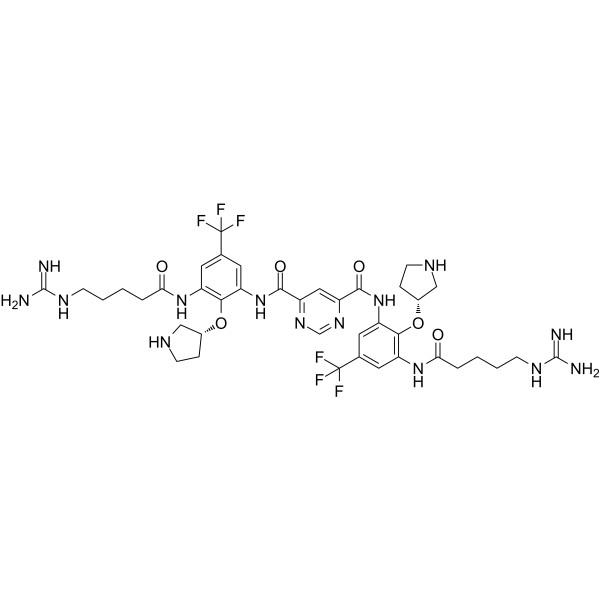
Physicochemical Properties
| Molecular Formula | C40H50F6N14O6 |
| Molecular Weight | 936.91 |
| Exact Mass | 936.394 |
| CAS # | 1224095-98-0 |
| Related CAS # | Brilacidin tetrahydrochloride;1224095-99-1 |
| PubChem CID | 25023695 |
| Appearance | Light yellow to yellow solid powder |
| LogP | 8.479 |
| Hydrogen Bond Donor Count | 10 |
| Hydrogen Bond Acceptor Count | 18 |
| Rotatable Bond Count | 20 |
| Heavy Atom Count | 66 |
| Complexity | 1560 |
| Defined Atom Stereocenter Count | 2 |
| SMILES | C1CNC[C@@H]1OC2=C(C=C(C=C2NC(=O)C3=CC(=NC=N3)C(=O)NC4=CC(=CC(=C4O[C@@H]5CCNC5)NC(=O)CCCCN=C(N)N)C(F)(F)F)C(F)(F)F)NC(=O)CCCCN=C(N)N |
| InChi Key | QPDYBCZNGUJZDK-DNQXCXABSA-N |
| InChi Code | InChI=1S/C40H50F6N14O6/c41-39(42,43)21-13-25(57-31(61)5-1-3-9-53-37(47)48)33(65-23-7-11-51-18-23)27(15-21)59-35(63)29-17-30(56-20-55-29)36(64)60-28-16-22(40(44,45)46)14-26(34(28)66-24-8-12-52-19-24)58-32(62)6-2-4-10-54-38(49)50/h13-17,20,23-24,51-52H,1-12,18-19H2,(H,57,61)(H,58,62)(H,59,63)(H,60,64)(H4,47,48,53)(H4,49,50,54)/t23-,24-/m1/s1 |
| Chemical Name | 4-N,6-N-bis[3-[5-(diaminomethylideneamino)pentanoylamino]-2-[(3R)-pyrrolidin-3-yl]oxy-5-(trifluoromethyl)phenyl]pyrimidine-4,6-dicarboxamide |
| HS Tariff Code | 2934.99.9001 |
| Storage |
Powder-20°C 3 years 4°C 2 years In solvent -80°C 6 months -20°C 1 month |
| Shipping Condition | Room temperature (This product is stable at ambient temperature for a few days during ordinary shipping and time spent in Customs) |
Biological Activity
| ln Vitro | Among the bacterial groupings, Staphylococcus aureus (SA) and Staphylococcus epidermidis (SE) exhibited the lowest minimum inhibitory concentrations. Brilacidin exhibits efficacious activity against Moraxella spp., Streptococcus pneumoniae (SP), and Streptococcus viridans (SV). The MIC90 values for MS, HI, PA, SM, and Haemophilus influenzae were 4, 32, 256, 32, 16, and 128 times greater than those for SE and SA, respectively. In vitro, Brilacidin demonstrates Gram-positive activity. Topical application of Brilacidin 0.5% causes minimal irritation. In a methicillin-resistant Staphylococcus aureus (MRSA) keratitis model, Brilacidin 0.5% is equally effective as vancomycin (VAN) following corneal epithelial ablation. Brilacidin mainly depolarizes bacterial cell membranes in order to effect them. Compared to Gram-negative bacteria, Brilacidin is more efficient against Gram-positive bacteria (except from SV) [2]. |
| ln Vivo | Brilacidin showed dose-dependent ocular damage after 7 local instillations (every 30 minutes for 3 hours) in the NZW rabbit ocular toxicity paradigm. Brilacidin 1% was determined to be mildly irritating (23.0), Brilacidin 0.5% (6.5) and Brilacidin 0.25% (4.0) were considered to be mildly irritating, while Brilacidin 0.1% (2.0) and TBS (1.0) were determined to be slightly irritating. Irritating. Practically non-irritating and 0.01% Brilacidin (0.5) was determined to be non-irritating based on the Maximum Mean Total Score (MMTS) value [2]. |
| References |
[1]. Comparative Mechanistic Studies of Brilacidin, Daptomycin, and the Antimicrobial Peptide LL16. Antimicrob Agents Chemother. 2014 Sep;58(9):5136-45. [2]. An Independent Evaluation of a Novel Peptide Mimetic, Brilacidin (PMX30063), for Ocular Anti-infective. J Ocul Pharmacol Ther. Jan-Feb 2016;32(1):23-7. |
| Additional Infomation |
Brilacidin is under investigation for the supportive care of Mucositis, Stomatitis, Mouth Diseases, and Head and Neck Neoplasms. Brilacidin is a synthetic, nonpeptidic, small molecule mimetic of defensin, a type of host defense proteins/peptides (HDPs) or antimicrobial peptides (AMPs), with potential antibacterial and antiviral activities. Upon administration, brilacidin selectively destabilizes bacterial and viral membrane integrity, which leads to their proteolysis and degradation. HDPs are part of the innate immune response and act as the first line of defense against foreign pathogens. Severe acute respiratory syndrome coronavirus-2 (SARS-CoV-2) infection has been shown to suppress defensins. |
Solubility Data
| Solubility (In Vitro) | May dissolve in DMSO (in most cases), if not, try other solvents such as H2O, Ethanol, or DMF with a minute amount of products to avoid loss of samples |
| Solubility (In Vivo) |
Note: Listed below are some common formulations that may be used to formulate products with low water solubility (e.g. < 1 mg/mL), you may test these formulations using a minute amount of products to avoid loss of samples. Injection Formulations (e.g. IP/IV/IM/SC) Injection Formulation 1: DMSO : Tween 80: Saline = 10 : 5 : 85 (i.e. 100 μL DMSO stock solution → 50 μL Tween 80 → 850 μL Saline) *Preparation of saline: Dissolve 0.9 g of sodium chloride in 100 mL ddH ₂ O to obtain a clear solution. Injection Formulation 2: DMSO : PEG300 :Tween 80 : Saline = 10 : 40 : 5 : 45 (i.e. 100 μL DMSO → 400 μLPEG300 → 50 μL Tween 80 → 450 μL Saline) Injection Formulation 3: DMSO : Corn oil = 10 : 90 (i.e. 100 μL DMSO → 900 μL Corn oil) Example: Take the Injection Formulation 3 (DMSO : Corn oil = 10 : 90) as an example, if 1 mL of 2.5 mg/mL working solution is to be prepared, you can take 100 μL 25 mg/mL DMSO stock solution and add to 900 μL corn oil, mix well to obtain a clear or suspension solution (2.5 mg/mL, ready for use in animals). Injection Formulation 4: DMSO : 20% SBE-β-CD in saline = 10 : 90 [i.e. 100 μL DMSO → 900 μL (20% SBE-β-CD in saline)] *Preparation of 20% SBE-β-CD in Saline (4°C,1 week): Dissolve 2 g SBE-β-CD in 10 mL saline to obtain a clear solution. Injection Formulation 5: 2-Hydroxypropyl-β-cyclodextrin : Saline = 50 : 50 (i.e. 500 μL 2-Hydroxypropyl-β-cyclodextrin → 500 μL Saline) Injection Formulation 6: DMSO : PEG300 : castor oil : Saline = 5 : 10 : 20 : 65 (i.e. 50 μL DMSO → 100 μLPEG300 → 200 μL castor oil → 650 μL Saline) Injection Formulation 7: Ethanol : Cremophor : Saline = 10: 10 : 80 (i.e. 100 μL Ethanol → 100 μL Cremophor → 800 μL Saline) Injection Formulation 8: Dissolve in Cremophor/Ethanol (50 : 50), then diluted by Saline Injection Formulation 9: EtOH : Corn oil = 10 : 90 (i.e. 100 μL EtOH → 900 μL Corn oil) Injection Formulation 10: EtOH : PEG300:Tween 80 : Saline = 10 : 40 : 5 : 45 (i.e. 100 μL EtOH → 400 μLPEG300 → 50 μL Tween 80 → 450 μL Saline) Oral Formulations Oral Formulation 1: Suspend in 0.5% CMC Na (carboxymethylcellulose sodium) Oral Formulation 2: Suspend in 0.5% Carboxymethyl cellulose Example: Take the Oral Formulation 1 (Suspend in 0.5% CMC Na) as an example, if 100 mL of 2.5 mg/mL working solution is to be prepared, you can first prepare 0.5% CMC Na solution by measuring 0.5 g CMC Na and dissolve it in 100 mL ddH2O to obtain a clear solution; then add 250 mg of the product to 100 mL 0.5% CMC Na solution, to make the suspension solution (2.5 mg/mL, ready for use in animals). Oral Formulation 3: Dissolved in PEG400 Oral Formulation 4: Suspend in 0.2% Carboxymethyl cellulose Oral Formulation 5: Dissolve in 0.25% Tween 80 and 0.5% Carboxymethyl cellulose Oral Formulation 6: Mixing with food powders Note: Please be aware that the above formulations are for reference only. InvivoChem strongly recommends customers to read literature methods/protocols carefully before determining which formulation you should use for in vivo studies, as different compounds have different solubility properties and have to be formulated differently. (Please use freshly prepared in vivo formulations for optimal results.) |
| Preparing Stock Solutions | 1 mg | 5 mg | 10 mg | |
| 1 mM | 1.0673 mL | 5.3367 mL | 10.6734 mL | |
| 5 mM | 0.2135 mL | 1.0673 mL | 2.1347 mL | |
| 10 mM | 0.1067 mL | 0.5337 mL | 1.0673 mL |