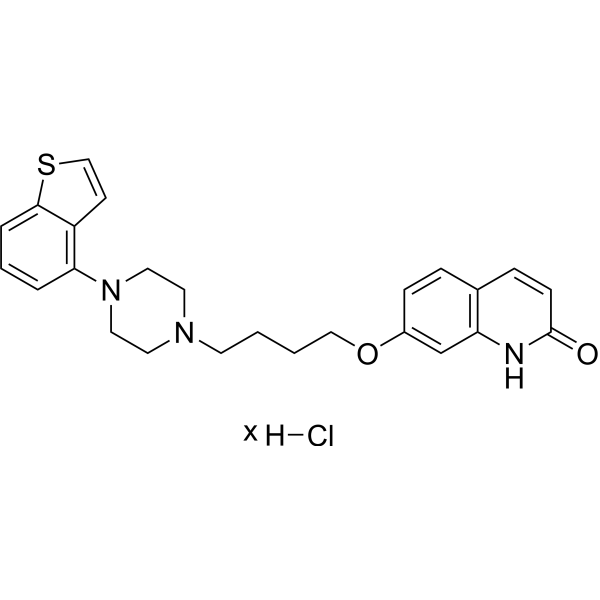
Physicochemical Properties
| Molecular Formula | C25H28CLN3O2S |
| Molecular Weight | 470.026723861694 |
| Exact Mass | 469.159 |
| CAS # | 913612-38-1 |
| Related CAS # | Brexpiprazole;913611-97-9 |
| PubChem CID | 66884211 |
| Appearance | Typically exists as solid at room temperature |
| Hydrogen Bond Donor Count | 2 |
| Hydrogen Bond Acceptor Count | 5 |
| Rotatable Bond Count | 7 |
| Heavy Atom Count | 32 |
| Complexity | 636 |
| Defined Atom Stereocenter Count | 0 |
| InChi Key | RQCIZERYSLEVFB-UHFFFAOYSA-N |
| InChi Code | InChI=1S/C25H27N3O2S.ClH/c29-25-9-7-19-6-8-20(18-22(19)26-25)30-16-2-1-11-27-12-14-28(15-13-27)23-4-3-5-24-21(23)10-17-31-24;/h3-10,17-18H,1-2,11-16H2,(H,26,29);1H |
| Chemical Name | 7-[4-[4-(1-benzothiophen-4-yl)piperazin-1-yl]butoxy]-1H-quinolin-2-one;hydrochloride |
| Synonyms | Brexpiprazole dihydrochloride; Brexpiprazole hydrochloride; 913612-38-1; 7-(4-(4-(Benzo[b]thiophen-4-yl)piperazin-1-yl)butoxy)quinolin-2(1H)-one hydrochloride; 1420987-74-1; SCHEMBL1034589; RQCIZERYSLEVFB-UHFFFAOYSA-N; |
| HS Tariff Code | 2934.99.9001 |
| Storage |
Powder-20°C 3 years 4°C 2 years In solvent -80°C 6 months -20°C 1 month |
| Shipping Condition | Room temperature (This product is stable at ambient temperature for a few days during ordinary shipping and time spent in Customs) |
Biological Activity
| Targets | 5-HT1A Receptor (Ki = 0.12 nM); 5-HT2A Receptor (Ki = 0.47 nM); D2L Receptor (Ki = 0.3 nM); human noradrenergic α1B (Ki = 0.17 nM); human noradrenergic α2C (Ki = 0.59 nM) |
| ln Vitro |
In PC12 cells, breexpipromaze (0-1.0 μM, 4 days) dose-dependently promotes NGF-induced neurite outgrowth [1]. Brexpiprazole, a novel atypical antipsychotic drug, is currently being tested in clinical trials for treatment of psychiatric disorders, such as schizophrenia and major depressive disorder. The drug is known to act through a combination of partial agonistic activity at 5-hydroxytryptamine (5-HT)1A, and dopamine D2 receptors, and antagonistic activity at 5-HT2A receptors. Accumulating evidence suggests that antipsychotic drugs act by promoting neurite outgrowth. In this study, we examined whether brexpiprazole affected neurite outgrowth in cell culture. We found that brexpiprazole significantly potentiated nerve growth factor (NGF)-induced neurite outgrowth in PC12 cells, in a concentration dependent manner. The selective 5-HT1A receptor antagonist, WAY-100,635, was able to block the effects of brexpiprazole on neurite outgrowth, unlike the selective dopamine D2 receptor antagonist, raclopride. Furthermore, the selective 5-HT2A receptor antagonist M100907, but not DOI (5-HT2A receptor agonist), significantly potentiated NGF-induced neurite outgrowth. Moreover, xestospongin C and 2-aminoethoxydiphenyl borate (2-APB), both specific inhibitors of inositol 1,4,5-triphosphate (IP3) receptors, significantly blocked the effects of brexpiprazole. These findings suggest that brexpiprazole-induced neurite outgrowth is mediated through 5-HT1A and 5-HT2A receptors, and subsequent Ca(2+) signaling via IP3 receptors[1]. |
| ln Vivo |
Brexpiprazole (0-0.1 mg/kg; oral; once) improves social cognition impairments in mice [2]. Brexpiprazole (7-{4-[4-(1-benzothiophen-4-yl)piperazin-1-yl]butoxy}quinolin-2(1H)-one), a novel serotonin-dopamine activity modulator, was developed to offer efficacious and tolerable therapy for different psychiatric disorders, including schizophrenia and adjunctive treatment of MDD. In this study, we investigated whether brexpiprazole could improve social recognition deficits (one of social cognition deficits) in mice, after administration of the N-methyl-d-aspartate (NMDA) receptor antagonist MK-801 (dizocilpine). Dosing with dizocilpine (0.1mg/kg) induced significant impairment of social recognition in mice. Brexpiprazole (0.01, 0.03, 0.1mg/kg, p.o.) significantly ameliorated dizocilpine-induced social recognition deficits, without sedation or a reduction of exploratory behavior. In addition, brexpiprazole alone had no effect on social recognition in untreated control mice. By contrast, neither risperidone (0.03mg/kg, p.o.) nor olanzapine (0.03mg/kg, p.o.) altered dizocilpine-induced social recognition deficits. Finally, the effect of brexpiprazole on dizocilpine-induced social recognition deficits was antagonized by WAY-100,635, a selective serotonin 5-HT1A antagonist. These results suggest that brexpiprazole could improve dizocilpine-induced social recognition deficits via 5-HT1A receptor activation in mice. Therefore, brexpiprazole may confer a beneficial effect on social cognition deficits in patients with psychiatric disorders[2]. |
| Cell Assay |
Cell culture and quantification of neurite outgrowth [1] PC12 cells were cultured at 37 °C, 5% CO2 in Dulbecco׳s modified Eagle׳s medium (DMEM), supplemented with 5% heat-inactivated fetal bovine serum (FBS), 10% heat-inactivated horse serum, and 1% penicillin–streptomycin. Medium was changed two to three times a week. PC12 cells were plated onto 24-well tissue culture plates coated with poly-d-lysine/laminin. Cells were plated at relatively low density (0.25×10⁴ cells/cm2) in DMEM medium containing 0.5% FBS, 1% penicillin–streptomycin. Medium containing a minimal level of serum (0.5% FBS) was used as previously reported (Nishimura et al., 2008, Ishima et al., 2008, Ishima et al., 2012, Minase et al., 2010, Hashimoto and Ishima, 2010, Hashimoto and Ishima, 2011, Itoh et al., 2011, Ishima and Hashimoto, 2012). Previously, we examined the optimal concentration of NGF needed to induce neurite outgrowth in PC12 cells, and found that NGF (2.5, 5, 10, 20, 40 ng/ml) increased the number of cells with neurite outgrowth in a concentration-dependent manner (Nishimura et al., 2008). In this study, 2.5 ng/ml of NGF was used to study the potentiating effects of brexpiprazole on neurite outgrowth. Twenty-four hours after plating, the medium was replaced with DMEM medium containing 0.5% FBS and 1% penicillin–streptomycin with NGF (2.5 ng/ml), with or without brexpiprazole (0.001, 0.01, 0.1 or 1.0 μM), WAY-100,635 (5-HT1A receptor antagonist; 10 μM), raclopride (dopamine D2 receptor antagonist; 10 μM), DOI (5-HT2A receptor agonist; 0.1, 1.0 or 10 μM), M100,907 (5-HT2A receptor antagonist; 0.1, 1.0 or 10 μM), xestospongin C (IP3 receptor antagonist; 1.0 μM), 2-APB (IP3 receptor antagonist; 100 μM), fluoxetine (5-HT transporter inhibitor: 1.0 μM), or paroxetine (5-HT transporter inhibitor: 1.0 μM). Four days after incubation with NGF (2.5 ng/ml) with or without specified drugs, morphometric analysis was performed on digitized images of live cells taken under phase-contrast illumination, with an inverted microscope linked to a camera. Images of three fields per well were taken, with an average of 100 cells per field. Differentiated cells were counted by visual examination of the field; only cells that had at least one neurite with a length equal to the cell body diameter were counted, and were then expressed as a percentage of the total cells in the field. Counting was performed in a blinded manner. |
| Animal Protocol |
Animal/Disease Models: Male C57BL/6NCrSlc mice, dizozepine (0.1 mg/kg)-induced social recognition deficit [2] Doses: 0.01, 0.03 and 0.1 mg/kg Route of Administration: Oral administration, once Experimental Results:Significant Amelioration of dizozepine-induced social recognition deficits without sedation or reduction in exploratory behavior. Brexpiprazole, risperidone, olanzapine and WAY-100,635 were dissolved in 5% (w/v) gum Arabic and administered orally (p.o.), at 10 ml/kg, 1 h prior to sociability testing. Male C57BL/6NCrSlc mice aged between 4 and 5 weeks old were selected as stranger mice, while animals between 8 and 10 weeks old were used for this study. |
| ADME/Pharmacokinetics |
Absorption, Distribution and Excretion After a single-dose administration, the Tmax was four hours and the absolute oral bioavailability was 95%. Brexpiprazole steady-state concentrations were attained within 10 to 12 days of dosing. After single and multiple once-daily dose administration, the Cmax and AUC increased dose-proportionally. A high-fat meal did not significantly affect the Cmax or AUC of brexpiprazole. Following a single oral dose of radiolabeled brexpiprazole, approximately 25% and 46% of radioactivity was recovered in the urine and feces, respectively. Less than 1% of unchanged brexpiprazole was excreted in the urine, and approximately 14% of the oral dose was recovered unchanged in the feces. The volume of distribution of brexpiprazole following intravenous administration is 1.56 ± 0.42 L/kg, indicating extravascular distribution. Apparent oral clearance of brexpiprazole after once-daily administration is 19.8 (±11.4) mL/h/kg. Metabolism / Metabolites According to _in vitro_ studies, brexpiprazole is mainly metabolized by CYP3A4 and CYP2D6. Brexpiprazole and its major metabolite, DM-3411, were the predominant drug moieties in the systemic circulation following single and multiple dose administration. At steady-state, DM-3411 represented 23% to 48% of brexpiprazole exposure (AUC) in plasma. DM-3411 is considered not to be pharmacologically active. Biological Half-Life After multiple once-daily administrations, the terminal elimination half-lives of brexpiprazole and its major metabolite, DM-3411, were 91 hours and 86 hours, respectively. |
| Toxicity/Toxicokinetics |
Hepatotoxicity Liver test abnormalities were reported to occur in ~1% of patients on long term therapy with brexpiprazole, but similar rates occurred in patients on placebo or with comparator agents. There have been no published reports of clinically apparent acute liver injury due to brexpiprazole and only rare instances have been reported with the much more frequently used aripiprazole. Thus, liver injury due to brexpiprazole must be rare, if it occurs at all. Likelihood score: E (unlikely cause of clinically apparent liver injury). Effects During Pregnancy and Lactation ◉ Summary of Use during Lactation No information is available on the excretion of brexpiprazole in breastmilk. A single case report implicated brexpiprazole as a cause of decreased lactation. A review of case reports found lactation disorders and breast secretion reported as side effects, but details are lacking. Until more data are available, an alternate drug may be preferred. ◉ Effects in Breastfed Infants Relevant published information was not found as of the revision date. ◉ Effects on Lactation and Breastmilk A woman was taking brexpiprazole 2 mg daily during the third trimester of pregnancy for bipolar disorder. Her newborn infant was hospitalized in the NICU for hypoxic ischemic encephalopathy for 18 days. While her infant was in the NICU, she reduced her brexpiprazole dose to 2 mg every 2 days because of a shortage of medication. The mother, who had successfully breastfed 2 previous infants, pumped milk 10 times daily and was able to pump 120 mL daily by one week postpartum. After her infant was discharged, she increased the dose back to 2 mg daily. At a follow-up clinic visit, she could only pump 30 mL daily. She then stopped brexpiprazole and began a short course of metoclopramide. Within 10 days of stopping brexpiprazole, her milk supply increased, and she could almost exclusively breastfeed her infant who gained weight normally. Her serum prolactin level also increased to normal. A review of case reports of adverse reactions reported in the US Food and Drug Administration’s Adverse Event Reporting System from 2015 to 2023 found 6 reports of “lactation disorder” and 10 cases of “breast discharge” reported with brexpiprazole. Other details were lacking. Protein Binding _In vitro_, brexpiprazole was 99% bound to plasma proteins, mainly serum albumin and α1-acid glycoprotein. |
| References |
[1]. Potentiation of neurite outgrowth by brexpiprazole, a novel serotonin-dopamine activity modulator: a role for serotonin 5-HT1A and 5-HT2A receptors. Eur Neuropsychopharmacol. 2015 Apr;25(4):505-11. [2]. Improvement of dizocilpine-induced social recognition deficits in mice by brexpiprazole, a novel serotonin-dopamine activity modulator. Eur Neuropsychopharmacol. 2015 Mar;25(3):356-64. |
| Additional Infomation |
Brexpiprazole is a N-arylpiperazine. Brexpiprazole is an atypical antipsychotic and a novel D2 dopamine and serotonin 1A partial agonist called serotonin-dopamine activity modulator (SDAM). It has a high affinity for serotonin, dopamine and alpha (α)-adrenergic receptors. Although it is structurally similar to [aripiprazole], brexpiprazole has different binding affinities for dopamine and serotonin receptors. Compared to aripiprazole, brexpiprazole has less potential for partial agonist-mediated adverse effects such as extrapyramidal symptoms, which is attributed to lower intrinsic activity at the D2 receptor. It also displays stronger antagonism at the 5-HT1A and 5-HT2A receptors. Brexpiprazole was first approved by the FDA on July 10, 2015. Currently approved for the treatment of depression, schizophrenia, and agitation associated with dementia due to Alzheimer’s disease, brexpiprazole has also been investigated in other psychiatric disorders, such as post-traumatic stress disorder. Brexpiprazole is an Atypical Antipsychotic. Brexpiprazole is an atypical antipsychotic used in the treatment of schizophrenia and major depressive disorders. Brexpiprazole has been associated with a low rate of serum aminotransferase elevations during therapy but has not been linked to instances of clinically apparent acute liver injury. Drug Indication Brexpiprazole is indicated as adjunctive therapy to antidepressants for the treatment of major depressive disorder in adults. It is also indicated for the treatment of schizophrenia in patients 13 years of age and older. Brexpiprazole is also indicated for the treatment of agitation associated with dementia due to Alzheimer’s disease; however, it is not indicated as an as-needed (“prn”) treatment for this condition. Treatment of schizophrenia. Treatment of schizophrenia Mechanism of Action Although the exact mechanism of action of brexpiprazole in psychiatric disorders has not been fully elucidated, the efficacy of brexpiprazole may be attributed to combined partial agonist activity at 5-HT1A and dopamine D2 receptors, and antagonist activity at 5-HT2A receptors. Brexpiprazole binds to these receptors with subnanomolar affinities. These therapeutic targets have been implicated in psychiatric conditions such as schizophrenia and depression. Partial D2 receptor agonism allows the drug to stimulate D2 receptors under low dopamine conditions, while attenuating their activation when dopamine levels are high. Partial agonism at 5-HT1A receptors may be tied to improved memory function and cognitive performance. Antagonism at α-adrenergic receptors has also been implicated in schizophrenia and depression. In conclusion, brexpiprazole ameliorated social recognition deficits in mice after administration of dizocilpine, and the 5-HT1A receptor antagonist WAY-100,635 reversed the effects of brexpiprazole in this model. Our results imply that brexpiprazole could potentially serve as a therapeutic drug to treat social cognitive deficits in patients with schizophrenia and MDD.[2] In conclusion, our results suggest that brexpiprazole potentiates NGF-induced neurite outgrowth in PC12 cells, through activation of 5-HT1A and 5-HT2A receptors and subsequent Ca2+ signaling, via IP3 receptors. Furthermore, it is clear that the increased levels of Hsp90α protein induced by brexpiprazole, also play a role in NGF-induced neurite outgrowth.[1] |
Solubility Data
| Solubility (In Vitro) | May dissolve in DMSO (in most cases), if not, try other solvents such as H2O, Ethanol, or DMF with a minute amount of products to avoid loss of samples |
| Solubility (In Vivo) |
Note: Listed below are some common formulations that may be used to formulate products with low water solubility (e.g. < 1 mg/mL), you may test these formulations using a minute amount of products to avoid loss of samples. Injection Formulations (e.g. IP/IV/IM/SC) Injection Formulation 1: DMSO : Tween 80: Saline = 10 : 5 : 85 (i.e. 100 μL DMSO stock solution → 50 μL Tween 80 → 850 μL Saline) *Preparation of saline: Dissolve 0.9 g of sodium chloride in 100 mL ddH ₂ O to obtain a clear solution. Injection Formulation 2: DMSO : PEG300 :Tween 80 : Saline = 10 : 40 : 5 : 45 (i.e. 100 μL DMSO → 400 μLPEG300 → 50 μL Tween 80 → 450 μL Saline) Injection Formulation 3: DMSO : Corn oil = 10 : 90 (i.e. 100 μL DMSO → 900 μL Corn oil) Example: Take the Injection Formulation 3 (DMSO : Corn oil = 10 : 90) as an example, if 1 mL of 2.5 mg/mL working solution is to be prepared, you can take 100 μL 25 mg/mL DMSO stock solution and add to 900 μL corn oil, mix well to obtain a clear or suspension solution (2.5 mg/mL, ready for use in animals). Injection Formulation 4: DMSO : 20% SBE-β-CD in saline = 10 : 90 [i.e. 100 μL DMSO → 900 μL (20% SBE-β-CD in saline)] *Preparation of 20% SBE-β-CD in Saline (4°C,1 week): Dissolve 2 g SBE-β-CD in 10 mL saline to obtain a clear solution. Injection Formulation 5: 2-Hydroxypropyl-β-cyclodextrin : Saline = 50 : 50 (i.e. 500 μL 2-Hydroxypropyl-β-cyclodextrin → 500 μL Saline) Injection Formulation 6: DMSO : PEG300 : castor oil : Saline = 5 : 10 : 20 : 65 (i.e. 50 μL DMSO → 100 μLPEG300 → 200 μL castor oil → 650 μL Saline) Injection Formulation 7: Ethanol : Cremophor : Saline = 10: 10 : 80 (i.e. 100 μL Ethanol → 100 μL Cremophor → 800 μL Saline) Injection Formulation 8: Dissolve in Cremophor/Ethanol (50 : 50), then diluted by Saline Injection Formulation 9: EtOH : Corn oil = 10 : 90 (i.e. 100 μL EtOH → 900 μL Corn oil) Injection Formulation 10: EtOH : PEG300:Tween 80 : Saline = 10 : 40 : 5 : 45 (i.e. 100 μL EtOH → 400 μLPEG300 → 50 μL Tween 80 → 450 μL Saline) Oral Formulations Oral Formulation 1: Suspend in 0.5% CMC Na (carboxymethylcellulose sodium) Oral Formulation 2: Suspend in 0.5% Carboxymethyl cellulose Example: Take the Oral Formulation 1 (Suspend in 0.5% CMC Na) as an example, if 100 mL of 2.5 mg/mL working solution is to be prepared, you can first prepare 0.5% CMC Na solution by measuring 0.5 g CMC Na and dissolve it in 100 mL ddH2O to obtain a clear solution; then add 250 mg of the product to 100 mL 0.5% CMC Na solution, to make the suspension solution (2.5 mg/mL, ready for use in animals). Oral Formulation 3: Dissolved in PEG400 Oral Formulation 4: Suspend in 0.2% Carboxymethyl cellulose Oral Formulation 5: Dissolve in 0.25% Tween 80 and 0.5% Carboxymethyl cellulose Oral Formulation 6: Mixing with food powders Note: Please be aware that the above formulations are for reference only. InvivoChem strongly recommends customers to read literature methods/protocols carefully before determining which formulation you should use for in vivo studies, as different compounds have different solubility properties and have to be formulated differently. (Please use freshly prepared in vivo formulations for optimal results.) |
| Preparing Stock Solutions | 1 mg | 5 mg | 10 mg | |
| 1 mM | 2.1275 mL | 10.6376 mL | 21.2752 mL | |
| 5 mM | 0.4255 mL | 2.1275 mL | 4.2550 mL | |
| 10 mM | 0.2128 mL | 1.0638 mL | 2.1275 mL |