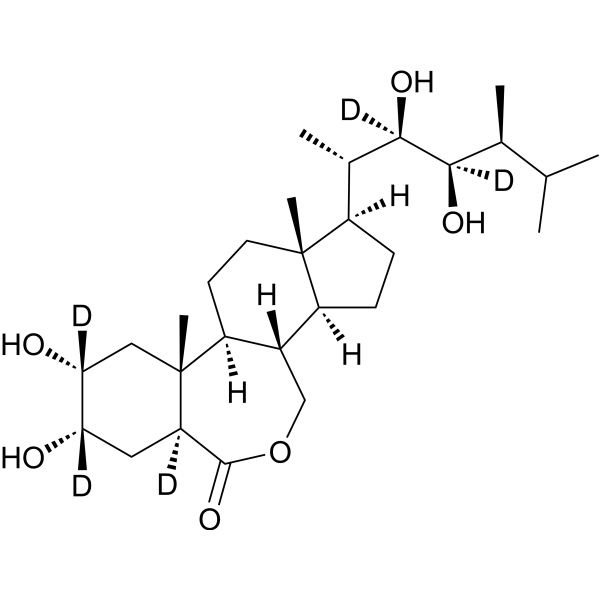
Physicochemical Properties
| Molecular Formula | C28H43D5O6 |
| Molecular Weight | 485.71 |
| Appearance | Typically exists as solid at room temperature |
| Synonyms | Brassin lactone-d5 |
| HS Tariff Code | 2934.99.9001 |
| Storage |
Powder-20°C 3 years 4°C 2 years In solvent -80°C 6 months -20°C 1 month |
| Shipping Condition | Room temperature (This product is stable at ambient temperature for a few days during ordinary shipping and time spent in Customs) |
Biological Activity
| Targets | plant growth modulator[1] |
| ln Vitro | Brassinolide is a plant sterol first isolated from pollen of rape (Brassica napus L.). Brassinolide can induce a time and concentration-dependent cytotoxicity in PC-3 cells. The mode of cell death appears to be predominately apoptosis, as shown by flow- cytometric analysis, fluorescence and transmission electron microscopes. Caspase-3 activity is obviously increased after Brassinolide treatment. Western blot studies indicate that treatment with Brassinolide triggered a time-dependent decrease in the expression of anti-apoptotic protein Bcl-2, which suggests that Brassinolide can induce cytotoxicity in PC-3 cells by triggering apoptosis. Brassinolide might therefore be a promising candidate for the treatment of prostate cancer[1]. Brassinolide is a plant growth modulator, on multidrug resistance (MDR) of human T lymphoblastoid cell line CCRF- VCR 1000 which is obtained by progressive addition of vincristine (VCR) to sensitive CCRF-CEM cells, and to explore preliminarily the mechanism of reversing action. After treatment of Brassinolide under the concentration of 0.001-10 μg/mL, the resistance of CCRF-VCR is reversed partly with the reversing folds respectively as 4.4-11.6. The intracellular accumulation of rhodamine 123 is significantly reduced in the resistant cells. After treatment of Brassinolide, the accumulation increased, the level of fluorescent dye is situated between resistant cells and sensitive cells. No alteration of the catalytic activity of topoisomerase II is found among three groups . The level of protein expression of p53 in resistant cells is higher than that of sensitive cells. After Brassinolide treatment, the expression of p53 in CCRF-VCR cells restored to the level of sensitive cells. Brassinolide can effectively reverse the resistance of CCRF-VCR cells by inhibiting the effusion of drug transported by P-glucoprotein. To down regulate the abnormal expression of p53 maybe one of the mechanisms of reversing MDR for Brassinolide[2]. Stable heavy isotopes of hydrogen, carbon, and other elements have been incorporated into drug molecules, largely as tracers for quantitation during the drug development process. Deuteration has gained attention because of its potential to affect the pharmacokinetic and metabolic profiles of drugs[3]. |
| References |
[1]. Reversing effect of brassinolide on multidrug resistance of-CCRF-VCR1000 cells and a preliminary investigation on its mechanisms. Yao Xue Xue Bao. 2005 Feb;40(2):117-21. [2]. Brassinolide, a plant sterol from pollen of Brassica napus L., induces apoptosis in human prostate cancer PC-3 cells. Pharmazie. 2007 May;62(5):392-5. |
Solubility Data
| Solubility (In Vitro) | May dissolve in DMSO (in most cases), if not, try other solvents such as H2O, Ethanol, or DMF with a minute amount of products to avoid loss of samples |
| Solubility (In Vivo) |
Note: Listed below are some common formulations that may be used to formulate products with low water solubility (e.g. < 1 mg/mL), you may test these formulations using a minute amount of products to avoid loss of samples. Injection Formulations (e.g. IP/IV/IM/SC) Injection Formulation 1: DMSO : Tween 80: Saline = 10 : 5 : 85 (i.e. 100 μL DMSO stock solution → 50 μL Tween 80 → 850 μL Saline) *Preparation of saline: Dissolve 0.9 g of sodium chloride in 100 mL ddH ₂ O to obtain a clear solution. Injection Formulation 2: DMSO : PEG300 :Tween 80 : Saline = 10 : 40 : 5 : 45 (i.e. 100 μL DMSO → 400 μLPEG300 → 50 μL Tween 80 → 450 μL Saline) Injection Formulation 3: DMSO : Corn oil = 10 : 90 (i.e. 100 μL DMSO → 900 μL Corn oil) Example: Take the Injection Formulation 3 (DMSO : Corn oil = 10 : 90) as an example, if 1 mL of 2.5 mg/mL working solution is to be prepared, you can take 100 μL 25 mg/mL DMSO stock solution and add to 900 μL corn oil, mix well to obtain a clear or suspension solution (2.5 mg/mL, ready for use in animals). Injection Formulation 4: DMSO : 20% SBE-β-CD in saline = 10 : 90 [i.e. 100 μL DMSO → 900 μL (20% SBE-β-CD in saline)] *Preparation of 20% SBE-β-CD in Saline (4°C,1 week): Dissolve 2 g SBE-β-CD in 10 mL saline to obtain a clear solution. Injection Formulation 5: 2-Hydroxypropyl-β-cyclodextrin : Saline = 50 : 50 (i.e. 500 μL 2-Hydroxypropyl-β-cyclodextrin → 500 μL Saline) Injection Formulation 6: DMSO : PEG300 : castor oil : Saline = 5 : 10 : 20 : 65 (i.e. 50 μL DMSO → 100 μLPEG300 → 200 μL castor oil → 650 μL Saline) Injection Formulation 7: Ethanol : Cremophor : Saline = 10: 10 : 80 (i.e. 100 μL Ethanol → 100 μL Cremophor → 800 μL Saline) Injection Formulation 8: Dissolve in Cremophor/Ethanol (50 : 50), then diluted by Saline Injection Formulation 9: EtOH : Corn oil = 10 : 90 (i.e. 100 μL EtOH → 900 μL Corn oil) Injection Formulation 10: EtOH : PEG300:Tween 80 : Saline = 10 : 40 : 5 : 45 (i.e. 100 μL EtOH → 400 μLPEG300 → 50 μL Tween 80 → 450 μL Saline) Oral Formulations Oral Formulation 1: Suspend in 0.5% CMC Na (carboxymethylcellulose sodium) Oral Formulation 2: Suspend in 0.5% Carboxymethyl cellulose Example: Take the Oral Formulation 1 (Suspend in 0.5% CMC Na) as an example, if 100 mL of 2.5 mg/mL working solution is to be prepared, you can first prepare 0.5% CMC Na solution by measuring 0.5 g CMC Na and dissolve it in 100 mL ddH2O to obtain a clear solution; then add 250 mg of the product to 100 mL 0.5% CMC Na solution, to make the suspension solution (2.5 mg/mL, ready for use in animals). Oral Formulation 3: Dissolved in PEG400 Oral Formulation 4: Suspend in 0.2% Carboxymethyl cellulose Oral Formulation 5: Dissolve in 0.25% Tween 80 and 0.5% Carboxymethyl cellulose Oral Formulation 6: Mixing with food powders Note: Please be aware that the above formulations are for reference only. InvivoChem strongly recommends customers to read literature methods/protocols carefully before determining which formulation you should use for in vivo studies, as different compounds have different solubility properties and have to be formulated differently. (Please use freshly prepared in vivo formulations for optimal results.) |
| Preparing Stock Solutions | 1 mg | 5 mg | 10 mg | |
| 1 mM | 2.0588 mL | 10.2942 mL | 20.5884 mL | |
| 5 mM | 0.4118 mL | 2.0588 mL | 4.1177 mL | |
| 10 mM | 0.2059 mL | 1.0294 mL | 2.0588 mL |