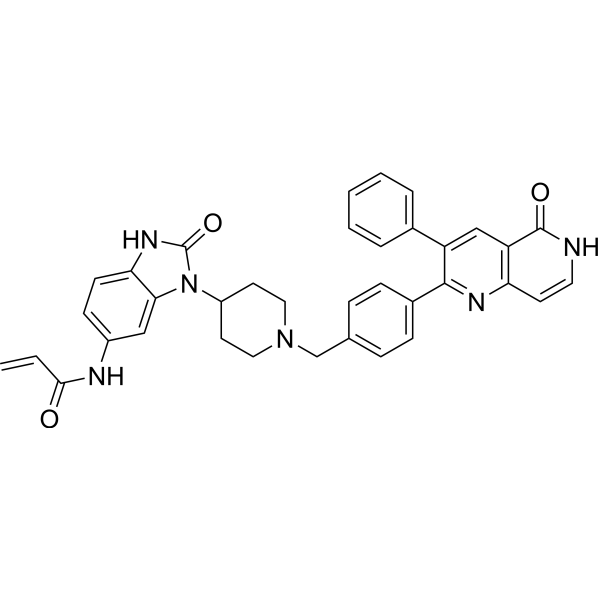
Physicochemical Properties
| Molecular Formula | C36H32N6O3 |
| Molecular Weight | 596.677687644959 |
| Exact Mass | 596.253 |
| CAS # | 1800070-77-2 |
| PubChem CID | 122668091 |
| Appearance | White to off-white solid powder |
| LogP | 4.3 |
| Hydrogen Bond Donor Count | 3 |
| Hydrogen Bond Acceptor Count | 5 |
| Rotatable Bond Count | 7 |
| Heavy Atom Count | 45 |
| Complexity | 1120 |
| Defined Atom Stereocenter Count | 0 |
| SMILES | O=C1NC2C=CC(=CC=2N1C1CCN(CC2C=CC(C3C(C4C=CC=CC=4)=CC4C(NC=CC=4N=3)=O)=CC=2)CC1)NC(C=C)=O |
| InChi Key | HXBRBOYWXDLHDC-UHFFFAOYSA-N |
| InChi Code | InChI=1S/C36H32N6O3/c1-2-33(43)38-26-12-13-31-32(20-26)42(36(45)40-31)27-15-18-41(19-16-27)22-23-8-10-25(11-9-23)34-28(24-6-4-3-5-7-24)21-29-30(39-34)14-17-37-35(29)44/h2-14,17,20-21,27H,1,15-16,18-19,22H2,(H,37,44)(H,38,43)(H,40,45) |
| Chemical Name | N-[2-oxo-3-[1-[[4-(5-oxo-3-phenyl-6H-1,6-naphthyridin-2-yl)phenyl]methyl]piperidin-4-yl]-1H-benzimidazol-5-yl]prop-2-enamide |
| HS Tariff Code | 2934.99.9001 |
| Storage |
Powder-20°C 3 years 4°C 2 years In solvent -80°C 6 months -20°C 1 month |
| Shipping Condition | Room temperature (This product is stable at ambient temperature for a few days during ordinary shipping and time spent in Customs) |
Biological Activity
| Targets | In AN3CA (endometrium), T47D (breast), ZR-75-1 (breast), MCF-7 (breast), BT-474 (breast), and KU, borussertib demonstrates excellent cellular activity in the nanomolar range. The EC50 values in the -19-19 (bladder) cell line are 191±90 nM, 48±15 nM, 5±1 nM, 277±90 nM, 373±54 nM, and 7770±641 nM [1]. |
| ln Vitro |
In AN3CA (endometrium), T47D (breast), ZR-75-1 (breast), MCF-7 (breast), BT-474 (breast), and KU, borussertib demonstrates excellent cellular activity in the nanomolar range. The EC50 values in the -19-19 (bladder) cell line are 191±90 nM, 48±15 nM, 5±1 nM, 277±90 nM, 373±54 nM, and 7770±641 nM [1]. In a biochemical kinase assay using full-length Akt, Borussertib exhibited potent inhibitory activity with an IC50 of 0.8 ± 0.3 nM and a Ki of 2.2 ± 0.3 nM. The kinetic parameter kinact/Ki, which combines affinity and covalent bond formation, was 0.853 ± 0.038 µM−1s−1. [1] In cell viability assays, Borussertib inhibited the proliferation of several cancer cell lines dependent on Akt signaling. The half-maximal effective concentration (EC50) values were: 191 ± 90 nM (AN3CA, endometrium), 48 ± 15 nM (T47D, breast), 5 ± 1 nM (ZR-75-1, breast), 277 ± 90 nM (MCF-7, breast), 373 ± 54 nM (BT-474, breast), and 7770 ± 641 nM (KU-19-19, bladder). [1] Mass spectrometry analysis confirmed that Borussertib covalently labels Akt1, as evidenced by a mass shift corresponding to mono-labeling of the protein. MS/MS analysis indicated modification of both Cys296 and Cys310 residues. [1] A kinome-wide selectivity screen against 100 kinases at 1 µM concentration showed that Borussertib potently inhibited all three Akt isoforms with a preference for Akt1 and Akt2, and exhibited minimal off-target activity, demonstrating a promising selectivity profile. [1] |
| Enzyme Assay |
The inhibitory potency (IC50) of Borussertib against full-length Akt was determined using a biochemical kinase activity assay. The assay conditions and detailed procedure are not fully described in the provided text. The IC50 and kinetic parameters (Ki, kinact) presented are means from at least three independent experiments. [1] The covalent binding character was orthogonally confirmed by incubating Borussertib with Akt1 protein and analyzing the samples by mass spectrometry, which showed a mass shift indicative of covalent modification. [1] |
| Cell Assay | Cellular activity was evaluated using cell viability/proliferation assays. Cancer cell lines with genetic alterations in the PI3K/Akt pathway (AN3CA, T47D, ZR-75-1, MCF-7, BT-474, KU-19-19) were treated with a range of concentrations of Borussertib. After an appropriate incubation period, cell viability was measured, and half-maximal effective concentration (EC50) values were calculated. [1] |
| ADME/Pharmacokinetics | The phase I metabolic stability of Borussertib was assessed using a microsomal stability assay. In human liver microsomes, the half-life (t1/2) was 99 minutes, and the intrinsic clearance (Clint) was 5 µL min−1 mg−1. In murine liver microsomes, the t1/2 was 46 minutes, and the Clint was 30 µL min−1 mg−1. The article states that Borussertib revealed a good pharmacokinetic profile with reasonable microsomal stability. [1] |
| References |
[1]. Structural and chemical insights into the covalentallosteric inhibition of the protein kinase Akt. Chem Sci., 2019, 10, 3573. |
| Additional Infomation |
Borussertib is the first-in-class covalent-allosteric inhibitor (CAI) of Akt. It is based on a 1,6-naphthyridinone scaffold and features an acrylamide warhead designed to form a covalent bond with Cys296 in the kinase domain via a Michael addition reaction. [1] It functions as an allosteric inhibitor that binds to the interdomain region between the pleckstrin homology (PH) domain and the kinase domain of full-length Akt, stabilizing the inactive "PH-in" conformation. [1] The co-crystal structure of Borussertib in complex with full-length Akt (PDB: 6HHF) confirmed its covalent-allosteric mode of action. Key interactions include a π-π-stacking interaction with Trp80 of the PH domain, and the acrylamide warhead forms a covalent bond with Cys296, stabilized by an H-bond to the backbone amide of Glu85. [1] Molecular dynamics simulations predict that Borussertib can react with both Cys296 and Cys310, but the reaction with Cys296 is clearly preferred, which aligns with the crystallographic data and MS/MS analysis showing labeling of both residues. [1] The study positions Borussertib as a novel tool compound with outstanding selectivity and potency, validating the concept of covalent-allosteric inhibition for Akt. [1] |
Solubility Data
| Solubility (In Vitro) | DMSO : ~25 mg/mL (~41.90 mM) |
| Solubility (In Vivo) |
Solubility in Formulation 1: ≥ 2.08 mg/mL (3.49 mM) (saturation unknown) in 10% DMSO + 40% PEG300 + 5% Tween80 + 45% Saline (add these co-solvents sequentially from left to right, and one by one), clear solution. For example, if 1 mL of working solution is to be prepared, you can add 100 μL of 20.8 mg/mL clear DMSO stock solution to 400 μL PEG300 and mix evenly; then add 50 μL Tween-80 to the above solution and mix evenly; then add 450 μL normal saline to adjust the volume to 1 mL. Preparation of saline: Dissolve 0.9 g of sodium chloride in 100 mL ddH₂ O to obtain a clear solution. Solubility in Formulation 2: ≥ 2.08 mg/mL (3.49 mM) (saturation unknown) in 10% DMSO + 90% Corn Oil (add these co-solvents sequentially from left to right, and one by one), clear solution. For example, if 1 mL of working solution is to be prepared, you can add 100 μL of 20.8 mg/mL clear DMSO stock solution to 900 μL of corn oil and mix evenly. (Please use freshly prepared in vivo formulations for optimal results.) |
| Preparing Stock Solutions | 1 mg | 5 mg | 10 mg | |
| 1 mM | 1.6759 mL | 8.3797 mL | 16.7594 mL | |
| 5 mM | 0.3352 mL | 1.6759 mL | 3.3519 mL | |
| 10 mM | 0.1676 mL | 0.8380 mL | 1.6759 mL |