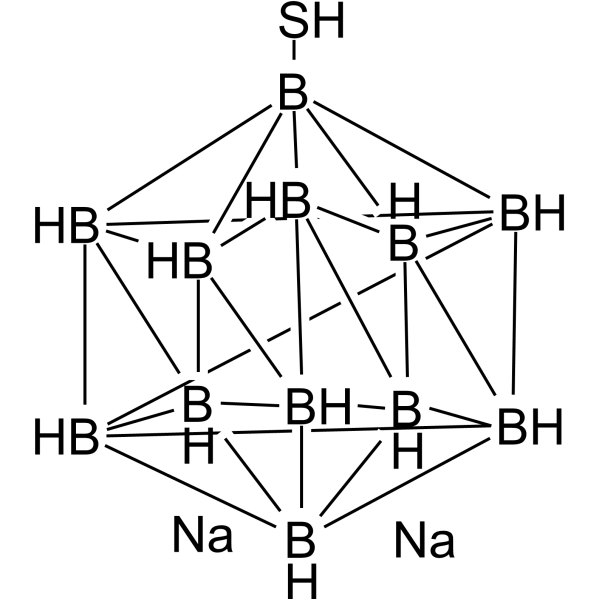
Physicochemical Properties
| Molecular Formula | B12H12NA2S |
| Molecular Weight | 219.87 |
| CAS # | 144885-51-8 |
| Appearance | Typically exists as Off-white to light yellow solid at room temperature |
| Melting Point | 180-181 °C(Solv: ethanol (64-17-5)) |
| SMILES | SB1234B567B89%10B%11%12%13B%14%15%16B%178%11B1%14(B12%15B2%16%12B59%13B3162)B47%10%17.[Na+] |
| Synonyms | BSH; Mercaptoundecahydrododecaborate; 12294-22-3; Sodium borocaptate (Na2B12H11SH); sodium undecahydromercapto-closo-dodecaborate; Borocaptate Sodium |
| HS Tariff Code | 2934.99.9001 |
| Storage |
Powder-20°C 3 years 4°C 2 years In solvent -80°C 6 months -20°C 1 month |
| Shipping Condition | Room temperature (This product is stable at ambient temperature for a few days during ordinary shipping and time spent in Customs) |
Biological Activity
| Targets | BNCT reagent |
| ln Vitro |
In human glioblastoma T98G cells, pretreatment with buthionine sulfoximine (BSO) to deplete glutathione significantly enhanced the radiobiological efficacy of sodium borocaptate when combined with thermal neutron irradiation. The survival fraction after neutron irradiation was 0.32 in cells treated with sodium borocaptate alone versus 0.18 in cells pretreated with BSO followed by sodium borocaptate (p<0.05). BSO alone showed no cytotoxic effect (survival fraction: 0.98). [3] |
| ln Vivo |
Evaluation in dogs with spontaneous intracranial tumors showed that intravenous administration of borocaptate sodium (BSH) at 50 mg/kg resulted in boron accumulation in tumor tissues. Boron concentrations were measured in blood and tumor samples at various time points. The tumor-to-blood boron concentration ratio was approximately 1.0 at 6 hours post-injection. Following neutron irradiation (thermal neutron flux: 1.5 × 10⁹ n/cm2/s), significant tumor regression was observed in 4 out of 7 dogs, with complete remission in one case. No pharmacological activity (e.g., antitumor effects) occurred without neutron irradiation. [2] |
| Cell Assay |
Uptake of sodium borocaptate was evaluated in human glioblastoma T98G cells. Cells were pretreated with 100 μM buthionine sulfoximine (BSO) for 24 hours to deplete glutathione, followed by exposure to 15 ppm boron-equivalent sodium borocaptate for 3 hours. Intracellular boron concentration was quantified using inductively coupled plasma atomic emission spectroscopy. For clonogenic survival assays, cells were irradiated with thermal neutrons (flux: 1.0 × 10⁹ n/cm2) after treatment, then cultured for 10 days to assess colony formation. [3] |
| Animal Protocol |
Dogs with spontaneous intracranial tumors received intravenous infusion of borocaptate sodium dissolved in saline (concentration not specified). The dose was 50 mg/kg body weight, administered as a single bolus injection. Neutron irradiation was performed at the Massachusetts Institute of Technology (MIT) reactor, with irradiation starting at 6–12 hours post-injection. The thermal neutron dose ranged from 8.7 to 15.6 Gy, and boron concentrations in blood, tumor, and normal tissues (e.g., brain, skin) were monitored using prompt gamma-ray spectroscopy or other analytical methods. [2] |
| ADME/Pharmacokinetics |
In dogs, borocaptate sodium exhibited rapid distribution post-intravenous injection. The plasma half-life was approximately 12.6 hours. Boron concentrations peaked in blood within 1–2 hours and declined biphasically. Tumor boron concentrations reached up to 35 μg/g at 6 hours, with a tumor-to-blood ratio of ~1.0. Excretion was primarily renal, with 70–80% of the administered dose eliminated unchanged in urine within 24 hours. No metabolism was detected. [2] Uptake of sodium borocaptate was evaluated in human glioblastoma T98G cells. Cells were pretreated with 100 μM buthionine sulfoximine (BSO) for 24 hours to deplete glutathione, followed by exposure to 15 ppm boron-equivalent sodium borocaptate for 3 hours. Intracellular boron concentration was quantified using inductively coupled plasma atomic emission spectroscopy. For clonogenic survival assays, cells were irradiated with thermal neutrons (flux: 1.0 × 10⁹ n/cm2) after treatment, then cultured for 10 days to assess colony formation. [3] |
| Toxicity/Toxicokinetics |
No severe acute toxicity was observed in dogs at the therapeutic dose of 50 mg/kg. Mild and transient adverse effects included vomiting (in 2 out of 7 dogs) and lethargy. The intravenous LD50 in mice was 1000 mg/kg. No hepatotoxicity or nephrotoxicity was reported based on blood chemistry and histopathological analysis. Plasma protein binding was not described. [2] |
| References |
[1]. Optimal detection of the neutron capture therapy agent borocaptate sodium (BSH): A comparison between and NMR[J]. Medical Physics, 2001, 28(2): 178-183. [2]. Borocaptate sodium: a potential boron delivery compound for boron neutron capture therapy evaluated in dogs with spontaneous intracranial tumors. Proc Natl Acad Sci U S A. 1992 Dec 15;89(24):11973-7. [3]. Enhancement of sodium borocaptate (BSH) uptake by tumor cells induced by glutathione depletion and its radiobiological effect. Cancer Lett. 2004 Nov 8;215(1):61-7. |
| Additional Infomation |
Borocaptate sodium (BSH) is a boron delivery agent for boron neutron capture therapy (BNCT), used to treat brain tumors. It selectively accumulates in tumor cells, where boron-10 nuclei capture thermal neutrons to produce high-linear energy transfer alpha particles that cause localized tumor cell destruction. [2] This study compared 11B NMR spectroscopy and other analytical methods (e.g., inductively coupled plasma atomic emission spectroscopy) for detecting BSH in biological samples. NMR provided non-invasive quantification with a detection limit of ~5 μg/g boron in tissues, facilitating BNCT treatment planning. [1] Glutathione depletion sensitizes tumor cells to boron neutron capture therapy by enhancing sodium borocaptate accumulation. The 10B(n,α)7Li reaction generates high-energy particles causing DNA damage after thermal neutron irradiation. [3] |
Solubility Data
| Solubility (In Vitro) | May dissolve in DMSO (in most cases), if not, try other solvents such as H2O, Ethanol, or DMF with a minute amount of products to avoid loss of samples |
| Solubility (In Vivo) |
Note: Listed below are some common formulations that may be used to formulate products with low water solubility (e.g. < 1 mg/mL), you may test these formulations using a minute amount of products to avoid loss of samples. Injection Formulations (e.g. IP/IV/IM/SC) Injection Formulation 1: DMSO : Tween 80: Saline = 10 : 5 : 85 (i.e. 100 μL DMSO stock solution → 50 μL Tween 80 → 850 μL Saline) *Preparation of saline: Dissolve 0.9 g of sodium chloride in 100 mL ddH ₂ O to obtain a clear solution. Injection Formulation 2: DMSO : PEG300 :Tween 80 : Saline = 10 : 40 : 5 : 45 (i.e. 100 μL DMSO → 400 μLPEG300 → 50 μL Tween 80 → 450 μL Saline) Injection Formulation 3: DMSO : Corn oil = 10 : 90 (i.e. 100 μL DMSO → 900 μL Corn oil) Example: Take the Injection Formulation 3 (DMSO : Corn oil = 10 : 90) as an example, if 1 mL of 2.5 mg/mL working solution is to be prepared, you can take 100 μL 25 mg/mL DMSO stock solution and add to 900 μL corn oil, mix well to obtain a clear or suspension solution (2.5 mg/mL, ready for use in animals). Injection Formulation 4: DMSO : 20% SBE-β-CD in saline = 10 : 90 [i.e. 100 μL DMSO → 900 μL (20% SBE-β-CD in saline)] *Preparation of 20% SBE-β-CD in Saline (4°C,1 week): Dissolve 2 g SBE-β-CD in 10 mL saline to obtain a clear solution. Injection Formulation 5: 2-Hydroxypropyl-β-cyclodextrin : Saline = 50 : 50 (i.e. 500 μL 2-Hydroxypropyl-β-cyclodextrin → 500 μL Saline) Injection Formulation 6: DMSO : PEG300 : castor oil : Saline = 5 : 10 : 20 : 65 (i.e. 50 μL DMSO → 100 μLPEG300 → 200 μL castor oil → 650 μL Saline) Injection Formulation 7: Ethanol : Cremophor : Saline = 10: 10 : 80 (i.e. 100 μL Ethanol → 100 μL Cremophor → 800 μL Saline) Injection Formulation 8: Dissolve in Cremophor/Ethanol (50 : 50), then diluted by Saline Injection Formulation 9: EtOH : Corn oil = 10 : 90 (i.e. 100 μL EtOH → 900 μL Corn oil) Injection Formulation 10: EtOH : PEG300:Tween 80 : Saline = 10 : 40 : 5 : 45 (i.e. 100 μL EtOH → 400 μLPEG300 → 50 μL Tween 80 → 450 μL Saline) Oral Formulations Oral Formulation 1: Suspend in 0.5% CMC Na (carboxymethylcellulose sodium) Oral Formulation 2: Suspend in 0.5% Carboxymethyl cellulose Example: Take the Oral Formulation 1 (Suspend in 0.5% CMC Na) as an example, if 100 mL of 2.5 mg/mL working solution is to be prepared, you can first prepare 0.5% CMC Na solution by measuring 0.5 g CMC Na and dissolve it in 100 mL ddH2O to obtain a clear solution; then add 250 mg of the product to 100 mL 0.5% CMC Na solution, to make the suspension solution (2.5 mg/mL, ready for use in animals). Oral Formulation 3: Dissolved in PEG400 Oral Formulation 4: Suspend in 0.2% Carboxymethyl cellulose Oral Formulation 5: Dissolve in 0.25% Tween 80 and 0.5% Carboxymethyl cellulose Oral Formulation 6: Mixing with food powders Note: Please be aware that the above formulations are for reference only. InvivoChem strongly recommends customers to read literature methods/protocols carefully before determining which formulation you should use for in vivo studies, as different compounds have different solubility properties and have to be formulated differently. (Please use freshly prepared in vivo formulations for optimal results.) |
| Preparing Stock Solutions | 1 mg | 5 mg | 10 mg | |
| 1 mM | 4.5481 mL | 22.7407 mL | 45.4814 mL | |
| 5 mM | 0.9096 mL | 4.5481 mL | 9.0963 mL | |
| 10 mM | 0.4548 mL | 2.2741 mL | 4.5481 mL |