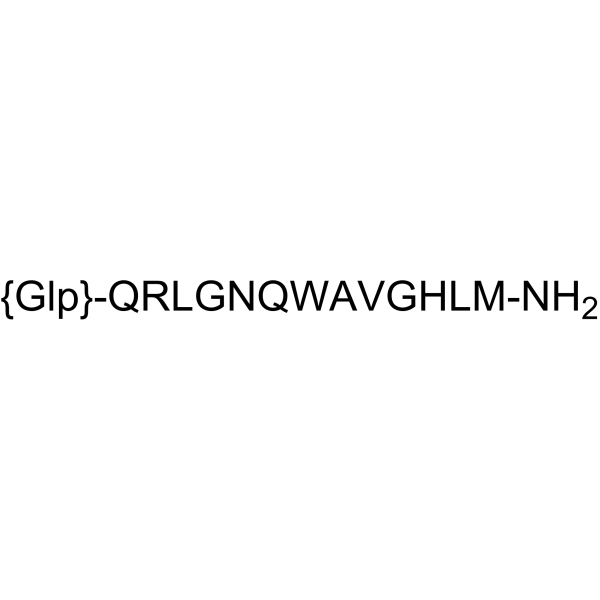
Physicochemical Properties
| Molecular Formula | C71H110N24O18S.2[HCL] |
| Molecular Weight | 1692.76998 |
| Exact Mass | 1618.82 |
| CAS # | 31362-50-2 |
| PubChem CID | 16201612 |
| Appearance | White to off-white solid powder |
| Density | 1.5g/cm3 |
| Index of Refraction | 1.681 |
| LogP | 2.598 |
| Hydrogen Bond Donor Count | 23 |
| Hydrogen Bond Acceptor Count | 21 |
| Rotatable Bond Count | 52 |
| Heavy Atom Count | 114 |
| Complexity | 3410 |
| Defined Atom Stereocenter Count | 12 |
| SMILES | C[C@@H](C(=O)N[C@@H](C(C)C)C(=O)NCC(=O)N[C@@H](CC1=CN=CN1)C(=O)N[C@@H](CC(C)C)C(=O)N[C@@H](CCSC)C(=O)N)NC(=O)[C@H](CC2=CNC3=CC=CC=C32)NC(=O)[C@H](CCC(=O)N)NC(=O)[C@H](CC(=O)N)NC(=O)CNC(=O)[C@H](CC(C)C)NC(=O)[C@H](CCCNC(=N)N)NC(=O)[C@H](CCC(=O)N)NC(=O)[C@@H]4CCC(=O)N4 |
| InChi Key | QXZBMSIDSOZZHK-DOPDSADYSA-N |
| InChi Code | InChI=1S/C71H110N24O18S/c1-34(2)24-47(92-62(105)43(14-11-22-79-71(76)77)89-64(107)45(15-18-52(72)96)90-63(106)44-17-20-55(99)85-44)61(104)81-31-56(100)87-51(28-54(74)98)69(112)91-46(16-19-53(73)97)65(108)94-49(26-38-29-80-41-13-10-9-12-40(38)41)66(109)84-37(7)60(103)95-58(36(5)6)70(113)82-32-57(101)86-50(27-39-30-78-33-83-39)68(111)93-48(25-35(3)4)67(110)88-42(59(75)102)21-23-114-8/h9-10,12-13,29-30,33-37,42-51,58,80H,11,14-28,31-32H2,1-8H3,(H2,72,96)(H2,73,97)(H2,74,98)(H2,75,102)(H,78,83)(H,81,104)(H,82,113)(H,84,109)(H,85,99)(H,86,101)(H,87,100)(H,88,110)(H,89,107)(H,90,106)(H,91,112)(H,92,105)(H,93,111)(H,94,108)(H,95,103)(H4,76,77,79)/t37-,42-,43-,44-,45-,46-,47-,48-,49-,50-,51-,58-/m0/s1 |
| Chemical Name | (2S)-N-[(2S)-1-[[(2S)-1-[[2-[[(2S)-4-amino-1-[[(2S)-5-amino-1-[[(2S)-1-[[(2S)-1-[[(2S)-1-[[2-[[(2S)-1-[[(2S)-1-[[(2S)-1-amino-4-methylsulfanyl-1-oxobutan-2-yl]amino]-4-methyl-1-oxopentan-2-yl]amino]-3-(1H-imidazol-5-yl)-1-oxopropan-2-yl]amino]-2-oxoethyl]amino]-3-methyl-1-oxobutan-2-yl]amino]-1-oxopropan-2-yl]amino]-3-(1H-indol-3-yl)-1-oxopropan-2-yl]amino]-1,5-dioxopentan-2-yl]amino]-1,4-dioxobutan-2-yl]amino]-2-oxoethyl]amino]-4-methyl-1-oxopentan-2-yl]amino]-5-carbamimidamido-1-oxopentan-2-yl]-2-[[(2S)-5-oxopyrrolidine-2-carbonyl]amino]pentanediamide |
| HS Tariff Code | 2934.99.9001 |
| Storage |
Powder-20°C 3 years 4°C 2 years In solvent -80°C 6 months -20°C 1 month Note: Please store this product in a sealed and protected environment (e.g. under nitrogen), avoid exposure to moisture and light. |
| Shipping Condition | Room temperature (This product is stable at ambient temperature for a few days during ordinary shipping and time spent in Customs) |
Biological Activity
| ln Vitro | Gastrin-releasing peptide (GRP) and neuregulin are two mammalian bombesin-related peptides that have been linked to bombesin, a tetradecapeptide with a COOH terminus ending in Gly-His-Leu-Met-NH2. Very similar is B (NMB) [1]. It was discovered that bombesin stimulated the release of gastrointestinal hormones, the contraction of the gallbladder, the secretions from the stomach and pancreas, and bronchoconstriction. It is found in the brains of birds as well as in the stomach endocrine cells of amphibians and avian species. It is mostly present in nerve cells and fibers in mammals. P cells in the developing lung are the only known mammalian endocrine cells to contain bombesin. The mammalian brain contains bombesin as well, with the hypothalamus having the highest concentrations [2]. It was demonstrated that bombesin was a strong mitogen for Swiss 3T3 cells. Bombesin promotes 3T3 cell division when serum is present in low concentrations (3.5%). Bombesin induces DNA synthesis (IC50=1 nM) in serum-free medium without the need for additional growth factors [3]. |
| References |
[1]. Bombesin-related peptides and their receptors: recent advances in their role in physiology and disease states. Curr Opin Endocrinol Diabetes Obes. 2008 Feb;15(1):58-64. [2]. Bombesin in human neuroendocrine (NE) neoplasms. Peptides. 1985;6 Suppl 3:107-12. |
| Additional Infomation |
Bombesin is under investigation in clinical trial NCT01205321 (PET/CT Imaging for Radiation Dosimetry, Plasma Pharmacokinetics, Biodistribution, Safety and Tolerability and Diagnostic Performance of BAY86-7548 in Patients With Prostate Cancer and Healthy Volunteers). A tetradecapeptide originally obtained from the skins of toads Bombina bombina and B. variegata. It is also an endogenous neurotransmitter in many animals including mammals. Bombesin affects vascular and other smooth muscle, gastric secretion, and renal circulation and function. |
Solubility Data
| Solubility (In Vitro) | H2O : ~50 mg/mL (~30.87 mM) |
| Solubility (In Vivo) |
Note: Listed below are some common formulations that may be used to formulate products with low water solubility (e.g. < 1 mg/mL), you may test these formulations using a minute amount of products to avoid loss of samples. Injection Formulations (e.g. IP/IV/IM/SC) Injection Formulation 1: DMSO : Tween 80: Saline = 10 : 5 : 85 (i.e. 100 μL DMSO stock solution → 50 μL Tween 80 → 850 μL Saline) *Preparation of saline: Dissolve 0.9 g of sodium chloride in 100 mL ddH ₂ O to obtain a clear solution. Injection Formulation 2: DMSO : PEG300 :Tween 80 : Saline = 10 : 40 : 5 : 45 (i.e. 100 μL DMSO → 400 μLPEG300 → 50 μL Tween 80 → 450 μL Saline) Injection Formulation 3: DMSO : Corn oil = 10 : 90 (i.e. 100 μL DMSO → 900 μL Corn oil) Example: Take the Injection Formulation 3 (DMSO : Corn oil = 10 : 90) as an example, if 1 mL of 2.5 mg/mL working solution is to be prepared, you can take 100 μL 25 mg/mL DMSO stock solution and add to 900 μL corn oil, mix well to obtain a clear or suspension solution (2.5 mg/mL, ready for use in animals). Injection Formulation 4: DMSO : 20% SBE-β-CD in saline = 10 : 90 [i.e. 100 μL DMSO → 900 μL (20% SBE-β-CD in saline)] *Preparation of 20% SBE-β-CD in Saline (4°C,1 week): Dissolve 2 g SBE-β-CD in 10 mL saline to obtain a clear solution. Injection Formulation 5: 2-Hydroxypropyl-β-cyclodextrin : Saline = 50 : 50 (i.e. 500 μL 2-Hydroxypropyl-β-cyclodextrin → 500 μL Saline) Injection Formulation 6: DMSO : PEG300 : castor oil : Saline = 5 : 10 : 20 : 65 (i.e. 50 μL DMSO → 100 μLPEG300 → 200 μL castor oil → 650 μL Saline) Injection Formulation 7: Ethanol : Cremophor : Saline = 10: 10 : 80 (i.e. 100 μL Ethanol → 100 μL Cremophor → 800 μL Saline) Injection Formulation 8: Dissolve in Cremophor/Ethanol (50 : 50), then diluted by Saline Injection Formulation 9: EtOH : Corn oil = 10 : 90 (i.e. 100 μL EtOH → 900 μL Corn oil) Injection Formulation 10: EtOH : PEG300:Tween 80 : Saline = 10 : 40 : 5 : 45 (i.e. 100 μL EtOH → 400 μLPEG300 → 50 μL Tween 80 → 450 μL Saline) Oral Formulations Oral Formulation 1: Suspend in 0.5% CMC Na (carboxymethylcellulose sodium) Oral Formulation 2: Suspend in 0.5% Carboxymethyl cellulose Example: Take the Oral Formulation 1 (Suspend in 0.5% CMC Na) as an example, if 100 mL of 2.5 mg/mL working solution is to be prepared, you can first prepare 0.5% CMC Na solution by measuring 0.5 g CMC Na and dissolve it in 100 mL ddH2O to obtain a clear solution; then add 250 mg of the product to 100 mL 0.5% CMC Na solution, to make the suspension solution (2.5 mg/mL, ready for use in animals). Oral Formulation 3: Dissolved in PEG400 Oral Formulation 4: Suspend in 0.2% Carboxymethyl cellulose Oral Formulation 5: Dissolve in 0.25% Tween 80 and 0.5% Carboxymethyl cellulose Oral Formulation 6: Mixing with food powders Note: Please be aware that the above formulations are for reference only. InvivoChem strongly recommends customers to read literature methods/protocols carefully before determining which formulation you should use for in vivo studies, as different compounds have different solubility properties and have to be formulated differently. (Please use freshly prepared in vivo formulations for optimal results.) |
| Preparing Stock Solutions | 1 mg | 5 mg | 10 mg | |
| 1 mM | 0.5907 mL | 2.9537 mL | 5.9075 mL | |
| 5 mM | 0.1181 mL | 0.5907 mL | 1.1815 mL | |
| 10 mM | 0.0591 mL | 0.2954 mL | 0.5907 mL |