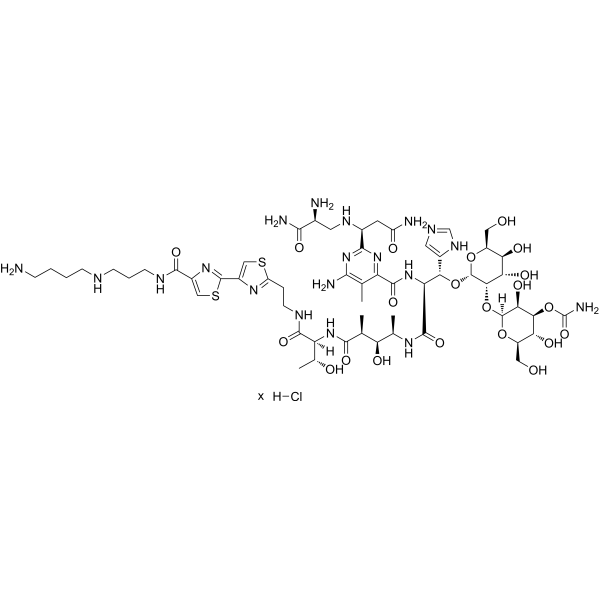
Physicochemical Properties
| Molecular Formula | C57H89N19O21S2.X(HCL) |
| Molecular Weight | 1477.02000 |
| Exact Mass | 1475.57 |
| CAS # | 55658-47-4 |
| Related CAS # | Bleomycin A5;11116-32-8 |
| PubChem CID | 84058 |
| Appearance | Typically exists as solid at room temperature |
| Density | 1.56g/cm3 |
| Hydrogen Bond Donor Count | 23 |
| Hydrogen Bond Acceptor Count | 33 |
| Rotatable Bond Count | 40 |
| Heavy Atom Count | 100 |
| Complexity | 2620 |
| Defined Atom Stereocenter Count | 0 |
| SMILES | CC1=C(N=C(NC1=N)[C@@H](NC[C@H](N)C(N)=O)CC(N)=O)C(N[C@H](C(N[C@@H]([C@@H](O)[C@H](C(N[C@H](C(NCCC2=NC(C3=NC(C(NCCCNCCCCN)=O)=CS3)=CS2)=O)[C@H](O)C)=O)C)C)=O)[C@@H](O[C@H]4[C@@H](O[C@@H]5[C@@H](O)[C@@H](OC(N)=O)[C@H](O)[C@H](O5)CO)[C@@H](O)[C@H](O)[C@@H](O4)CO)C6=CN=CN6)=O.Cl |
| InChi Key | NRVKJXFKQWUKCB-UHFFFAOYSA-N |
| InChi Code | InChI=1S/C57H89N19O21S2.ClH/c1-22-35(73-48(76-46(22)61)27(14-33(60)80)68-15-26(59)47(62)86)52(90)75-37(43(28-16-65-21-69-28)95-56-45(41(84)39(82)31(17-77)94-56)96-55-42(85)44(97-57(63)92)40(83)32(18-78)93-55)53(91)70-24(3)38(81)23(2)49(87)74-36(25(4)79)51(89)67-13-8-34-71-30(20-98-34)54-72-29(19-99-54)50(88)66-12-7-11-64-10-6-5-9-58;/h16,19-21,23-27,31-32,36-45,55-56,64,68,77-79,81-85H,5-15,17-18,58-59H2,1-4H3,(H2,60,80)(H2,62,86)(H2,63,92)(H,65,69)(H,66,88)(H,67,89)(H,70,91)(H,74,87)(H,75,90)(H2,61,73,76);1H |
| Chemical Name | [2-[2-[2-[[6-amino-2-[3-amino-1-[(2,3-diamino-3-oxopropyl)amino]-3-oxopropyl]-5-methylpyrimidine-4-carbonyl]amino]-3-[[5-[[1-[2-[4-[4-[3-(4-aminobutylamino)propylcarbamoyl]-1,3-thiazol-2-yl]-1,3-thiazol-2-yl]ethylamino]-3-hydroxy-1-oxobutan-2-yl]amino]-3-hydroxy-4-methyl-5-oxopentan-2-yl]amino]-1-(1H-imidazol-5-yl)-3-oxopropoxy]-4,5-dihydroxy-6-(hydroxymethyl)oxan-3-yl]oxy-3,5-dihydroxy-6-(hydroxymethyl)oxan-4-yl] carbamate;hydrochloride |
| Synonyms | Bleomycin A5 hydrochloride; Bleomycin A5 HCl; 55658-47-4; BLEOCIN(TM), STREPTOMYCES VERTICILLUS; N1-(3-((4-Aminobutyl)amino)propyl)bleomycinamide hydrochloride; T2UC5J38DD; Bleomycin A5 Hydrochloride Salt; Bleomycin A5 Hydrochloride(1:x); |
| HS Tariff Code | 2934.99.9001 |
| Storage |
Powder-20°C 3 years 4°C 2 years In solvent -80°C 6 months -20°C 1 month |
| Shipping Condition | Room temperature (This product is stable at ambient temperature for a few days during ordinary shipping and time spent in Customs) |
Biological Activity
| Targets | Glycopeptide antibiotic; antincancer antibiotic; apoptosis inducer; bacterial metabolite |
| ln Vitro |
Background: Bleomycin A5 is an anti-neoplastic glycoprotein antibiotic used for the treatment of various cancers. Previous work has shown that bleomycin A5 exerts its apoptotic effects on tumor cells. This was to study the signal transduction pathways that might exert the apoptotic effects of bleomycin A5 on tumor cells, as well as to examine the possibility of lower dosing of such drug in combinative treatment with other compounds in vitro.
Results: The apoptotic effect was associated with the sustained activation of c-Jun N-terminal kinases (JNK) and the inhibition of extracellular signal-regulated kinases1 (ERK1) and -2 activities, suggesting that JNK plays a positive role in the death process. ERK1 and -2 might exert a protection pathway from cell death. Here, it was determined that a combination treatment of bleomycin A5 and the MAP kinase-ERK kinase (MEK) inhibitor, PD98059, could lead to enhanced apoptosis. The activities of ERK1 and -2 are required for cell survival signaling using stable cell clones expressing MEK1. Upon bleomycin A5 treatment, cells expressing MEK1 exhibited significant delays in the onset of apoptosis, where the presence of MEK1 inhibitor enhanced cell death. Moreover, the increased activity of ERK1 and -2 coincided with cell survival. The survival signals exerted by MEK1 most likely result from the activation of ERK1 and -2.
Conclusions: The apoptosis enhancement through such combinative treatment in vitro has revealed new therapeutic opportunities and elucidated mechanisms contributing to the efficacy of existing anti-cancer treatments. [1] Intralesional injection of bleomycin‑A5 (BLE‑A5) is a novel treatment for nasal polyps. Our previous study clarified that BLE‑A5 could induce nasal polyp‑derived fibroblast (NPDF) apoptosis in nasal polyps. However, the detailed mechanisms are still unclear. The present study aimed to determine the effects of BLE‑A5 on NPDF mitochondrial dynamics and provide a theoretical basis for the local application of BLE‑A5 to treat nasal polyps. In the present study, an in vitro nasal polyp tissue culture model was used to define the BLE‑A5 target cell type in nasal polyps. NPDF primary cell culture was used to study the effects of BLE‑A5 on the mitochondrial dynamic‑related mechanism. The results showed that BLE‑A5 treatment of NPDFs caused mitochondrial‑mediated apoptosis. Dynamin‑related protein 1 (Drp1) was shown to be altered in BLE‑A5‑treated NPDFs. Drp1 knockdown increased the sensitivity of NPDFs to BLE‑A5 and exacerbated mitochondrial dysfunction. BLE‑A5 decreased cyclin B1‑CDK1 complex‑mediated phosphorylation of Drp1 and inhibited Drp1‑mediated mitophagy in NPDFs. Overall, the present study concluded that BLE‑A5 mainly induces NPDF apoptosis in nasal polyps. BLE‑A5 regulates the mitochondria by inhibiting Drp1 activation, resulting in NPDF mitochondrial dynamic disorder and apoptosis [2]. |
| ln Vivo | Background and objective: Pulmonary fibrosis has a poor prognosis. The pathogenesis of fibrotic disorders is unclear, but the extent of lung damage due to persistent inflammation is regarded as a critical factor. Rolipram inhibits inflammation induced by various stimuli, as well as the chemotaxis of fibroblasts. In this study rolipram was used to treat pulmonary fibrosis induced by bleomycin A5 in rats, and the possible mechanisms were investigated. Results: Bleomycin A5 induced pulmonary inflammation and fibrosis, increased the levels of malondialdehyde and tumour necrosis factor-alpha and enhanced accumulation of collagen in the lungs. Rolipram administration significantly attenuated these effects. Conclusions: Rolipram ameliorated pulmonary inflammation and fibrosis induced by bleomycin A5 in rats. The effects of rolipram may be associated with its antioxidant activity and inhibition of tumour necrosis factor-alpha production[3]. |
| Cell Assay | Methods: Bleomycin A5 was applied on a human oral epidermoid carcinoma cell line, human oral epidermoid carcinoma (KB), and the apoptotic activity was determined by the presence of DNA fragmentation and 4,6-diamidino-2-phenylindole (DAPI) nuclear staining. The signal transduction pathway was measured through Western blotting and in vitro kinase assay [1]. |
| Animal Protocol | Methods: Rolipram (0.25 mg/kg) was administered intraperitoneally daily, following intratracheal instillation of bleomycin A5 (5 mg/kg). Animals were killed at 7 or 28 days after bleomycin A5 instillation, and indices of lung damage and fibrosis were evaluated. [3] |
| Toxicity/Toxicokinetics |
84058 rat LD50 intraperitoneal 117 mg/kg Antibiotiki., 24(363), 1979 [PMID:87149] 84058 rat LD50 intravenous 75 mg/kg Antibiotiki., 24(363), 1979 [PMID:87149] 84058 rat LD50 intramuscular 102 mg/kg Antibiotiki., 24(363), 1979 [PMID:87149] 84058 mouse LD50 oral 800 mg/kg Antibiotiki., 24(363), 1979 [PMID:87149] 84058 mouse LD50 intraperitoneal 66 mg/kg Antibiotiki., 24(363), 1979 [PMID:87149] |
| References |
[1]. MEK inhibition enhances bleomycin A5-induced apoptosis in an oral cancer cell line: signaling mechanisms and therapeutic opportunities. J Oral Pathol Med. 2004;33(1):37-45. [2]. Bleomycin A5 suppresses Drp1 mediated mitochondrial fission and induces apoptosis in human nasal polyp derived fibroblasts. Int J Mol Med. 2021;47(1):346-360. [3]. Rolipram attenuates bleomycin A5-induced pulmonary fibrosis in rats. Respirology. 2009;14(7):975-982. [4]. Pingyangmycin and Bleomycin Share the Same Cytotoxicity Pathway. Molecules. 2016;21(7):862. Published 2016 Jun 30. |
| Additional Infomation |
Bleomycin A5 hydrochloride is a glycoside. Pingyangmycin is an anticancer drug known as bleomycin A5 (A5), discovered in the Pingyang County of Zhejiang Province of China. Bleomycin (BLM) is a mixture of mainly two compounds (A2 and B2), which is on the World Health Organization's list of essential medicines. Both BLM and A5 are hydrophilic molecules that depend on transporters or endocytosis receptors to get inside of cells. Once inside, the anticancer activities rely on their abilities to produce DNA breaks, thus leading to cell death. Interestingly, the half maximal inhibitory concentration (IC50) of BLMs in different cancer cell lines varies from nM to μM ranges. Different cellular uptake, DNA repair rate, and/or increased drug detoxification might be some of the reasons; however, the molecules and signaling pathways responsible for these processes are largely unknown. In the current study, we purified the A2 and B2 from the BLM and tested the cytotoxicities and the molecular mechanisms of each individual compound or in combination with six different cell lines, including a Chinese hamster ovary (CHO) cell line defective in glycosaminoglycan biosynthesis. Our data suggested that glycosaminoglycans might be involved in the cellular uptake of BLMs. Moreover, both BLM and A5 shared similar signaling pathways and are involved in cell cycle and apoptosis in different cancer cell lines. [4] |
Solubility Data
| Solubility (In Vitro) | May dissolve in DMSO (in most cases), if not, try other solvents such as H2O, Ethanol, or DMF with a minute amount of products to avoid loss of samples |
| Solubility (In Vivo) |
Note: Listed below are some common formulations that may be used to formulate products with low water solubility (e.g. < 1 mg/mL), you may test these formulations using a minute amount of products to avoid loss of samples. Injection Formulations (e.g. IP/IV/IM/SC) Injection Formulation 1: DMSO : Tween 80: Saline = 10 : 5 : 85 (i.e. 100 μL DMSO stock solution → 50 μL Tween 80 → 850 μL Saline) *Preparation of saline: Dissolve 0.9 g of sodium chloride in 100 mL ddH ₂ O to obtain a clear solution. Injection Formulation 2: DMSO : PEG300 :Tween 80 : Saline = 10 : 40 : 5 : 45 (i.e. 100 μL DMSO → 400 μLPEG300 → 50 μL Tween 80 → 450 μL Saline) Injection Formulation 3: DMSO : Corn oil = 10 : 90 (i.e. 100 μL DMSO → 900 μL Corn oil) Example: Take the Injection Formulation 3 (DMSO : Corn oil = 10 : 90) as an example, if 1 mL of 2.5 mg/mL working solution is to be prepared, you can take 100 μL 25 mg/mL DMSO stock solution and add to 900 μL corn oil, mix well to obtain a clear or suspension solution (2.5 mg/mL, ready for use in animals). Injection Formulation 4: DMSO : 20% SBE-β-CD in saline = 10 : 90 [i.e. 100 μL DMSO → 900 μL (20% SBE-β-CD in saline)] *Preparation of 20% SBE-β-CD in Saline (4°C,1 week): Dissolve 2 g SBE-β-CD in 10 mL saline to obtain a clear solution. Injection Formulation 5: 2-Hydroxypropyl-β-cyclodextrin : Saline = 50 : 50 (i.e. 500 μL 2-Hydroxypropyl-β-cyclodextrin → 500 μL Saline) Injection Formulation 6: DMSO : PEG300 : castor oil : Saline = 5 : 10 : 20 : 65 (i.e. 50 μL DMSO → 100 μLPEG300 → 200 μL castor oil → 650 μL Saline) Injection Formulation 7: Ethanol : Cremophor : Saline = 10: 10 : 80 (i.e. 100 μL Ethanol → 100 μL Cremophor → 800 μL Saline) Injection Formulation 8: Dissolve in Cremophor/Ethanol (50 : 50), then diluted by Saline Injection Formulation 9: EtOH : Corn oil = 10 : 90 (i.e. 100 μL EtOH → 900 μL Corn oil) Injection Formulation 10: EtOH : PEG300:Tween 80 : Saline = 10 : 40 : 5 : 45 (i.e. 100 μL EtOH → 400 μLPEG300 → 50 μL Tween 80 → 450 μL Saline) Oral Formulations Oral Formulation 1: Suspend in 0.5% CMC Na (carboxymethylcellulose sodium) Oral Formulation 2: Suspend in 0.5% Carboxymethyl cellulose Example: Take the Oral Formulation 1 (Suspend in 0.5% CMC Na) as an example, if 100 mL of 2.5 mg/mL working solution is to be prepared, you can first prepare 0.5% CMC Na solution by measuring 0.5 g CMC Na and dissolve it in 100 mL ddH2O to obtain a clear solution; then add 250 mg of the product to 100 mL 0.5% CMC Na solution, to make the suspension solution (2.5 mg/mL, ready for use in animals). Oral Formulation 3: Dissolved in PEG400 Oral Formulation 4: Suspend in 0.2% Carboxymethyl cellulose Oral Formulation 5: Dissolve in 0.25% Tween 80 and 0.5% Carboxymethyl cellulose Oral Formulation 6: Mixing with food powders Note: Please be aware that the above formulations are for reference only. InvivoChem strongly recommends customers to read literature methods/protocols carefully before determining which formulation you should use for in vivo studies, as different compounds have different solubility properties and have to be formulated differently. (Please use freshly prepared in vivo formulations for optimal results.) |
| Preparing Stock Solutions | 1 mg | 5 mg | 10 mg | |
| 1 mM | 0.6770 mL | 3.3852 mL | 6.7704 mL | |
| 5 mM | 0.1354 mL | 0.6770 mL | 1.3541 mL | |
| 10 mM | 0.0677 mL | 0.3385 mL | 0.6770 mL |