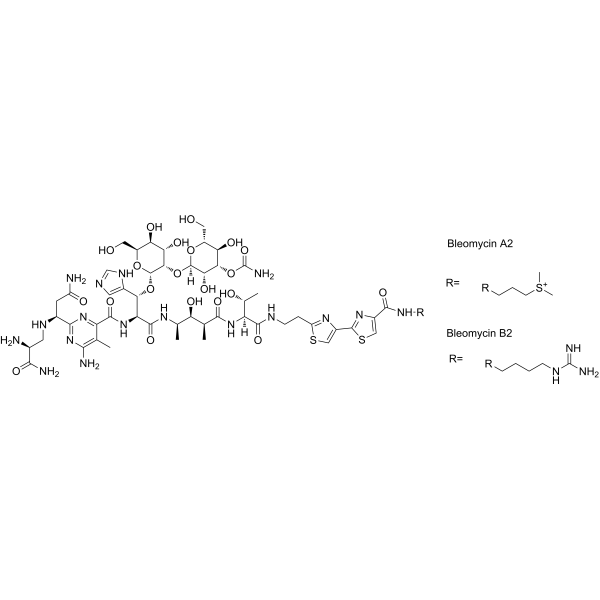
Physicochemical Properties
| Molecular Formula | C55H84N17O21S3 |
| Molecular Weight | 1415.55 |
| Exact Mass | 1414.518 |
| CAS # | 11056-06-7 |
| Related CAS # | Bleomycin sulfate;9041-93-4 |
| PubChem CID | 5460769 |
| Appearance | Colorless to yellow powder |
| LogP | -7.5 |
| Hydrogen Bond Donor Count | 20 |
| Hydrogen Bond Acceptor Count | 31 |
| Rotatable Bond Count | 36 |
| Heavy Atom Count | 96 |
| Complexity | 2580 |
| Defined Atom Stereocenter Count | 19 |
| SMILES | C[S+](CCCNC(C1=CSC(C2=CSC(CCNC([C@@H](NC([C@H]([C@@H]([C@H](NC([C@H]([C@@H](OC3OC(CO)C(O)C(O)C3OC3OC(CO)C(O)C(OC(=O)N)C3O)C3=CN=CN3)NC(C3=NC([C@@H](NC[C@@H](C(=O)N)N)CC(=O)N)=NC(N)=C3C)=O)=O)C)O)C)=O)[C@H](O)C)=O)=N2)=N1)=O)C |
| InChi Key | OYVAGSVQBOHSSS-UAPAGMARSA-O |
| InChi Code | InChI=1S/C55H83N17O21S3/c1-20-33(69-46(72-44(20)58)25(12-31(57)76)64-13-24(56)45(59)82)50(86)71-35(41(26-14-61-19-65-26)91-54-43(39(80)37(78)29(15-73)90-54)92-53-40(81)42(93-55(60)88)38(79)30(16-74)89-53)51(87)66-22(3)36(77)21(2)47(83)70-34(23(4)75)49(85)63-10-8-32-67-28(18-94-32)52-68-27(17-95-52)48(84)62-9-7-11-96(5)6/h14,17-19,21-25,29-30,34-43,53-54,64,73-75,77-81H,7-13,15-16,56H2,1-6H3,(H13-,57,58,59,60,61,62,63,65,66,69,70,71,72,76,82,83,84,85,86,87,88)/p+1/t21-,22+,23+,24-,25-,29-,30+,34-,35-,36-,37+,38+,39-,40-,41-,42-,43-,53+,54-/m0/s1 |
| Chemical Name | 3-[[2-[2-[2-[[(2S,3R)-2-[[(2S,3S,4R)-4-[[(2S,3R)-2-[[6-amino-2-[(1S)-3-amino-1-[[(2S)-2,3-diamino-3-oxopropyl]amino]-3-oxopropyl]-5-methylpyrimidine-4-carbonyl]amino]-3-[(2R,3S,4S,5S,6S)-3-[(2R,3S,4S,5R,6R)-4-carbamoyloxy-3,5-dihydroxy-6-(hydroxymethyl)oxan-2-yl]oxy-4,5-dihydroxy-6-(hydroxymethyl)oxan-2-yl]oxy-3-(1H-imidazol-5-yl)propanoyl]amino]-3-hydroxy-2-methylpentanoyl]amino]-3-hydroxybutanoyl]amino]ethyl]-1,3-thiazol-4-yl]-1,3-thiazole-4-carbonyl]amino]propyl-dimethylsulfanium |
| HS Tariff Code | 2934.99.9001 |
| Storage |
Powder-20°C 3 years 4°C 2 years In solvent -80°C 6 months -20°C 1 month |
| Shipping Condition | Room temperature (This product is stable at ambient temperature for a few days during ordinary shipping and time spent in Customs) |
Biological Activity
| ln Vitro | In V79 cells, bleomycin (0–4 mU/mL; 1 hour) causes double-strand breaks [2]. In S-phase cells, bleomycin (0–1 mU/mL; 1 hour) decreases DNA movement [2]. Chromatid abnormalities are induced in G2 cells by bleomycin (0-3 μg/mL; 1 hour) [3]. |
| ln Vivo | Bleomycin (1 mg and 10 μg; once injected into the retroorbital sinus) disrupts cell mitosis and promotes death in tumor models [4]. |
| Animal Protocol |
Animal/Disease Models: C57Bl/6 mice with LPB and B16F0 tumors [4] Doses: 1 mg and 10 μg Route of Administration: retroorbital sinus injection; 1 mg and 10 μg Primary Experimental Results: Proportion of mitotic cells in both tumors were diminished, apoptosis was induced after electrical pulse delivery, and the number of atypical cells increased in LPB tumors. |
| ADME/Pharmacokinetics |
Absorption, Distribution and Excretion Systemic absorption is approximately 45%. It was reported that patients with moderately severe renal failure excreted less than 20% of the dose in the urine. Bleomycin sulfate is not significantly absorbed from the GI tract and the drug must be administered parenterally. Bleomycin is absorbed systemically following intrapleural or intraperitoneal administration. Systemic absorption of 45% has been reported following intrapleural administration of bleomycin. Bleomycin is rapidly absorbed following either intramuscular (IM), subcutaneous (SC), intraperitoneal (IP) or intrapleural (IPL) administration reaching peak plasma concentrations in 30 to 60 minutes. Systemic bioavailability of bleomycin is 100% and 70% following IM and SC administrations, respectively, and 45% following both IP and IPL administrations, compared to intravenous and bolus administration. Bleomycin is widely distributed throughout the body with a mean volume of distribution of 17.5 L/sq m in patients following a 15 units/sq m IV bolus dose. Protein binding of bleomycin is very low (1%). For more Absorption, Distribution and Excretion (Complete) data for BLEOMYCIN (9 total), please visit the HSDB record page. Metabolism / Metabolites Hepatic Biotransformation is unknow; probably by enzymatic degradation in tissues (based on animal studdies). Tissue enzyme activity varies, which may determine toxicity and antitumor effect of bleomycin... It is not known if any of the metabolites are active. Bleomycin is inactivated by a cytosolic cysteine proteinase enzyme, bleomycin hydrolase. The enzyme is widely distributed in normal tissues with the exception of the skin and lungs, both targets of bleomycin toxicity. Systemic elimination of the drug by enzymatic degradation is probably only important in patients with severely compromised renal function. Biological Half-Life 115 minutes In patients with creatinine clearance exceeding 35 mL/minute, the serum or plasma terminal half-life of bleomycin is about 2 hours. In patients with creatinine clearances less than 35 mL/minute, the terminal half-life of the drug is inversely related to creatinine clearance. The average steady-state concentration of bleomycin in plasma of patients receiving continuous infusions of 30 units daily for 4-5 days is approx 150 ng/mL, and there is little bound to plasma proteins. Bleomycin disappears from plasma in a biphasic fashion; the initial half-life is about 1.3 hr, & the terminal half-life is approximately 9 hr. |
| Toxicity/Toxicokinetics |
Hepatotoxicity Chemotherapy with bleomycin in combination with other agents is associated with serum enzyme elevations in 10% to 40% of patients and with levels above 5 times ULN in 1% to 7% of patients, depending upon the dose and other agents used. The ALT elevations are usually asymptomatic and transient, resolving within a month of stopping chemotherapy. In many instances, it is difficult to attribute the liver test abnormalities to bleomycin because of the exposure to other potentially hepatotoxic agents. Rare instances of clinically apparent liver injury have been reported in patients receiving bleomycin, but the time to onset and pattern of injury has varied greatly and was usually attributed to other causes such as reactivation of hepatitis B or to sinusoidal obstruction syndrome due to other alkylating agents. Vanishing bile duct syndrome has been described during chemotherapy of Hodgkin disease with bleomycin containing regimens, but this distinctive form of liver injury also occurs in Hodgkin disease patients who are not treated; some instances arising before the diagnosis of lymphoma. The liver histology of bleomycin hepatotoxicity has not been well characterized, but it causes hepatic steatosis in animal models. In a single case report, biliary strictures and a sclerosing cholangitis-like syndrome was described arising several years after intra-arterial embolization of a large hepatic hemangioma with bleomycin. Likelihood score: D (possible rare cause of clinically apparent liver injury). Effects During Pregnancy and Lactation ◉ Summary of Use during Lactation Most sources consider breastfeeding to be contraindicated during maternal antineoplastic drug therapy. It might be possible to breastfeed safely during intermittent therapy with an appropriate period of breastfeeding abstinence. Although no data are available to determine an appropriate period to withhold breastfeeding, the drug's terminal half-life of 4 hours with normal kidney function suggests that withholding breastfeeding for at least 24 hours may be sufficient. This period may be longer in patients with impaired kidney function. Chemotherapy may adversely affect the normal microbiome and chemical makeup of breastmilk. Women who receive chemotherapy during pregnancy are more likely to have difficulty nursing their infant. ◉ Effects in Breastfed Infants Relevant published information was not found as of the revision date. ◉ Effects on Lactation and Breastmilk A woman diagnosed with Hodgkin's lymphoma during the second trimester of pregnancy received 3 rounds of chemotherapy during the third trimester of pregnancy and resumed chemotherapy 4 weeks postpartum. Milk samples were collected 15 to 30 minutes before and after chemotherapy for 16 weeks after restarting. The regimen consisted of doxorubicin 40 mg, bleomycin 16 units, vinblastine 9.6 mg and dacarbazine 600 mg, all given over a 2-hour period every 2 weeks. The microbial population and metabolic profile of her milk were compared to those of 8 healthy women who were not receiving chemotherapy. The breastmilk microbial population in the patient was markedly different from that of the healthy women, with increases in Acinetobacter sp., Xanthomonadacae and Stenotrophomonas sp. and decreases in Bifidobacterium sp. and Eubacterium sp. Marked differences were also found among numerous chemical components in the breastmilk of the treated woman, most notably DHA and inositol were decreased. A telephone follow-up study was conducted on 74 women who received cancer chemotherapy at one center during the second or third trimester of pregnancy to determine if they were successful at breastfeeding postpartum. Only 34% of the women were able to exclusively breastfeed their infants, and 66% of the women reported experiencing breastfeeding difficulties. This was in comparison to a 91% breastfeeding success rate in 22 other mothers diagnosed during pregnancy, but not treated with chemotherapy. Other statistically significant correlations included: 1. mothers with breastfeeding difficulties had an average of 5.5 cycles of chemotherapy compared with 3.8 cycles among mothers who had no difficulties; and 2. mothers with breastfeeding difficulties received their first cycle of chemotherapy on average 3.4 weeks earlier in pregnancy. Of the 9 women who received a bleomycin-containing regimen, 6 had breastfeeding difficulties. Protein Binding 1% |
| References |
[1]. Chen J, Stubbe J. Bleomycins: towards better therapeutics. Nat Rev Cancer. 2005;5(2):102-112. [2]. Detection of DNA double-strand breaks through the cell cycle after exposure to X-rays, bleomycin, etoposide and 125IdUrd. Int J Radiat Biol. 1993 Oct;64(4):349-58. [3]. Allio T, Preston RJ. Increased sensitivity to chromatid aberration induction by bleomycin and neocarzinostatin results from alterations in a DNA damage response pathway. Mutat Res. 2000 Sep 20;453(1):5-15. [4]. In vivo evolution of tumour cells after the generation of double-strand DNA breaks. Br J Cancer. 2003 Jun 2;88(11):1763-71. |
| Additional Infomation |
Bleomycin appears as colorless or yellowish powder. Possible bluish color depending on copper content. (NTP, 1992) Bleomycin A2 is a bleomycin. It has a role as an antineoplastic agent and a metabolite. A complex of related glycopeptide antibiotics from Streptomyces verticillus consisting of bleomycin A2 and B2 (B2 CAS # 9060-10-0). It inhibits DNA metabolism and is used as an antineoplastic, especially for solid tumors. Bleomycin A2 is used as the representative structure for Bleomycin. Bleomycin is a cystotoxic antibiotic that is used as an anticancer agent in the therapy of testicular and germ cell cancers, Hodgkin disease, lymphomas and tumors of the head and neck. Therapy with bleomycin in combination with other agents is often associated with mild-to-moderate serum enzyme elevations, but is a rare cause of clinically apparent liver injury. Bleomycin a2 has been reported in Streptomyces verticillus and Streptomyces mobaraensis with data available. Bleomycin A2 is the primary bleomycin species in bleomycin sulfate, a mixture of the sulfate salts of several basic glycopeptide antineoplastic antibiotics isolated from Streptomyces verticillus. Bleomycin A2 forms complexes with iron that reduce molecular oxygen to superoxide and hydroxyl radicals which cause single- and double-stranded breaks in DNA; these reactive oxygen species also induce lipid peroxidation, carbohydrate oxidation, and alterations in prostaglandin synthesis and degradation. (NCI04) Bleomycin is a mixture of glycopeptide antineoplastic antibiotics isolated from the bacterium Streptomyces verticillus. Bleomycin forms complexes with iron that reduce molecular oxygen to superoxide and hydroxyl radicals which cause single- and double-stranded breaks in DNA; these reactive oxygen species also induce lipid peroxidation, carbohydrate oxidation, and alterations in prostaglandin synthesis and degradation. A complex of related glycopeptide antibiotics from Streptomyces verticillus consisting of bleomycin A2 and B2. It inhibits DNA metabolism and is used as an antineoplastic, especially for solid tumors. Drug Indication For palliative treatment in the management malignant neoplasm (trachea, bronchus, lung), squamous cell carcinoma, and lymphomas. FDA Label Mechanism of Action Although the exact mechanism of action of bleomycin is unknown, available evidence would seem to indicate that the main mode of action is the inhibition of DNA synthesis with some evidence of lesser inhibition of RNA and protein synthesis. As evident in _in vitro_ studies, the DNA-cleaving actions of bleomycin is dependent on oxygen and metal ions. It is believed that bleomycin chelates metal ions (primarily iron) producing a pseudoenzyme that reacts with oxygen to produce superoxide and hydroxide free radicals that cleave DNA. Cytotoxic action of bleomycins results from their ability to cause fragmentation of DNA. Studies in vitro indicate that bleomycin causes accumulation of cells in the G2 phase of the cell cycle, and many of these cells display chromosomal aberrations, incl chromatid breaks, gaps, and fragments, as well as translocations. Bleomycin appears to cause scission of DNA by interacting with oxygen and iron(2+). In the presence of oxygen and a reducing agent, such as dithiothreitol, the metallobleomycin complex becomes activated and functions mechanistically as a ferrous oxidase, transferring electrons from iron(2) to molecular oxygen to produce activated species of oxygen. It has also been shown that metallobleomycin complexes can be activated by reaction with the flavin enzyme, NADPH-cytochrome p450 reductase. Bleomycin binds to DNA through its amino terminal peptide, and the activated complex generates free radicals that are responsible for scission of the DNA chain. Bleomycin is an antineoplastic antibiotic. The drug is active against gram-positive and gram-negative bacteria and fungi, but its cytotoxicity precludes its use as an anti-infective agent. The precise mechanism(s) of action of bleomycin is not fully known. Several studies in Escherichia coli and HeLa cells suggest that the drug inhibits the incorporation of thymidine into DNA. In these in vitro studies, DNA synthesis was inhibited to a greater extent than was RNA or protein synthesis. Bleomycin also appears to labilize the DNA structure, resulting in scission of both single- and double-stranded DNA. The drug has no immunosuppressive activity in mice. Bleomycin is classed as an antibiotic but is not used as an antimicrobial agent. Although bleomycin is effective against both cycling and non-cycling cells, it seems to be most effective in the G2 phase of cell division. Its exact mechanism of antineoplastic action is unknown but may involve binding to DNA, inducing lability of the DNA structure, and reduced synthesis of DNA, and to a lesser extent RNA and ptoteins. When administered into the pleural cavity in the treatment of malignant pleural effusion, /bleomycin/ acts as a sclerosing agent. |
Solubility Data
| Solubility (In Vitro) | May dissolve in DMSO (in most cases), if not, try other solvents such as H2O, Ethanol, or DMF with a minute amount of products to avoid loss of samples |
| Solubility (In Vivo) |
Note: Listed below are some common formulations that may be used to formulate products with low water solubility (e.g. < 1 mg/mL), you may test these formulations using a minute amount of products to avoid loss of samples. Injection Formulations (e.g. IP/IV/IM/SC) Injection Formulation 1: DMSO : Tween 80: Saline = 10 : 5 : 85 (i.e. 100 μL DMSO stock solution → 50 μL Tween 80 → 850 μL Saline) *Preparation of saline: Dissolve 0.9 g of sodium chloride in 100 mL ddH ₂ O to obtain a clear solution. Injection Formulation 2: DMSO : PEG300 :Tween 80 : Saline = 10 : 40 : 5 : 45 (i.e. 100 μL DMSO → 400 μLPEG300 → 50 μL Tween 80 → 450 μL Saline) Injection Formulation 3: DMSO : Corn oil = 10 : 90 (i.e. 100 μL DMSO → 900 μL Corn oil) Example: Take the Injection Formulation 3 (DMSO : Corn oil = 10 : 90) as an example, if 1 mL of 2.5 mg/mL working solution is to be prepared, you can take 100 μL 25 mg/mL DMSO stock solution and add to 900 μL corn oil, mix well to obtain a clear or suspension solution (2.5 mg/mL, ready for use in animals). Injection Formulation 4: DMSO : 20% SBE-β-CD in saline = 10 : 90 [i.e. 100 μL DMSO → 900 μL (20% SBE-β-CD in saline)] *Preparation of 20% SBE-β-CD in Saline (4°C,1 week): Dissolve 2 g SBE-β-CD in 10 mL saline to obtain a clear solution. Injection Formulation 5: 2-Hydroxypropyl-β-cyclodextrin : Saline = 50 : 50 (i.e. 500 μL 2-Hydroxypropyl-β-cyclodextrin → 500 μL Saline) Injection Formulation 6: DMSO : PEG300 : castor oil : Saline = 5 : 10 : 20 : 65 (i.e. 50 μL DMSO → 100 μLPEG300 → 200 μL castor oil → 650 μL Saline) Injection Formulation 7: Ethanol : Cremophor : Saline = 10: 10 : 80 (i.e. 100 μL Ethanol → 100 μL Cremophor → 800 μL Saline) Injection Formulation 8: Dissolve in Cremophor/Ethanol (50 : 50), then diluted by Saline Injection Formulation 9: EtOH : Corn oil = 10 : 90 (i.e. 100 μL EtOH → 900 μL Corn oil) Injection Formulation 10: EtOH : PEG300:Tween 80 : Saline = 10 : 40 : 5 : 45 (i.e. 100 μL EtOH → 400 μLPEG300 → 50 μL Tween 80 → 450 μL Saline) Oral Formulations Oral Formulation 1: Suspend in 0.5% CMC Na (carboxymethylcellulose sodium) Oral Formulation 2: Suspend in 0.5% Carboxymethyl cellulose Example: Take the Oral Formulation 1 (Suspend in 0.5% CMC Na) as an example, if 100 mL of 2.5 mg/mL working solution is to be prepared, you can first prepare 0.5% CMC Na solution by measuring 0.5 g CMC Na and dissolve it in 100 mL ddH2O to obtain a clear solution; then add 250 mg of the product to 100 mL 0.5% CMC Na solution, to make the suspension solution (2.5 mg/mL, ready for use in animals). Oral Formulation 3: Dissolved in PEG400 Oral Formulation 4: Suspend in 0.2% Carboxymethyl cellulose Oral Formulation 5: Dissolve in 0.25% Tween 80 and 0.5% Carboxymethyl cellulose Oral Formulation 6: Mixing with food powders Note: Please be aware that the above formulations are for reference only. InvivoChem strongly recommends customers to read literature methods/protocols carefully before determining which formulation you should use for in vivo studies, as different compounds have different solubility properties and have to be formulated differently. (Please use freshly prepared in vivo formulations for optimal results.) |
| Preparing Stock Solutions | 1 mg | 5 mg | 10 mg | |
| 1 mM | 0.7064 mL | 3.5322 mL | 7.0644 mL | |
| 5 mM | 0.1413 mL | 0.7064 mL | 1.4129 mL | |
| 10 mM | 0.0706 mL | 0.3532 mL | 0.7064 mL |