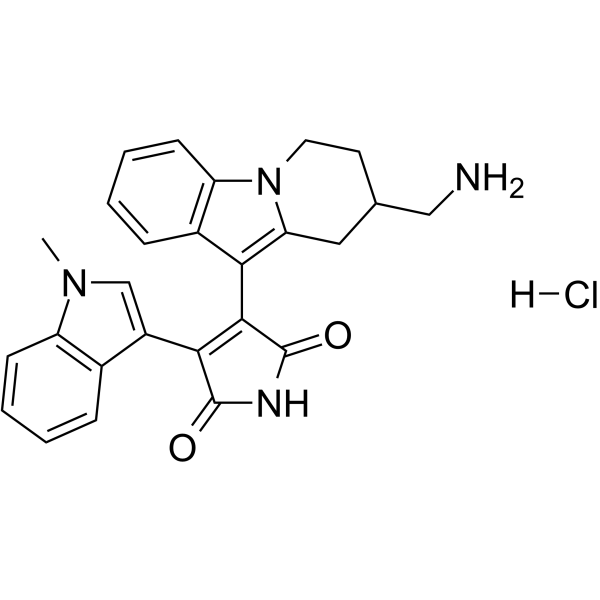
Physicochemical Properties
| Molecular Formula | C26H25CLN4O2 |
| Molecular Weight | 460.9553 |
| Exact Mass | 460.166 |
| Elemental Analysis | C, 67.75; H, 5.47; Cl, 7.69; N, 12.15; O, 6.94 |
| CAS # | 145317-11-9 |
| PubChem CID | 11539879 |
| Appearance | Light yellow to orange solid powder |
| Hydrogen Bond Donor Count | 3 |
| Hydrogen Bond Acceptor Count | 3 |
| Rotatable Bond Count | 3 |
| Heavy Atom Count | 33 |
| Complexity | 825 |
| Defined Atom Stereocenter Count | 0 |
| SMILES | Cl[H].O=C1C(=C(C(N1)=O)C1=CN(C)C2=CC=CC=C12)C1C2=CC=CC=C2N2CCC(CN)CC2=1 |
| InChi Key | IMBOYWXMTUUYGZ-UHFFFAOYSA-N |
| InChi Code | InChI=1S/C26H24N4O2.ClH/c1-29-14-18(16-6-2-4-8-19(16)29)23-24(26(32)28-25(23)31)22-17-7-3-5-9-20(17)30-11-10-15(13-27)12-21(22)30;/h2-9,14-15H,10-13,27H2,1H3,(H,28,31,32);1H |
| Chemical Name | 3-[8-(aminomethyl)-6,7,8,9-tetrahydropyrido[1,2-a]indol-10-yl]-4-(1-methylindol-3-yl)pyrrole-2,5-dione;hydrochloride |
| Synonyms | Ro-31-8425; 145317-11-9; Ro 31-8425; Ro31-8425;Bisindolylmaleimide X hydrochloride; bisindolylmaleimide x; Bisindoylmaleimide X HCl; Bisindolylmaleimide X (hydrochloride); Bisindolylmaleimide X HCl; 1H-Pyrrole-2,5-dione, 3-[8-(aMinoMethyl)-6,7,8,9-tetrahydropyrido[1,2-a]indol-10-yl]-4-(1-Methyl-1H-indol-3-yl)-, Monohy; Ro 318425; |
| HS Tariff Code | 2934.99.9001 |
| Storage |
Powder-20°C 3 years 4°C 2 years In solvent -80°C 6 months -20°C 1 month Note: Please store this product in a sealed and protected environment (e.g. under nitrogen), avoid exposure to moisture and light. |
| Shipping Condition | Room temperature (This product is stable at ambient temperature for a few days during ordinary shipping and time spent in Customs) |
Biological Activity
| Targets | CDK2 (IC50 = 200 nM); PKC |
| ln Vitro | Bisindolylmaleimide X hydrochloride (BIM-X hydrochloride; Ro31-8425 hydrochloride) derivatives are effective instruments for evaluating inhibitor potency and target selectivity [1]. |
| References |
[1]. Proteome-wide identification of cellular targets affected by bisindolylmaleimide-type protein kinase C inhibitors. Mol Cell Proteomics. 2004 May;3(5):490-500. |
| Additional Infomation | Bisindolylmaleimide compounds such as GF109203X are potent inhibitors of protein kinase C (PKC) activity. Although bisindolylmaleimides are not entirely selective for PKC and are known to inhibit a few other protein kinases, these reagents have been extensively used to study the functional roles of PKC family enzymes in cellular signal transduction for more than a decade. Here, we establish a proteomics approach to gain further insights into the cellular effects of this compound class. Functional immobilization of suitable bisindolylmaleimide analogues in combination with the specific purification of cellular binding proteins by affinity chromatography led to the identification of several known and previously unknown enzyme targets. Subsequent in vitro binding and activity assays confirmed the protein kinases Ste20-related kinase and cyclin-dependent kinase 2 (CDK2) and the non-protein kinases adenosine kinase and quinone reductase type 2 as novel targets of bisindolylmaleimide inhibitors. As observed specifically for CDK2, minor chemical variation of the ligand by immobilizing the closely related bisindolylmaleimides III, VIII, and X dramatically affected target binding. These observed changes in affinity correlated with both the measured IC(50) values for in vitro CDK2 inhibition and results from molecular docking into the CDK2 crystal structure. Moreover, the conditions for affinity purification could be adapted in a way that immobilized bisindolylmaleimide III selectively interacted with either PKC alpha or ribosomal S6 protein kinase 1 only after activation of these kinases. Thus, we have established an efficient technique for the rapid identification of cellular bisindolylmaleimide targets and further demonstrate the comparative selectivity profiling of closely related kinase inhibitors within a cellular proteome. [1] |
Solubility Data
| Solubility (In Vitro) |
DMSO : ~20.83 mg/mL (~45.19 mM) H2O : < 0.1 mg/mL |
| Solubility (In Vivo) |
Solubility in Formulation 1: ≥ 2.08 mg/mL (4.51 mM) (saturation unknown) in 10% DMSO + 40% PEG300 +5% Tween-80 + 45% Saline (add these co-solvents sequentially from left to right, and one by one), clear solution. For example, if 1 mL of working solution is to be prepared, you can add 100 μL of 20.8 mg/mL clear DMSO stock solution to 400 μL PEG300 and mix evenly; then add 50 μL Tween-80 + to the above solution and mix evenly; then add 450 μL normal saline to adjust the volume to 1 mL. Preparation of saline: Dissolve 0.9 g of sodium chloride in 100 mL ddH₂ O to obtain a clear solution. (Please use freshly prepared in vivo formulations for optimal results.) |
| Preparing Stock Solutions | 1 mg | 5 mg | 10 mg | |
| 1 mM | 2.1694 mL | 10.8469 mL | 21.6939 mL | |
| 5 mM | 0.4339 mL | 2.1694 mL | 4.3388 mL | |
| 10 mM | 0.2169 mL | 1.0847 mL | 2.1694 mL |