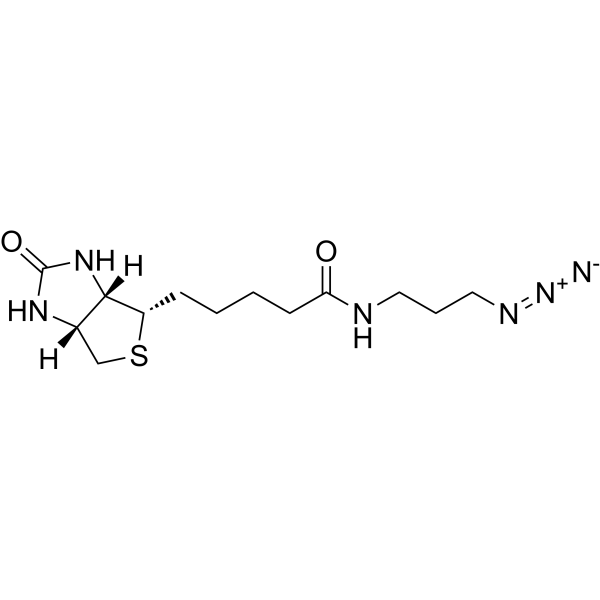
Biotin-azide (known also as N-(3-Azidopropyl)biotinamide) is azide form of biotin used to prepare various biotinylated conjugates via Click Chemistry, or a phosphine group, using Staudinger ligation. Biotin-azide has been commonly used to biotin-tag alkynylated lipids, particularly those associated with proteins through post-translational modification. It can also be used to biotin-tag proteins, lipids, carbohydrates, and nucleic acids that have been modified with alkyne or phosphine groups.
Physicochemical Properties
| Molecular Formula | C13H22N6O2S |
| Molecular Weight | 326.4178 |
| Exact Mass | 326.152 |
| CAS # | 908007-17-0 |
| PubChem CID | 59828156 |
| Appearance | White to off-white solid powder |
| Melting Point | 168 °C |
| LogP | 1.79 |
| Hydrogen Bond Donor Count | 3 |
| Hydrogen Bond Acceptor Count | 5 |
| Rotatable Bond Count | 9 |
| Heavy Atom Count | 22 |
| Complexity | 454 |
| Defined Atom Stereocenter Count | 3 |
| SMILES | C1[C@H]2[C@@H]([C@@H](S1)CCCCC(=O)NCCCN=[N+]=[N-])NC(=O)N2 |
| InChi Key | SWODDJWJUGOAQB-NHCYSSNCSA-N |
| InChi Code | InChI=1S/C13H22N6O2S/c14-19-16-7-3-6-15-11(20)5-2-1-4-10-12-9(8-22-10)17-13(21)18-12/h9-10,12H,1-8H2,(H,15,20)(H2,17,18,21)/t9-,10-,12-/m0/s1 |
| Chemical Name | 5-[(3aS,4S,6aR)-2-oxo-1,3,3a,4,6,6a-hexahydrothieno[3,4-d]imidazol-4-yl]-N-(3-azidopropyl)pentanamide |
| HS Tariff Code | 2934.99.9001 |
| Storage |
Powder-20°C 3 years 4°C 2 years In solvent -80°C 6 months -20°C 1 month |
| Shipping Condition | Room temperature (This product is stable at ambient temperature for a few days during ordinary shipping and time spent in Customs) |
Biological Activity
| ln Vitro | By functionalizing yeast cells with click chemistry and then cross-linking with biotin-conjugates, recombinant protein complexes can be extracted [3]. |
| References |
[1]. Tobacco mosaic virus-based protein nanoparticles and nanorods for chemotherapy delivery targeting breast cancer. J Control Release. 2016;231:103‐113. [2]. An azido-biotin reagent for use in the isolation of protein adducts of lipid-derived electrophiles by streptavidin catch and photorelease. Mol Cell Proteomics. 2009;8(9):2080‐2089. [3]. A Bifunctional Amino Acid Enables Both Covalent Chemical Capture and Isolation of in Vivo Protein-Protein Interactions. Chembiochem. 2017 Jan 17;18(2):181-184. |
Solubility Data
| Solubility (In Vitro) |
DMSO : ~100 mg/mL (~306.35 mM) H2O : ~4 mg/mL (~12.25 mM) |
| Solubility (In Vivo) |
Solubility in Formulation 1: ≥ 2.08 mg/mL (6.37 mM) (saturation unknown) in 10% DMSO + 40% PEG300 + 5% Tween80 + 45% Saline (add these co-solvents sequentially from left to right, and one by one), clear solution. For example, if 1 mL of working solution is to be prepared, you can add 100 μL of 20.8 mg/mL clear DMSO stock solution to 400 μL PEG300 and mix evenly; then add 50 μL Tween-80 to the above solution and mix evenly; then add 450 μL normal saline to adjust the volume to 1 mL. Preparation of saline: Dissolve 0.9 g of sodium chloride in 100 mL ddH₂ O to obtain a clear solution. Solubility in Formulation 2: ≥ 2.08 mg/mL (6.37 mM) (saturation unknown) in 10% DMSO + 90% (20% SBE-β-CD in Saline) (add these co-solvents sequentially from left to right, and one by one), clear solution. For example, if 1 mL of working solution is to be prepared, you can add 100 μL of 20.8 mg/mL clear DMSO stock solution to 900 μL of 20% SBE-β-CD physiological saline solution and mix evenly. Preparation of 20% SBE-β-CD in Saline (4°C,1 week): Dissolve 2 g SBE-β-CD in 10 mL saline to obtain a clear solution. Solubility in Formulation 3: ≥ 2.08 mg/mL (6.37 mM) (saturation unknown) in 10% DMSO + 90% Corn Oil (add these co-solvents sequentially from left to right, and one by one), clear solution. For example, if 1 mL of working solution is to be prepared, you can add 100 μL of 20.8 mg/mL clear DMSO stock solution to 900 μL of corn oil and mix evenly. (Please use freshly prepared in vivo formulations for optimal results.) |
| Preparing Stock Solutions | 1 mg | 5 mg | 10 mg | |
| 1 mM | 3.0635 mL | 15.3177 mL | 30.6354 mL | |
| 5 mM | 0.6127 mL | 3.0635 mL | 6.1271 mL | |
| 10 mM | 0.3064 mL | 1.5318 mL | 3.0635 mL |