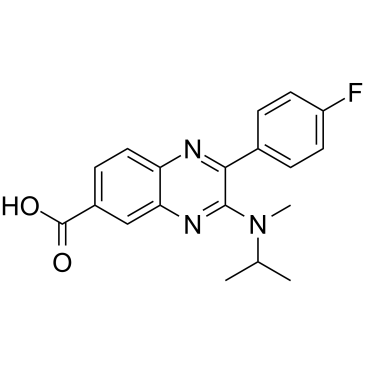
Description: BioE-1115 (BioE 1115) is a novel, potent and highly selective PAS kinase (PASK) inhibitor with an IC50 of ~4 nM, it is also a potent casein kinase 2α inhibitor with an IC50 of ~10 μM. It is a dual inhibitor of PAS kinase (PASK) and casein kinase 2α (CK2α).
Physicochemical Properties
| Molecular Formula | C19H18FN3O2 |
| Molecular Weight | 339.363527774811 |
| Exact Mass | 339.138 |
| CAS # | 1268863-35-9 |
| Related CAS # | 1268863-35-9 |
| PubChem CID | 50922674 |
| Appearance | Light yellow to yellow solid powder |
| LogP | 3.8 |
| Hydrogen Bond Donor Count | 1 |
| Hydrogen Bond Acceptor Count | 6 |
| Rotatable Bond Count | 4 |
| Heavy Atom Count | 25 |
| Complexity | 468 |
| Defined Atom Stereocenter Count | 0 |
| SMILES | FC1C=CC(=CC=1)C1C(=NC2C=C(C(=O)O)C=CC=2N=1)N(C)C(C)C |
| InChi Key | JKKRYYTVQXUOKL-UHFFFAOYSA-N |
| InChi Code | InChI=1S/C19H18FN3O2/c1-11(2)23(3)18-17(12-4-7-14(20)8-5-12)21-15-9-6-13(19(24)25)10-16(15)22-18/h4-11H,1-3H3,(H,24,25) |
| Chemical Name | 2-(4-fluorophenyl)-3-[methyl(propan-2-yl)amino]quinoxaline-6-carboxylic acid |
| Synonyms | BioE-1115BioE 1115BioE1115 |
| HS Tariff Code | 2934.99.9001 |
| Storage |
Powder-20°C 3 years 4°C 2 years In solvent -80°C 6 months -20°C 1 month |
| Shipping Condition | Room temperature (This product is stable at ambient temperature for a few days during ordinary shipping and time spent in Customs) |
Biological Activity
| ln Vitro | With an IC50 of approximately 1 μM in HEK293 cells, a dose that is thought to cause a loss of PASK phosphorylation was demonstrated in the presence of BioE-1115 [1]. When BioE-1115 was applied at a dose of 10 μM, HepG2 cell growth rate and cell shape did not exhibit any discernible changes, but SREBP activity was significantly reduced [1]. |
| ln Vivo | Doses of Gpat1, Fasn, and all other SREBP-1c target gene expression examined in BioE-1115 (1-100 mg/kg; borderline gavage; daily; for 7 days; cosmetic Sprague-Dawley construct) were found to be dose regulators. SREBP-1 saturation in Manhattan was also inhibited at doses of 10, 30, and 100 mg/kg treated with 1115. BioE-1115 was applied in a dose-dependent manner to decrease HOMA-IR, a computed marker of insulin resistance. By using BioE-1115, liver and serum TAG were decreased in a dose-dependent manner. Serum blood glucose levels significantly dropped after receiving BioE-1115 therapy. At the highest dose, the mRNA for SREBP-1c and SREBP-1a fell consistently. |
| Animal Protocol |
Animal/Disease Models: Male SD (SD (Sprague-Dawley)) rats (12 weeks old; 129.4 ± 0.63 g) fed a high-fructose diet [1] Doses: 1 mg of BioE-1115 did not cause significant changes in body weight or weight [1]. /kg, 3 mg/kg, 10 mg/kg, 30 mg/kg and 100 mg/kg Route of Administration: po (oral gavage); daily; 7-day Experimental Results: Treatment with 10, 30 and 100 mg/kg, shown Dose-dependent inhibition of Gpat1, Fasn, and all other SREBP-1c target gene expression analyzed. Hepatic expression of lipogenic SREBP-1c target genes was diminished, serum triglycerides were diminished and insulin resistance was partially reversed. |
| References |
[1]. PAS kinase drives lipogenesis through SREBP-1 maturation. Cell Rep. 2014 Jul 10;8(1):242-55. |
Solubility Data
| Solubility (In Vitro) | DMSO : ~62.5 mg/mL (~184.17 mM) |
| Solubility (In Vivo) |
Solubility in Formulation 1: 2.08 mg/mL (6.13 mM) in 10% DMSO + 40% PEG300 + 5% Tween80 + 45% Saline (add these co-solvents sequentially from left to right, and one by one), suspension solution; with sonication. For example, if 1 mL of working solution is to be prepared, you can add 100 μL of 20.8 mg/mL clear DMSO stock solution to 400 μL PEG300 and mix evenly; then add 50 μL Tween-80 to the above solution and mix evenly; then add 450 μL normal saline to adjust the volume to 1 mL. Preparation of saline: Dissolve 0.9 g of sodium chloride in 100 mL ddH₂ O to obtain a clear solution. Solubility in Formulation 2: ≥ 2.08 mg/mL (6.13 mM) (saturation unknown) in 10% DMSO + 90% Corn Oil (add these co-solvents sequentially from left to right, and one by one), clear solution. For example, if 1 mL of working solution is to be prepared, you can add 100 μL of 20.8 mg/mL clear DMSO stock solution to 900 μL of corn oil and mix evenly. (Please use freshly prepared in vivo formulations for optimal results.) |
| Preparing Stock Solutions | 1 mg | 5 mg | 10 mg | |
| 1 mM | 2.9467 mL | 14.7336 mL | 29.4672 mL | |
| 5 mM | 0.5893 mL | 2.9467 mL | 5.8934 mL | |
| 10 mM | 0.2947 mL | 1.4734 mL | 2.9467 mL |