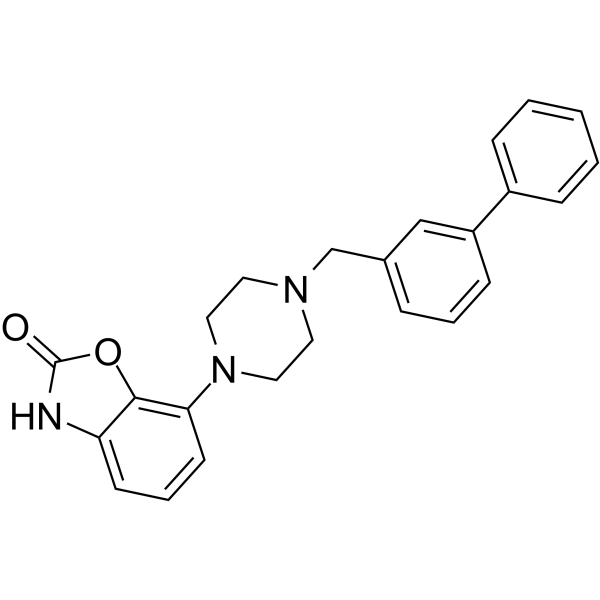
Physicochemical Properties
| Molecular Formula | C24H23N3O2 |
| Molecular Weight | 385.45832 |
| Exact Mass | 385.179 |
| CAS # | 350992-10-8 |
| Related CAS # | Bifeprunox mesylate;350992-13-1 |
| PubChem CID | 208951 |
| Appearance | Typically exists as solid at room temperature |
| Density | 1.247g/cm3 |
| Index of Refraction | 1.643 |
| LogP | 4.113 |
| Hydrogen Bond Donor Count | 1 |
| Hydrogen Bond Acceptor Count | 4 |
| Rotatable Bond Count | 4 |
| Heavy Atom Count | 29 |
| Complexity | 556 |
| Defined Atom Stereocenter Count | 0 |
| SMILES | C1=CC=C(C=C1)C2=CC=CC(=C2)CN3CCN(CC3)C4=CC=CC5=C4OC(=N5)O |
| InChi Key | CYGODHVAJQTCBG-UHFFFAOYSA-N |
| InChi Code | InChI=1S/C24H23N3O2/c28-24-25-21-10-5-11-22(23(21)29-24)27-14-12-26(13-15-27)17-18-6-4-9-20(16-18)19-7-2-1-3-8-19/h1-11,16H,12-15,17H2,(H,25,28) |
| Chemical Name | 7-[4-[(3-phenylphenyl)methyl]piperazin-1-yl]-3H-1,3-benzoxazol-2-one |
| HS Tariff Code | 2934.99.9001 |
| Storage |
Powder-20°C 3 years 4°C 2 years In solvent -80°C 6 months -20°C 1 month |
| Shipping Condition | Room temperature (This product is stable at ambient temperature for a few days during ordinary shipping and time spent in Customs) |
Biological Activity
| ln Vitro | Bifeprunox binds to the h5-HT1A receptor with a pKi of 8 and an Emax of 70% [1]. |
| ln Vivo | In mice, marble burying is decreased by bifeprunox (0.001-2.5 mg/kg) [2]. Rats' responses to drug-related cues alter their behavior when they seek nicotine when exposed to bifeprunox (4–250 μg/kg) [3]. |
| Animal Protocol |
Animal/Disease Models: Male NMRI mice (body weight 20-22 g) [2] Doses: 0.001, 0.0025, 0.01, 0.04, 0.16, 0.63 and 2.5 mg/kg Route of Administration: intraperitoneal (ip) injection Experimental Results: diminished marble burial. Effective activity begins at 0.0025 mg/kg. Animal/Disease Models: Naive male Wistar rats (body weight 250-275 g) [3] Doses: 4, 16, 64 and 250 μg/kg Route of Administration: subcutaneous injection 30 minutes before test Experimental Results: 4-16 μg/kg dose dependent Effects of nicotine-related cues on sexually attenuated response restoration. Higher doses (64-250 μg/kg, subcutaneously (sc) (sc)) reduce spontaneous locomotor activity and inhibit operant responses induced by sucrose-related cues and the primary reinforcing properties of nicotine or sucrose. |
| References |
[1]. Newman-Tancredi A, et al. Novel antipsychotics activate recombinant human and native rat serotonin 5-HT1A receptors: affinity, efficacy and potential implications for treatment of schizophrenia. Int J Neuropsychopharmacol. 2005 Sep;8(3):341-56. [2]. Bruins Slot LA, et al. Effects of antipsychotics and reference monoaminergic ligands on marble burying behavior in mice. Behav Pharmacol. 2008 Mar;19(2):145-52. [3]. Di Clemente A, et al. Bifeprunox: a partial agonist at dopamine D2 and serotonin 1A receptors, influences nicotine-seeking behaviour in response to drug-associated stimuli in rats. Addict Biol. 2012 Mar;17(2):274-86. |
| Additional Infomation |
Bifeprunox is a member of biphenyls. Bifeprunox is a novel atypical antipsychotic agent which, along with SLV313, [aripiprazole] and SSR-181507 combines minimal D2 receptor agonism with 5-HT receptor agonism. See also: Bifeprunox Mesylate (annotation moved to). Drug Indication Bifeprunox is being evaluated for the treatment of schizophrenia, psychosis, and Parkinson's disease. Mechanism of Action In contrast to D2 receptor antagonism, partial D2 agonism is believed to decrease dopamine activity in an overactive dopamine system while simultaneously increasing dopamine activity in regions of the brain where dopaminergic activity is too low. By blocking overstimulated receptors and stimulating underactive ones, partial D2 agonists act as dopamine stabilisers. In common with aripiprazole, bifeprunox also acts as a serotonin, 5-HT1A agonist. This property may contribute to efficacy against the negative symptoms of schizophrenia and reduce the likelihood of extrapyramidal symptoms (EPS). |
Solubility Data
| Solubility (In Vitro) | May dissolve in DMSO (in most cases), if not, try other solvents such as H2O, Ethanol, or DMF with a minute amount of products to avoid loss of samples |
| Solubility (In Vivo) |
Note: Listed below are some common formulations that may be used to formulate products with low water solubility (e.g. < 1 mg/mL), you may test these formulations using a minute amount of products to avoid loss of samples. Injection Formulations (e.g. IP/IV/IM/SC) Injection Formulation 1: DMSO : Tween 80: Saline = 10 : 5 : 85 (i.e. 100 μL DMSO stock solution → 50 μL Tween 80 → 850 μL Saline) *Preparation of saline: Dissolve 0.9 g of sodium chloride in 100 mL ddH ₂ O to obtain a clear solution. Injection Formulation 2: DMSO : PEG300 :Tween 80 : Saline = 10 : 40 : 5 : 45 (i.e. 100 μL DMSO → 400 μLPEG300 → 50 μL Tween 80 → 450 μL Saline) Injection Formulation 3: DMSO : Corn oil = 10 : 90 (i.e. 100 μL DMSO → 900 μL Corn oil) Example: Take the Injection Formulation 3 (DMSO : Corn oil = 10 : 90) as an example, if 1 mL of 2.5 mg/mL working solution is to be prepared, you can take 100 μL 25 mg/mL DMSO stock solution and add to 900 μL corn oil, mix well to obtain a clear or suspension solution (2.5 mg/mL, ready for use in animals). Injection Formulation 4: DMSO : 20% SBE-β-CD in saline = 10 : 90 [i.e. 100 μL DMSO → 900 μL (20% SBE-β-CD in saline)] *Preparation of 20% SBE-β-CD in Saline (4°C,1 week): Dissolve 2 g SBE-β-CD in 10 mL saline to obtain a clear solution. Injection Formulation 5: 2-Hydroxypropyl-β-cyclodextrin : Saline = 50 : 50 (i.e. 500 μL 2-Hydroxypropyl-β-cyclodextrin → 500 μL Saline) Injection Formulation 6: DMSO : PEG300 : castor oil : Saline = 5 : 10 : 20 : 65 (i.e. 50 μL DMSO → 100 μLPEG300 → 200 μL castor oil → 650 μL Saline) Injection Formulation 7: Ethanol : Cremophor : Saline = 10: 10 : 80 (i.e. 100 μL Ethanol → 100 μL Cremophor → 800 μL Saline) Injection Formulation 8: Dissolve in Cremophor/Ethanol (50 : 50), then diluted by Saline Injection Formulation 9: EtOH : Corn oil = 10 : 90 (i.e. 100 μL EtOH → 900 μL Corn oil) Injection Formulation 10: EtOH : PEG300:Tween 80 : Saline = 10 : 40 : 5 : 45 (i.e. 100 μL EtOH → 400 μLPEG300 → 50 μL Tween 80 → 450 μL Saline) Oral Formulations Oral Formulation 1: Suspend in 0.5% CMC Na (carboxymethylcellulose sodium) Oral Formulation 2: Suspend in 0.5% Carboxymethyl cellulose Example: Take the Oral Formulation 1 (Suspend in 0.5% CMC Na) as an example, if 100 mL of 2.5 mg/mL working solution is to be prepared, you can first prepare 0.5% CMC Na solution by measuring 0.5 g CMC Na and dissolve it in 100 mL ddH2O to obtain a clear solution; then add 250 mg of the product to 100 mL 0.5% CMC Na solution, to make the suspension solution (2.5 mg/mL, ready for use in animals). Oral Formulation 3: Dissolved in PEG400 Oral Formulation 4: Suspend in 0.2% Carboxymethyl cellulose Oral Formulation 5: Dissolve in 0.25% Tween 80 and 0.5% Carboxymethyl cellulose Oral Formulation 6: Mixing with food powders Note: Please be aware that the above formulations are for reference only. InvivoChem strongly recommends customers to read literature methods/protocols carefully before determining which formulation you should use for in vivo studies, as different compounds have different solubility properties and have to be formulated differently. (Please use freshly prepared in vivo formulations for optimal results.) |
| Preparing Stock Solutions | 1 mg | 5 mg | 10 mg | |
| 1 mM | 2.5943 mL | 12.9715 mL | 25.9430 mL | |
| 5 mM | 0.5189 mL | 2.5943 mL | 5.1886 mL | |
| 10 mM | 0.2594 mL | 1.2972 mL | 2.5943 mL |