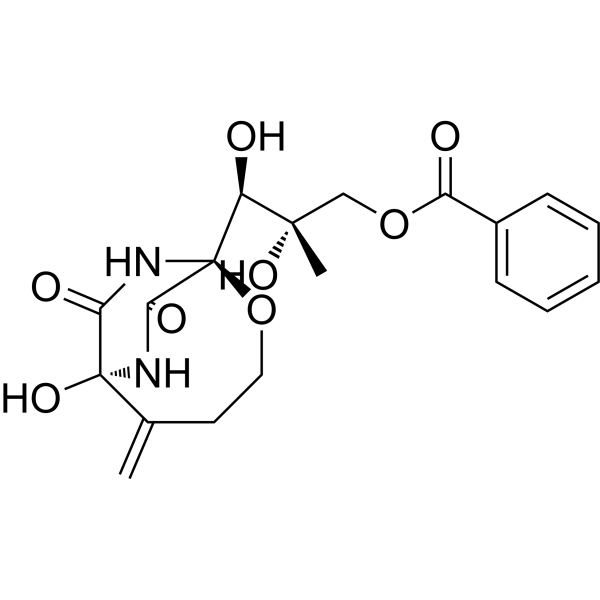
Physicochemical Properties
| Molecular Formula | C19H22N2O8 |
| Molecular Weight | 406.3866 |
| Exact Mass | 406.137 |
| CAS # | 37134-40-0 |
| Related CAS # | Bicyclomycin;38129-37-2 |
| PubChem CID | 91618023 |
| Appearance | White to off-white solid powder |
| Density | 1.5±0.1 g/cm3 |
| Boiling Point | 788.6±60.0 °C at 760 mmHg |
| Flash Point | 430.7±32.9 °C |
| Vapour Pressure | 0.0±2.9 mmHg at 25°C |
| Index of Refraction | 1.640 |
| LogP | 1.87 |
| Hydrogen Bond Donor Count | 5 |
| Hydrogen Bond Acceptor Count | 8 |
| Rotatable Bond Count | 6 |
| Heavy Atom Count | 29 |
| Complexity | 721 |
| Defined Atom Stereocenter Count | 4 |
| SMILES | O1C([H])([H])C([H])([H])C(=C([H])[H])[C@]2(C(N([H])[C@@]1(C(N2[H])=O)[C@]([H])([C@](C([H])([H])[H])(C([H])([H])OC(C1C([H])=C([H])C([H])=C([H])C=1[H])=O)O[H])O[H])=O)O[H] |
| InChi Key | YYGLCPHONATYBU-FZDIXFNVSA-N |
| InChi Code | InChI=1S/C19H22N2O8/c1-11-8-9-29-19(16(25)20-18(11,27)15(24)21-19)14(23)17(2,26)10-28-13(22)12-6-4-3-5-7-12/h3-7,14,23,26-27H,1,8-10H2,2H3,(H,20,25)(H,21,24)/t14-,17-,18+,19-/m0/s1 |
| Chemical Name | [(2S,3S)-2,3-dihydroxy-3-[(1S,6R)-6-hydroxy-5-methylidene-8,10-dioxo-2-oxa-7,9-diazabicyclo[4.2.2]decan-1-yl]-2-methylpropyl] benzoate |
| HS Tariff Code | 2934.99.9001 |
| Storage |
Powder-20°C 3 years 4°C 2 years In solvent -80°C 6 months -20°C 1 month |
| Shipping Condition | Room temperature (This product is stable at ambient temperature for a few days during ordinary shipping and time spent in Customs) |
Biological Activity
| ln Vitro | Dicyclomycin's primary action is to obstruct lipoprotein production and assembly with peptidoglycan in the E. coli cell envelope. Coli. Dicyclomycin suppresses RNA and protein synthesis in growing E. coli at fatal concentrations. fifteen THU of coli cells [1]. In Escherichia coli, dicyclomycin targets the rho transcription termination factor. Dicyclomycin is a weak rho inhibitor that can damage the rho molecular mechanism, causing anomalous constitutively expressed proteins to be overproduced too soon, which can have harmful effects on cells and cause catastrophic outcomes [2]. Dicyclomycin has been discovered to inhibit rho poly(C)-stimulated ATP hydrolysis via a noncompetitive, reversible route with regard to ATP (Ki=20 μM) [3]. |
| ln Vivo | Rats excreted a small amount of dicyclomycin following a single intramuscular dose of 50 mg/kg. Dicyclomycin is widely dispersed throughout the body, with the kidney exhibiting the greatest concentration of 100 mg/kg [4]. |
| References |
[1]. Tanaka N, et al. Mechanism of action of bicyclomycin. J Antibiot (Tokyo). 1976 Feb;29(2):155-68. [2]. Kohn H, et al. The molecular basis for the mode of action of bicyclomycin. Curr Drug Targets Infect Disord. 2005 Sep;5(3):273-95. [3]. Park HG, et al. Bicyclomycin and dihydrobicyclomycin inhibition kinetics of Escherichia coli rho-dependent transcription termination factor ATPase activity. Arch Biochem Biophys. 1995 Nov 10;323(2):447-54. [4]. Nishida M. et al. Bicyclomycin, a new antibiotic. IV. Absorption, excretion and tissue distribution. J Antibiot (Tokyo). 1972 Oct;25(10):594-601 |
Solubility Data
| Solubility (In Vitro) | DMSO : ~100 mg/mL (~246.07 mM) |
| Solubility (In Vivo) |
Solubility in Formulation 1: ≥ 2.5 mg/mL (6.15 mM) (saturation unknown) in 10% DMSO + 40% PEG300 + 5% Tween80 + 45% Saline (add these co-solvents sequentially from left to right, and one by one), clear solution. For example, if 1 mL of working solution is to be prepared, you can add 100 μL of 25.0 mg/mL clear DMSO stock solution to 400 μL PEG300 and mix evenly; then add 50 μL Tween-80 to the above solution and mix evenly; then add 450 μL normal saline to adjust the volume to 1 mL. Preparation of saline: Dissolve 0.9 g of sodium chloride in 100 mL ddH₂ O to obtain a clear solution. Solubility in Formulation 2: ≥ 2.5 mg/mL (6.15 mM) (saturation unknown) in 10% DMSO + 90% (20% SBE-β-CD in Saline) (add these co-solvents sequentially from left to right, and one by one), clear solution. For example, if 1 mL of working solution is to be prepared, you can add 100 μL of 25.0 mg/mL clear DMSO stock solution to 900 μL of 20% SBE-β-CD physiological saline solution and mix evenly. Preparation of 20% SBE-β-CD in Saline (4°C,1 week): Dissolve 2 g SBE-β-CD in 10 mL saline to obtain a clear solution. Solubility in Formulation 3: ≥ 2.5 mg/mL (6.15 mM) (saturation unknown) in 10% DMSO + 90% Corn Oil (add these co-solvents sequentially from left to right, and one by one), clear solution. For example, if 1 mL of working solution is to be prepared, you can add 100 μL of 25.0 mg/mL clear DMSO stock solution to 900 μL of corn oil and mix evenly. (Please use freshly prepared in vivo formulations for optimal results.) |
| Preparing Stock Solutions | 1 mg | 5 mg | 10 mg | |
| 1 mM | 2.4607 mL | 12.3035 mL | 24.6069 mL | |
| 5 mM | 0.4921 mL | 2.4607 mL | 4.9214 mL | |
| 10 mM | 0.2461 mL | 1.2303 mL | 2.4607 mL |