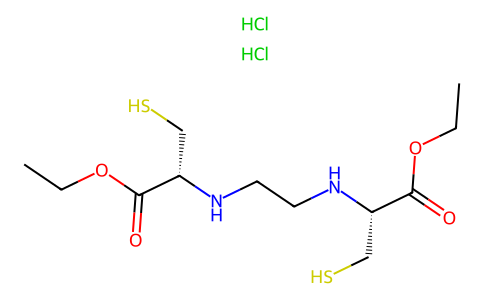
Physicochemical Properties
| Molecular Formula | C12H24N2O4S2.2[HCL] |
| Molecular Weight | 397.38184 |
| Exact Mass | 396.071 |
| CAS # | 14344-58-2 |
| Related CAS # | 121251-02-3;14344-58-2 (HCl); |
| PubChem CID | 71586979 |
| Appearance | Typically exists as solid at room temperature |
| Flash Point | 195.7ºC |
| LogP | 2.274 |
| Hydrogen Bond Donor Count | 6 |
| Hydrogen Bond Acceptor Count | 8 |
| Rotatable Bond Count | 13 |
| Heavy Atom Count | 22 |
| Complexity | 265 |
| Defined Atom Stereocenter Count | 2 |
| SMILES | Cl.Cl.CCOC([C@@H](NCCN[C@H](C(OCC)=O)CS)CS)=O |
| InChi Key | HKASNZKRIQURIX-BZDVOYDHSA-N |
| InChi Code | InChI=1S/C12H24N2O4S2.2ClH/c1-3-17-11(15)9(7-19)13-5-6-14-10(8-20)12(16)18-4-2;;/h9-10,13-14,19-20H,3-8H2,1-2H3;2*1H/t9-,10-;;/m0../s1 |
| Chemical Name | ethyl (2R)-2-[2-[[(2R)-1-ethoxy-1-oxo-3-sulfanylpropan-2-yl]amino]ethylamino]-3-sulfanylpropanoate;dihydrochloride |
| HS Tariff Code | 2934.99.9001 |
| Storage |
Powder-20°C 3 years 4°C 2 years In solvent -80°C 6 months -20°C 1 month |
| Shipping Condition | Room temperature (This product is stable at ambient temperature for a few days during ordinary shipping and time spent in Customs) |
Biological Activity
| Toxicity/Toxicokinetics |
Effects During Pregnancy and Lactation ◉ Summary of Use during Lactation Information in this record refers to the use of technetium Tc 99m bicisate (Tc 99m ethylcysteinate dimer; Tc 99m ECD) as a diagnostic agent. A US Nuclear Regulatory Commission subcommittee has recommended that nursing be discontinued for 24 hours after administration of all technetium Tc 99m diagnostic products to simplify guidance recommendations, although this time interval may be longer than necessary. The International Commission on Radiological Protection states that breastfeeding need not be interrupted after administration of Tc 99m ECD. To follow the principle of keeping exposure "as low as reasonably achievable", some experts recommend nursing the infant just before administration of the radiopharmaceutical and interrupting breastfeeding for 3 to 6 hours after the dose, then expressing the milk completely once and discarding it. If the mother has expressed and saved milk prior to the examination, she can feed it to the infant during the period of nursing interruption. Mothers need not refrain from close contact with their infants after usual clinical doses. However, reducing close contact with the child to the least possible time for 6 hours following injection of the radiopharmaceutical, will ensure that the exposure is "as low as reasonably achievable". Mothers concerned about the level of radioactivity in their milk could ask to have it tested at a nuclear medicine facility at their hospital. When the radioactivity is at a safe level, she may resume breastfeeding. A method for measuring milk radioactivity and determining the time when a mother can safely resume breastfeeding has been published. For nursing mothers who work with Tc 99m substances in their workplace, there is no need to take any precautions other than those appropriate for general radiation protection. ◉ Effects in Breastfed Infants Relevant published information was not found as of the revision date. ◉ Effects on Lactation and Breastmilk Relevant published information was not found as of the revision date. |
| Additional Infomation | See also: Bicisate (has active moiety). |
Solubility Data
| Solubility (In Vitro) | May dissolve in DMSO (in most cases), if not, try other solvents such as H2O, Ethanol, or DMF with a minute amount of products to avoid loss of samples |
| Solubility (In Vivo) |
Note: Listed below are some common formulations that may be used to formulate products with low water solubility (e.g. < 1 mg/mL), you may test these formulations using a minute amount of products to avoid loss of samples. Injection Formulations (e.g. IP/IV/IM/SC) Injection Formulation 1: DMSO : Tween 80: Saline = 10 : 5 : 85 (i.e. 100 μL DMSO stock solution → 50 μL Tween 80 → 850 μL Saline) *Preparation of saline: Dissolve 0.9 g of sodium chloride in 100 mL ddH ₂ O to obtain a clear solution. Injection Formulation 2: DMSO : PEG300 :Tween 80 : Saline = 10 : 40 : 5 : 45 (i.e. 100 μL DMSO → 400 μLPEG300 → 50 μL Tween 80 → 450 μL Saline) Injection Formulation 3: DMSO : Corn oil = 10 : 90 (i.e. 100 μL DMSO → 900 μL Corn oil) Example: Take the Injection Formulation 3 (DMSO : Corn oil = 10 : 90) as an example, if 1 mL of 2.5 mg/mL working solution is to be prepared, you can take 100 μL 25 mg/mL DMSO stock solution and add to 900 μL corn oil, mix well to obtain a clear or suspension solution (2.5 mg/mL, ready for use in animals). Injection Formulation 4: DMSO : 20% SBE-β-CD in saline = 10 : 90 [i.e. 100 μL DMSO → 900 μL (20% SBE-β-CD in saline)] *Preparation of 20% SBE-β-CD in Saline (4°C,1 week): Dissolve 2 g SBE-β-CD in 10 mL saline to obtain a clear solution. Injection Formulation 5: 2-Hydroxypropyl-β-cyclodextrin : Saline = 50 : 50 (i.e. 500 μL 2-Hydroxypropyl-β-cyclodextrin → 500 μL Saline) Injection Formulation 6: DMSO : PEG300 : castor oil : Saline = 5 : 10 : 20 : 65 (i.e. 50 μL DMSO → 100 μLPEG300 → 200 μL castor oil → 650 μL Saline) Injection Formulation 7: Ethanol : Cremophor : Saline = 10: 10 : 80 (i.e. 100 μL Ethanol → 100 μL Cremophor → 800 μL Saline) Injection Formulation 8: Dissolve in Cremophor/Ethanol (50 : 50), then diluted by Saline Injection Formulation 9: EtOH : Corn oil = 10 : 90 (i.e. 100 μL EtOH → 900 μL Corn oil) Injection Formulation 10: EtOH : PEG300:Tween 80 : Saline = 10 : 40 : 5 : 45 (i.e. 100 μL EtOH → 400 μLPEG300 → 50 μL Tween 80 → 450 μL Saline) Oral Formulations Oral Formulation 1: Suspend in 0.5% CMC Na (carboxymethylcellulose sodium) Oral Formulation 2: Suspend in 0.5% Carboxymethyl cellulose Example: Take the Oral Formulation 1 (Suspend in 0.5% CMC Na) as an example, if 100 mL of 2.5 mg/mL working solution is to be prepared, you can first prepare 0.5% CMC Na solution by measuring 0.5 g CMC Na and dissolve it in 100 mL ddH2O to obtain a clear solution; then add 250 mg of the product to 100 mL 0.5% CMC Na solution, to make the suspension solution (2.5 mg/mL, ready for use in animals). Oral Formulation 3: Dissolved in PEG400 Oral Formulation 4: Suspend in 0.2% Carboxymethyl cellulose Oral Formulation 5: Dissolve in 0.25% Tween 80 and 0.5% Carboxymethyl cellulose Oral Formulation 6: Mixing with food powders Note: Please be aware that the above formulations are for reference only. InvivoChem strongly recommends customers to read literature methods/protocols carefully before determining which formulation you should use for in vivo studies, as different compounds have different solubility properties and have to be formulated differently. (Please use freshly prepared in vivo formulations for optimal results.) |
| Preparing Stock Solutions | 1 mg | 5 mg | 10 mg | |
| 1 mM | 2.5165 mL | 12.5824 mL | 25.1648 mL | |
| 5 mM | 0.5033 mL | 2.5165 mL | 5.0330 mL | |
| 10 mM | 0.2516 mL | 1.2582 mL | 2.5165 mL |