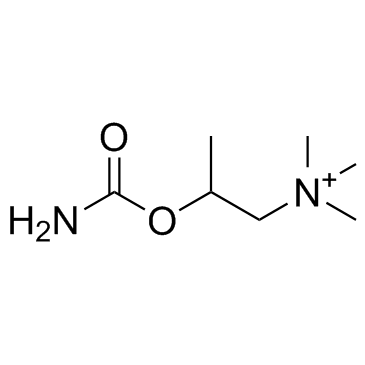
Bethanechol (Carbamyl-β-methylcholine chloride), a parasympathomimetic choline carbamate and an analog of acetylcholine, is a selective muscarinic receptor agonist without any effect on nicotinic receptors. In addition to treating dry mouth, bethanechol can also be administered subcutaneously or orally to treat gastrointestinal lack of muscular tone, diabetic neuropathy of the bladder, and urinary retention brought on by general anesthesia.
Physicochemical Properties
| Molecular Formula | C₇H₁₇N₂O₂ |
| Molecular Weight | 161.22 |
| Exact Mass | 161.129 |
| CAS # | 674-38-4 |
| Related CAS # | Bethanechol chloride; 590-63-6 |
| PubChem CID | 2370 |
| Appearance | Typically exists as solid at room temperature |
| Melting Point | 217 - 221 °C (chloride salt) |
| LogP | 0.876 |
| Hydrogen Bond Donor Count | 1 |
| Hydrogen Bond Acceptor Count | 2 |
| Rotatable Bond Count | 4 |
| Heavy Atom Count | 11 |
| Complexity | 140 |
| Defined Atom Stereocenter Count | 0 |
| SMILES | CC(OC(N)=O)C[N+](C)(C)C |
| InChi Key | NZUPCNDJBJXXRF-UHFFFAOYSA-O |
| InChi Code | InChI=1S/C7H16N2O2/c1-6(11-7(8)10)5-9(2,3)4/h6H,5H2,1-4H3,(H-,8,10)/p+1 |
| Chemical Name | 2-carbamoyloxypropyl(trimethyl)azanium |
| Synonyms | Bethanechol; Carbamyl-β-methylcholine |
| HS Tariff Code | 2934.99.9001 |
| Storage |
Powder-20°C 3 years 4°C 2 years In solvent -80°C 6 months -20°C 1 month |
| Shipping Condition | Room temperature (This product is stable at ambient temperature for a few days during ordinary shipping and time spent in Customs) |
Biological Activity
| Targets | mAChR |
| ln Vitro | Bethanechol (0.3-300 μM) decreases ileal pacemaker potentials noticeably[2]. |
| ln Vivo | Bethanechol (2-12 mg/kg; i.p.) causes rats to drink more and produce more urine in a dose-dependent fashion[4]. |
| Animal Protocol |
Female rats of the Blue Spruce Farms (Sprague-Dawley) (280-330 g) 2 mg/kg, 4 mg/kg, 8 mg/kg, 12 mg/kg Intraperitoneal injection |
| ADME/Pharmacokinetics |
Absorption, Distribution and Excretion After oral administration of bethanechol, maximum effectiveness of the drug on the bladder and GI tract typically occur after 60-90 minutes; however, effects may present as early as 30 minutes after administration. The duration of action of a typical oral dose of bethanechol is around 1 hour while higher doses (300-400 mg) may be effective for up to 6 hours. Subcutaneously administered bethanechol produces effects more rapidly after 5-15 minutes with maximum effectiveness achieved after 15-30 minutes. The effects of subcutaneous bethanechol subside within 2 hours of administration. |
| Toxicity/Toxicokinetics |
Toxicity Summary Bethanechol directly stimulates cholinergic receptors in the parasympathetic nervous system while stimulating the ganglia to a lesser extent. Its effects are predominantly muscarinic, inducing little effect on nicotinic receptors and negligible effects on the cardiovascular system. Effects During Pregnancy and Lactation ◉ Summary of Use during Lactation No information is available on the use of bethanechol during breastfeeding. If it is used during breastfeeding, monitor the infant for signs of cholinergic excess (diarrhea, lacrimation, and excessive salivation or urination), especially in younger, exclusively breastfed infants. ◉ Effects in Breastfed Infants Relevant published information was not found as of the revision date. ◉ Effects on Lactation and Breastmilk Relevant published information in nursing mothers was not found as of the revision date. In animals, cholinergic drugs increase oxytocin release, and have variable effects on serum prolactin. The prolactin level in a mother with established lactation may not affect her ability to breastfeed. |
| References |
[1]. Bethanechol. Treasure Island (FL): StatPearls Publishing; 2020 Jan-. [2]. Acetylcholine exerts inhibitory and excitatory actions on mouse ileal pacemaker activity: role of muscarinic versus nicotinic receptors. Am J Physiol Gastrointest Liver Physiol. 2020 Jul 1;319(1):G97-G107. [3]. Bethanechol-induced water intake in rats: possible mechanisms of induction. Pharmacol Biochem Behav. 1982 Oct;17(4):727-32. |
| Additional Infomation |
Bethanechol is the carbamic acid ester of 2-methylcholine. A slowly hydrolysed muscarinic agonist with no nicotinic effects, it is used as its chloride salt to increase smooth muscle tone, as in the gastrointestinal tract following abdominal surgery, treatment of gastro-oesophageal reflux disease, and as an alternative to catheterisation in the treatment of non-obstructive urinary retention. It has a role as a muscarinic agonist. It is a quaternary ammonium ion and a carbamate ester. Bethanechol is a synthetic ester that was initially synthesized in 1935. As a cholinergic agent, bethanechol is similar in structure and pharmacological function to acetylcholine and is used in specific cases when stimulation of the parasympathetic nervous system is necessary. For example, bethanechol is readily used to treat postoperative or postpartum urinary retention. An advantage of bethanechol is that in contrast to acetylcholine, bethanechol is not degraded by cholinesterase allowing its effects to be longer-lasting. Bethanechol is a Cholinergic Muscarinic Agonist. The mechanism of action of bethanechol is as a Cholinergic Muscarinic Agonist. Bethanechol is a synthetic ester structurally and pharmacologically related to acetylcholine. A slowly hydrolyzed muscarinic agonist with no nicotinic effects, bethanechol is generally used to increase smooth muscle tone, as in the GI tract following abdominal surgery or in urinary retention in the absence of obstruction. It may cause hypotension, cardiac rate changes, and bronchial spasms. [PubChem] A slowly hydrolyzing muscarinic agonist with no nicotinic effects. Bethanechol is generally used to increase smooth muscle tone, as in the GI tract following abdominal surgery or in urinary retention in the absence of obstruction. It may cause hypotension, HEART RATE changes, and BRONCHIAL SPASM. See also: Bethanechol Chloride (has salt form). Drug Indication Bethanechol is indicated for the treatment of acute, functional postpartum and postoperative urinary retention. It is also indicated for the treatment of neurogenic atony of the bladder with retention. Mechanism of Action Bethanechol is a direct muscarinic agonist and stimulates the parasympathetic nervous system by binding to postganglionic muscarinic receptors. Though there are 5 types of muscarinic receptors (M1, M2, M3, M4, M5), binding of bethanechol to M3 is most clinically significant since M3 receptors are present in intestinal smooth muscle and the bladder. The cholinergic effects of bethanechol lead to increased detrusor muscle tone to promote bladder emptying and increased smooth muscle tone which restores gastrointestinal peristalsis and motility. As a result of selectivity for muscarinic receptors, bethanechol produces minimal to no nicotinic effects. Pharmacodynamics Bethanechol is selective for muscarinic receptors and has little to no impact on nicotinic receptors. The charged quaternary amine in the structure of bethanechol prevents it from crossing the blood-brain barrier which minimizes central nervous system related adverse effects. |
Solubility Data
| Solubility (In Vitro) | May dissolve in DMSO (in most cases), if not, try other solvents such as H2O, Ethanol, or DMF with a minute amount of products to avoid loss of samples |
| Solubility (In Vivo) |
Note: Listed below are some common formulations that may be used to formulate products with low water solubility (e.g. < 1 mg/mL), you may test these formulations using a minute amount of products to avoid loss of samples. Injection Formulations (e.g. IP/IV/IM/SC) Injection Formulation 1: DMSO : Tween 80: Saline = 10 : 5 : 85 (i.e. 100 μL DMSO stock solution → 50 μL Tween 80 → 850 μL Saline) *Preparation of saline: Dissolve 0.9 g of sodium chloride in 100 mL ddH ₂ O to obtain a clear solution. Injection Formulation 2: DMSO : PEG300 :Tween 80 : Saline = 10 : 40 : 5 : 45 (i.e. 100 μL DMSO → 400 μLPEG300 → 50 μL Tween 80 → 450 μL Saline) Injection Formulation 3: DMSO : Corn oil = 10 : 90 (i.e. 100 μL DMSO → 900 μL Corn oil) Example: Take the Injection Formulation 3 (DMSO : Corn oil = 10 : 90) as an example, if 1 mL of 2.5 mg/mL working solution is to be prepared, you can take 100 μL 25 mg/mL DMSO stock solution and add to 900 μL corn oil, mix well to obtain a clear or suspension solution (2.5 mg/mL, ready for use in animals). Injection Formulation 4: DMSO : 20% SBE-β-CD in saline = 10 : 90 [i.e. 100 μL DMSO → 900 μL (20% SBE-β-CD in saline)] *Preparation of 20% SBE-β-CD in Saline (4°C,1 week): Dissolve 2 g SBE-β-CD in 10 mL saline to obtain a clear solution. Injection Formulation 5: 2-Hydroxypropyl-β-cyclodextrin : Saline = 50 : 50 (i.e. 500 μL 2-Hydroxypropyl-β-cyclodextrin → 500 μL Saline) Injection Formulation 6: DMSO : PEG300 : castor oil : Saline = 5 : 10 : 20 : 65 (i.e. 50 μL DMSO → 100 μLPEG300 → 200 μL castor oil → 650 μL Saline) Injection Formulation 7: Ethanol : Cremophor : Saline = 10: 10 : 80 (i.e. 100 μL Ethanol → 100 μL Cremophor → 800 μL Saline) Injection Formulation 8: Dissolve in Cremophor/Ethanol (50 : 50), then diluted by Saline Injection Formulation 9: EtOH : Corn oil = 10 : 90 (i.e. 100 μL EtOH → 900 μL Corn oil) Injection Formulation 10: EtOH : PEG300:Tween 80 : Saline = 10 : 40 : 5 : 45 (i.e. 100 μL EtOH → 400 μLPEG300 → 50 μL Tween 80 → 450 μL Saline) Oral Formulations Oral Formulation 1: Suspend in 0.5% CMC Na (carboxymethylcellulose sodium) Oral Formulation 2: Suspend in 0.5% Carboxymethyl cellulose Example: Take the Oral Formulation 1 (Suspend in 0.5% CMC Na) as an example, if 100 mL of 2.5 mg/mL working solution is to be prepared, you can first prepare 0.5% CMC Na solution by measuring 0.5 g CMC Na and dissolve it in 100 mL ddH2O to obtain a clear solution; then add 250 mg of the product to 100 mL 0.5% CMC Na solution, to make the suspension solution (2.5 mg/mL, ready for use in animals). Oral Formulation 3: Dissolved in PEG400 Oral Formulation 4: Suspend in 0.2% Carboxymethyl cellulose Oral Formulation 5: Dissolve in 0.25% Tween 80 and 0.5% Carboxymethyl cellulose Oral Formulation 6: Mixing with food powders Note: Please be aware that the above formulations are for reference only. InvivoChem strongly recommends customers to read literature methods/protocols carefully before determining which formulation you should use for in vivo studies, as different compounds have different solubility properties and have to be formulated differently. (Please use freshly prepared in vivo formulations for optimal results.) |
| Preparing Stock Solutions | 1 mg | 5 mg | 10 mg | |
| 1 mM | 6.2027 mL | 31.0135 mL | 62.0270 mL | |
| 5 mM | 1.2405 mL | 6.2027 mL | 12.4054 mL | |
| 10 mM | 0.6203 mL | 3.1014 mL | 6.2027 mL |