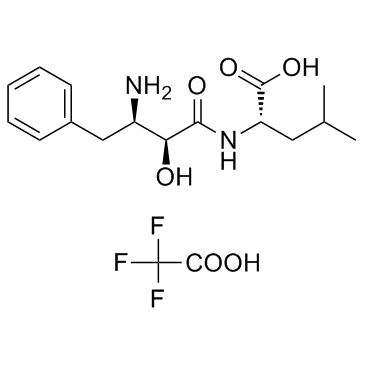
Bestatin trifluoroacetate (Ubenimex) is a novel and potent inhibitor of CD13 (Aminopeptidase N)/APN and leukotriene A4 hydrolase with anticancer activity. Bestatin has been known as an immunomodulating agent in anti-leukemia treatment.
Physicochemical Properties
| Molecular Formula | C18H25F3N2O6 |
| Molecular Weight | 422.3961 |
| Exact Mass | 422.166 |
| CAS # | 223763-80-2 |
| Related CAS # | Bestatin;58970-76-6;Bestatin hydrochloride;65391-42-6 |
| PubChem CID | 78358331 |
| Appearance | Typically exists as solid at room temperature |
| Hydrogen Bond Donor Count | 5 |
| Hydrogen Bond Acceptor Count | 10 |
| Rotatable Bond Count | 8 |
| Heavy Atom Count | 29 |
| Complexity | 451 |
| Defined Atom Stereocenter Count | 3 |
| SMILES | FC(C(=O)O[H])(F)F.O([H])[C@]([H])(C(N([H])[C@]([H])(C(=O)O[H])C([H])([H])C([H])(C([H])([H])[H])C([H])([H])[H])=O)[C@@]([H])(C([H])([H])C1C([H])=C([H])C([H])=C([H])C=1[H])N([H])[H] |
| InChi Key | UOALAMWBTXFYPB-UDYGKFQRSA-N |
| InChi Code | InChI=1S/C16H24N2O4.C2HF3O2/c1-10(2)8-13(16(21)22)18-15(20)14(19)12(17)9-11-6-4-3-5-7-11;3-2(4,5)1(6)7/h3-7,10,12-14,19H,8-9,17H2,1-2H3,(H,18,20)(H,21,22);(H,6,7)/t12-,13+,14+;/m1./s1 |
| Chemical Name | (2S)-2-[[(2S,3R)-3-amino-2-hydroxy-4-phenylbutanoyl]amino]-4-methylpentanoic acid;2,2,2-trifluoroacetic acid |
| HS Tariff Code | 2934.99.9001 |
| Storage |
Powder-20°C 3 years 4°C 2 years In solvent -80°C 6 months -20°C 1 month |
| Shipping Condition | Room temperature (This product is stable at ambient temperature for a few days during ordinary shipping and time spent in Customs) |
Biological Activity
| ln Vitro | In ATRA-sensitive APL NB4 cells, bestatin promotes ATRA-induced differentiation and prevents ATRA-driven activation of p38 MAPK. ATRA-resistant APL MR2 cells have a differentiation block that is not reversible by bestatin. When CD13 is ligated with the anti-CD13 antibody WM-15, p38 MAPK is phosphorylated, Bestatin's suppression of p38 MAPK phosphorylation is lessened, and the enhancement of Bestatin on ATRA-inducing differentiation in NB4 cells is entirely eliminated[2]. Cells treated with bestatin (600 μM) undergo delayed cell cycle progression because their frequency and growth rate of division are reduced. Bestatin is not harmful to D. discoideum cells at concentrations between 0-600 μM, but it does suppress the frequency of mitosis and the intrinsic multinuclearity in these cells. In lysates of PsaA-GFP- and GFP-expressing cells, bestatin decreases aminopeptidase activity by 69.39% ± 10.5% and 39.93% ± 18.7% of control, respectively[4]. | |
| ln Vivo | When compared to diabetic vehicle-treated mice, bestatin (20 μM) dramatically inhibits MMP-9 specific gelationolytic band densities and considerably lowers CD13 expression in diabetic mice. In diabetic mice, treatment with betatin dramatically reduces the expression of heparanase and VEGF. In the retinas of diabetic mice, intravitreal bestatin therapy dramatically reduces the expression of VEGF and HIF-1α. Furthermore, intravitreal bestatin therapy effectively inhibits the increased expression of heparanase in the retinas of diabetic mice[1]. Before the antigen-potentiated humoral response to SRBC, bestatin (10, 1, and 0.1 mg/kg, ip) administration increases the number of splenocytes that produce hemolytic anti-SRBC antibodies (PFC) and the 2-ME-resistant serum hemagglutinin titer (at a dose of 0.1 mg/kg). When mice are given bestatin (1 and 0.1 mg/kg) five times on different days following cyclophosphamide injection, the drug's suppressive effect on the number of PFC remains unchanged. In fact, on day seven following antigen stimulation, bestatin (1 mg/kg) causes a further decrease in total anti-SRBC hemagglutinins. | |
| Enzyme Assay |
|
|
| Cell Assay |
|
|
| References |
[1]. Protective effects of bestatin in the retina of streptozotocin-induced diabetic mice. Exp Eye Res. 2016 Aug;149:100-6. [2]. Inhibition of p38 MAPK Phosphorylation Is Critical for Bestatin to Enhance ATRA-Induced Cell Differentiation in Acute Promyelocytic Leukemia NB4 Cells. Am J Ther. 2016 May-Jun;23(3):e680-9. [3]. The effects of bestatin on humoral response to sheep erythrocytes in non-treated and cyclophosphamide-immunocompromised mice. Immunopharmacol Immunotoxicol. 2013 Feb;35(1):133-8. [4]. Bestatin inhibits cell growth, cell division, and spore cell differentiation in Dictyostelium discoideum. Eukaryot Cell. 2012 Apr;11(4):545-57. |
Solubility Data
| Solubility (In Vitro) | May dissolve in DMSO (in most cases), if not, try other solvents such as H2O, Ethanol, or DMF with a minute amount of products to avoid loss of samples |
| Solubility (In Vivo) |
Note: Listed below are some common formulations that may be used to formulate products with low water solubility (e.g. < 1 mg/mL), you may test these formulations using a minute amount of products to avoid loss of samples. Injection Formulations (e.g. IP/IV/IM/SC) Injection Formulation 1: DMSO : Tween 80: Saline = 10 : 5 : 85 (i.e. 100 μL DMSO stock solution → 50 μL Tween 80 → 850 μL Saline) *Preparation of saline: Dissolve 0.9 g of sodium chloride in 100 mL ddH ₂ O to obtain a clear solution. Injection Formulation 2: DMSO : PEG300 :Tween 80 : Saline = 10 : 40 : 5 : 45 (i.e. 100 μL DMSO → 400 μLPEG300 → 50 μL Tween 80 → 450 μL Saline) Injection Formulation 3: DMSO : Corn oil = 10 : 90 (i.e. 100 μL DMSO → 900 μL Corn oil) Example: Take the Injection Formulation 3 (DMSO : Corn oil = 10 : 90) as an example, if 1 mL of 2.5 mg/mL working solution is to be prepared, you can take 100 μL 25 mg/mL DMSO stock solution and add to 900 μL corn oil, mix well to obtain a clear or suspension solution (2.5 mg/mL, ready for use in animals). Injection Formulation 4: DMSO : 20% SBE-β-CD in saline = 10 : 90 [i.e. 100 μL DMSO → 900 μL (20% SBE-β-CD in saline)] *Preparation of 20% SBE-β-CD in Saline (4°C,1 week): Dissolve 2 g SBE-β-CD in 10 mL saline to obtain a clear solution. Injection Formulation 5: 2-Hydroxypropyl-β-cyclodextrin : Saline = 50 : 50 (i.e. 500 μL 2-Hydroxypropyl-β-cyclodextrin → 500 μL Saline) Injection Formulation 6: DMSO : PEG300 : castor oil : Saline = 5 : 10 : 20 : 65 (i.e. 50 μL DMSO → 100 μLPEG300 → 200 μL castor oil → 650 μL Saline) Injection Formulation 7: Ethanol : Cremophor : Saline = 10: 10 : 80 (i.e. 100 μL Ethanol → 100 μL Cremophor → 800 μL Saline) Injection Formulation 8: Dissolve in Cremophor/Ethanol (50 : 50), then diluted by Saline Injection Formulation 9: EtOH : Corn oil = 10 : 90 (i.e. 100 μL EtOH → 900 μL Corn oil) Injection Formulation 10: EtOH : PEG300:Tween 80 : Saline = 10 : 40 : 5 : 45 (i.e. 100 μL EtOH → 400 μLPEG300 → 50 μL Tween 80 → 450 μL Saline) Oral Formulations Oral Formulation 1: Suspend in 0.5% CMC Na (carboxymethylcellulose sodium) Oral Formulation 2: Suspend in 0.5% Carboxymethyl cellulose Example: Take the Oral Formulation 1 (Suspend in 0.5% CMC Na) as an example, if 100 mL of 2.5 mg/mL working solution is to be prepared, you can first prepare 0.5% CMC Na solution by measuring 0.5 g CMC Na and dissolve it in 100 mL ddH2O to obtain a clear solution; then add 250 mg of the product to 100 mL 0.5% CMC Na solution, to make the suspension solution (2.5 mg/mL, ready for use in animals). Oral Formulation 3: Dissolved in PEG400 Oral Formulation 4: Suspend in 0.2% Carboxymethyl cellulose Oral Formulation 5: Dissolve in 0.25% Tween 80 and 0.5% Carboxymethyl cellulose Oral Formulation 6: Mixing with food powders Note: Please be aware that the above formulations are for reference only. InvivoChem strongly recommends customers to read literature methods/protocols carefully before determining which formulation you should use for in vivo studies, as different compounds have different solubility properties and have to be formulated differently. (Please use freshly prepared in vivo formulations for optimal results.) |
| Preparing Stock Solutions | 1 mg | 5 mg | 10 mg | |
| 1 mM | 2.3674 mL | 11.8371 mL | 23.6742 mL | |
| 5 mM | 0.4735 mL | 2.3674 mL | 4.7348 mL | |
| 10 mM | 0.2367 mL | 1.1837 mL | 2.3674 mL |