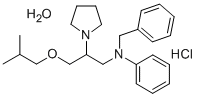
Bepridil hydrochloride hydrate is a potent calcium channel blocker/antagonist and class IV anti-arrhythmic agent once used to treat angina but is no longer on the market.
Physicochemical Properties
| Molecular Formula | C24H34N2O.HCL.H2O |
| Molecular Weight | 421.022 |
| Exact Mass | 402.244 |
| CAS # | 68099-86-5 |
| Related CAS # | Bepridil hydrochloride hydrate;74764-40-2;Bepridil;64706-54-3 |
| PubChem CID | 50088 |
| Appearance | White to light yellow solid powder |
| Density | 1.054g/cm3 |
| Boiling Point | 492.3ºC at 760 mmHg |
| Flash Point | 133.2ºC |
| LogP | 5.57 |
| Hydrogen Bond Donor Count | 1 |
| Hydrogen Bond Acceptor Count | 3 |
| Rotatable Bond Count | 10 |
| Heavy Atom Count | 28 |
| Complexity | 382 |
| Defined Atom Stereocenter Count | 0 |
| InChi Key | JXBBWYGMTNAYNM-UHFFFAOYSA-N |
| InChi Code | InChI=1S/C24H34N2O.ClH/c1-21(2)19-27-20-24(25-15-9-10-16-25)18-26(23-13-7-4-8-14-23)17-22-11-5-3-6-12-22;/h3-8,11-14,21,24H,9-10,15-20H2,1-2H3;1H |
| Chemical Name | 1-Pyrrolideneethanamine, beta-((2-methylpropoxy)methyl)-N-phenyl-N-(phenylmethyl)-, hydrochloride hydrate |
| Synonyms | CERM 1978 Angopril, Bepadin, Bepridil HCl,CERM1978CERM-1978 Bepridil hydrochloride |
| HS Tariff Code | 2934.99.9001 |
| Storage |
Powder-20°C 3 years 4°C 2 years In solvent -80°C 6 months -20°C 1 month Note: Please store this product in a sealed and protected environment, avoid exposure to moisture. |
| Shipping Condition | Room temperature (This product is stable at ambient temperature for a few days during ordinary shipping and time spent in Customs) |
Biological Activity
| ln Vitro | Bepridil Hydrochloride is an antianginal calcium channel blocker [1]. |
| ln Vivo | Rats given 21 mg/kg of bepridil hydrochloride have lower heart rates, mean arterial pressure, decreased mean coronary vascular resistance, and increased stroke volume [1]. |
| References |
[1]. Effects of bepridil hydrochloride on cardiocirculatory dynamics, coronary vascular resistance, and cardiac output distribution in normal, conscious rats. J Cardiovasc Pharmacol. 1988 Mar;11(3):363-72. |
| Additional Infomation |
Bepridil Hydrochloride is the hydrochloride salt form of bepridil, a calcium antagonist and class IV anti-arrhythmic agent. Bepridil hydrochloride blocks calcium entry through membranous calcium channels of coronary and peripheral vascular smooth muscle, thereby dilating coronary arteries and peripheral arterioles. This increases oxygen delivery and reduces oxygen requirements. This drug is used to treat chronic stable and variant angina pectoris. A long-acting calcium-blocking agent with significant anti-anginal activity. The drug produces significant coronary vasodilation and modest peripheral effects. It has antihypertensive and selective anti-arrhythmia activities and acts as a calmodulin antagonist. |
Solubility Data
| Solubility (In Vitro) |
DMSO : ~125 mg/mL (~310.17 mM) H2O : ~12.5 mg/mL (~31.02 mM) |
| Solubility (In Vivo) |
Solubility in Formulation 1: ≥ 2.08 mg/mL (5.16 mM) (saturation unknown) in 10% DMSO + 40% PEG300 + 5% Tween80 + 45% Saline (add these co-solvents sequentially from left to right, and one by one), clear solution. For example, if 1 mL of working solution is to be prepared, you can add 100 μL of 20.8 mg/mL clear DMSO stock solution to 400 μL PEG300 and mix evenly; then add 50 μL Tween-80 to the above solution and mix evenly; then add 450 μL normal saline to adjust the volume to 1 mL. Preparation of saline: Dissolve 0.9 g of sodium chloride in 100 mL ddH₂ O to obtain a clear solution. Solubility in Formulation 2: ≥ 2.08 mg/mL (5.16 mM) (saturation unknown) in 10% DMSO + 90% (20% SBE-β-CD in Saline) (add these co-solvents sequentially from left to right, and one by one), clear solution. For example, if 1 mL of working solution is to be prepared, you can add 100 μL of 20.8 mg/mL clear DMSO stock solution to 900 μL of 20% SBE-β-CD physiological saline solution and mix evenly. Preparation of 20% SBE-β-CD in Saline (4°C,1 week): Dissolve 2 g SBE-β-CD in 10 mL saline to obtain a clear solution. Solubility in Formulation 3: ≥ 2.08 mg/mL (5.16 mM) (saturation unknown) in 10% DMSO + 90% Corn Oil (add these co-solvents sequentially from left to right, and one by one), clear solution. For example, if 1 mL of working solution is to be prepared, you can add 100 μL of 20.8 mg/mL clear DMSO stock solution to 900 μL of corn oil and mix evenly. Solubility in Formulation 4: 25 mg/mL (62.03 mM) in PBS (add these co-solvents sequentially from left to right, and one by one), clear solution; with ultrasonication. (Please use freshly prepared in vivo formulations for optimal results.) |
| Preparing Stock Solutions | 1 mg | 5 mg | 10 mg | |
| 1 mM | 2.3752 mL | 11.8759 mL | 23.7518 mL | |
| 5 mM | 0.4750 mL | 2.3752 mL | 4.7504 mL | |
| 10 mM | 0.2375 mL | 1.1876 mL | 2.3752 mL |