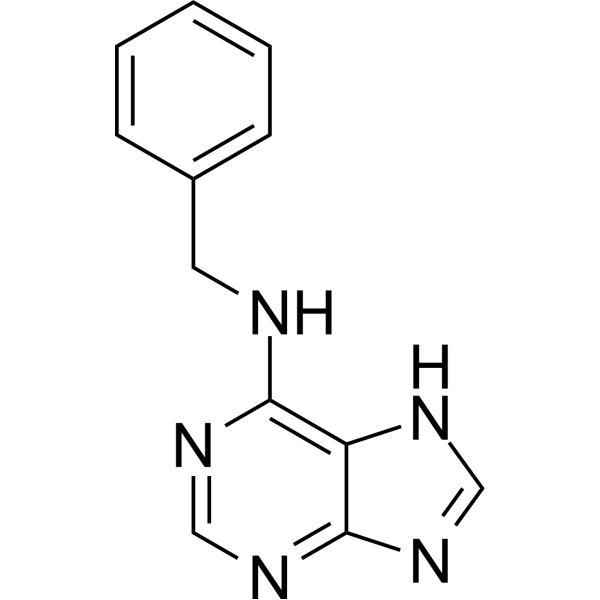
Physicochemical Properties
| Molecular Formula | C12H11N5 |
| Molecular Weight | 225.2492 |
| Exact Mass | 225.101 |
| CAS # | 1214-39-7 |
| Related CAS # | 6-Benzylaminopurine-d5;2322358-20-1 |
| PubChem CID | 62389 |
| Appearance | White to off-white solid powder |
| Density | 1.4±0.1 g/cm3 |
| Boiling Point | 387.5±52.0 °C at 760 mmHg |
| Melting Point | 230-233 °C |
| Flash Point | 188.1±30.7 °C |
| Vapour Pressure | 0.0±0.9 mmHg at 25°C |
| Index of Refraction | 1.731 |
| LogP | 0.28 |
| Hydrogen Bond Donor Count | 2 |
| Hydrogen Bond Acceptor Count | 4 |
| Rotatable Bond Count | 3 |
| Heavy Atom Count | 17 |
| Complexity | 241 |
| Defined Atom Stereocenter Count | 0 |
| InChi Key | NWBJYWHLCVSVIJ-UHFFFAOYSA-N |
| InChi Code | InChI=1S/C12H11N5/c1-2-4-9(5-3-1)6-13-11-10-12(15-7-14-10)17-8-16-11/h1-5,7-8H,6H2,(H2,13,14,15,16,17) |
| Chemical Name | N-benzyl-7H-purin-6-amine |
| HS Tariff Code | 2934.99.9001 |
| Storage |
Powder-20°C 3 years 4°C 2 years In solvent -80°C 6 months -20°C 1 month |
| Shipping Condition | Room temperature (This product is stable at ambient temperature for a few days during ordinary shipping and time spent in Customs) |
Biological Activity
| ADME/Pharmacokinetics |
Metabolism / Metabolites ... The report summarized results of metabolism of labeled compound in rats and dogs. With dogs, the compound (15 mg with label as benzyl-1-C14 -adenine) was fed in a small ball of meat. Urine was collected for 24 and 48 hours. Essentially all of the radioactivity was excreted in urine in 24 hours. By cochromatography, three metabolites were identified as hippuric acid, benzoic acid and benzyladenine (the same as in the rat). With animals given benzyladenine-8-C14, the profile was somewhat different and components were not identified except for parent compound. Excretion of the adenine label was slower. Profiles of rat and dog were, again, similar.[California Environmental Protection Agency/Department of Pesticide Regulation; SUMMARY OF TOXICOLOGY DATA CYTOKININ and 6-Benzyladenine |
| Toxicity/Toxicokinetics |
Toxicity Data LC50 (rabbit) = 5,200 mg/m3/1hr Non-Human Toxicity Values LD50 Rabbit Dermal 5 g/kg LC50 Rabbit inhalation 5.2 mg/L 1 hour. LD50 Rat Oral 1.3 g/kg |
| References |
[1]. HECATE2 acts with GLABROUS3 and Tu to boost cytokinin biosynthesis and regulate cucumber fruit wart formation. Plant Physiol. 2021 Nov 3;187(3):1619-1635. |
| Additional Infomation |
N-benzyladenine is a member of the class of 6-aminopurines that is adenine in which one of the hydrogens of the amino group is replaced by a benzyl group. It has a role as a plant metabolite and a cytokinin. It is functionally related to an adenine. 6-Benzylaminopurine has been reported in Humulus lupulus, Rehmannia glutinosa, and other organisms with data available. |
Solubility Data
| Solubility (In Vitro) | DMSO : ~50 mg/mL (~221.98 mM) |
| Solubility (In Vivo) |
Solubility in Formulation 1: ≥ 2.5 mg/mL (11.10 mM) (saturation unknown) in 10% DMSO + 40% PEG300 + 5% Tween80 + 45% Saline (add these co-solvents sequentially from left to right, and one by one), clear solution. For example, if 1 mL of working solution is to be prepared, you can add 100 μL of 25.0 mg/mL clear DMSO stock solution to 400 μL PEG300 and mix evenly; then add 50 μL Tween-80 to the above solution and mix evenly; then add 450 μL normal saline to adjust the volume to 1 mL. Preparation of saline: Dissolve 0.9 g of sodium chloride in 100 mL ddH₂ O to obtain a clear solution. Solubility in Formulation 2: ≥ 2.5 mg/mL (11.10 mM) (saturation unknown) in 10% DMSO + 90% (20% SBE-β-CD in Saline) (add these co-solvents sequentially from left to right, and one by one), clear solution. For example, if 1 mL of working solution is to be prepared, you can add 100 μL of 25.0 mg/mL clear DMSO stock solution to 900 μL of 20% SBE-β-CD physiological saline solution and mix evenly. Preparation of 20% SBE-β-CD in Saline (4°C,1 week): Dissolve 2 g SBE-β-CD in 10 mL saline to obtain a clear solution. Solubility in Formulation 3: ≥ 2.5 mg/mL (11.10 mM) (saturation unknown) in 10% DMSO + 90% Corn Oil (add these co-solvents sequentially from left to right, and one by one), clear solution. For example, if 1 mL of working solution is to be prepared, you can add 100 μL of 25.0 mg/mL clear DMSO stock solution to 900 μL of corn oil and mix evenly. (Please use freshly prepared in vivo formulations for optimal results.) |
| Preparing Stock Solutions | 1 mg | 5 mg | 10 mg | |
| 1 mM | 4.4395 mL | 22.1976 mL | 44.3951 mL | |
| 5 mM | 0.8879 mL | 4.4395 mL | 8.8790 mL | |
| 10 mM | 0.4440 mL | 2.2198 mL | 4.4395 mL |