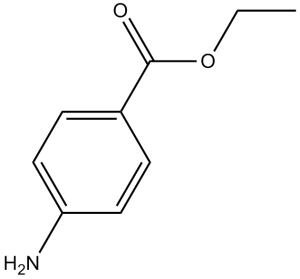
Benzocaine (H-4-Abz-OEt; NSC-4688; NSC-41531; trade name Orajel among others), the ethyl ester of p-aminobenzoic acid (PABA), is a local anesthetic that has been widely used as a topical pain reliever or in cough drops. Benzocaine acts by reversibly inactivating voltage-dependent sodium channels. It is the active ingredient in many OTC anesthetic ointments (e.g. products for oral ulcers). It is also used in combination with antipyrine as A/B otic drops to relieve ear pain and to remove earwax.
Physicochemical Properties
| Molecular Formula | C9H11NO2 |
| Molecular Weight | 165.19 |
| Exact Mass | 165.078 |
| CAS # | 94-09-7 |
| Related CAS # | Benzocaine-d4;342611-08-9;Benzocaine-(ethyl-d5);1219803-76-5 |
| PubChem CID | 2337 |
| Appearance | White to off-white solid powder |
| Density | 1.1±0.1 g/cm3 |
| Boiling Point | 310.7±15.0 °C at 760 mmHg |
| Melting Point | 88-90 °C |
| Flash Point | 164.2±17.9 °C |
| Vapour Pressure | 0.0±0.7 mmHg at 25°C |
| Index of Refraction | 1.555 |
| LogP | 1.95 |
| Hydrogen Bond Donor Count | 1 |
| Hydrogen Bond Acceptor Count | 3 |
| Rotatable Bond Count | 3 |
| Heavy Atom Count | 12 |
| Complexity | 151 |
| Defined Atom Stereocenter Count | 0 |
| InChi Key | BLFLLBZGZJTVJG-UHFFFAOYSA-N |
| InChi Code | InChI=1S/C9H11NO2/c1-2-12-9(11)7-3-5-8(10)6-4-7/h3-6H,2,10H2,1H3 |
| Chemical Name | Benzoic acid, p-amino-, ethyl ester |
| Synonyms | H-4-Abz-OEt; NSC-4688; NSC4688; NSC 41531; trade name Orajel amongst others |
| HS Tariff Code | 2934.99.9001 |
| Storage |
Powder-20°C 3 years 4°C 2 years In solvent -80°C 6 months -20°C 1 month Note: This product requires protection from light (avoid light exposure) during transportation and storage. |
| Shipping Condition | Room temperature (This product is stable at ambient temperature for a few days during ordinary shipping and time spent in Customs) |
Biological Activity
| Targets |
Voltage-gated mu1 Na+ channels [1] - Sarcoplasmic reticulum Ca-ATPase (IC50 for inhibiting enzyme activity: ~2.3 mM; EC50 for reducing Ca²⁺ uptake: ~1.8 mM)[3] |
| ln Vitro |
Benzocaine blocks μ1 wild-type Na+ currents in a dose-dependent Manner. The Benzocaine concentration that inhibits 50% of Na+ currents (IC50) is estimated to be about 0.8 mM when a test potential of +30 mV is applied. The slope of the h∞ curve is also significantly reduced by benzocaine (from 6.6 to 9.9 mV). Mutation of μ1-N1584A also significantly increases the potency of Benzocaine. At 1 mM, Benzocaine blocks about 55% of wild-type Na+ current but about 95% of μ1-N1584A mutant current. Benzocaine also appears to bind more strongly to its LA receptor in the N1584A mutant than in the wild type[1]. The inhibition of Ca2+ uptake occurs at lower Benzocaine concentration (IC50=40.3±1.2mM) than that affecting the enzymatic activity[2]. In Xenopus oocytes expressing voltage-gated mu1 Na+ channels, Benzocaine (0.1-10 mM) inhibited sodium currents in a concentration-dependent manner. It preferentially bound to the inactivated state of the channels, prolonging the inactivation recovery time and reducing the number of available functional channels. The inhibitory effect was voltage-dependent, with stronger blocking at more depolarized membrane potentials[1] - In isolated sarcoplasmic reticulum (SR) vesicles from fast-twitch skeletal muscle, Benzocaine (0.5-5 mM) dose-dependently inhibited Ca-ATPase activity. At 3 mM, it reduced enzyme activity by 47% and decreased SR Ca²⁺ uptake by 52%. The drug altered the enzyme's conformational state, as indicated by reduced intrinsic fluorescence of tryptophan residues in Ca-ATPase[3] |
| ln Vivo |
Dogs, domestic shorthair cats, Sprague-Dawley rats, Long-Evans rats, ferrets, rhesus monkeys, cynomolgus monkeys, owl monkeys, New Zealand White rabbits, miniature pigs, ICR mice, C3H mice, and C57BL/10SnJ mice are among the species to which benzocaine is applied topically. A 2-second spray is administered to the mucous membranes of the nasopharynx for an estimated dose of 56 mg to all animals, with the exception of mice and rats. An excessive amount of fluid is sprayed over the oral mucous membranes of rodents in a two-second burst. A few months later, the study is conducted again on dogs to confirm the poor response. Most studied animals show a reaction to benzocaine spray, with a peak response occurring 15–30 minutes after dosing[3]. In dogs, cats, rabbits, and guinea pigs, topical application of Benzocaine (5-20% formulation, 0.1-0.5 mL/kg) induced methemoglobinemia in a species-dependent manner. Dogs were the most sensitive, with methemoglobin levels reaching 35-45% 2-4 hours after application. Cats and rabbits showed moderate responses (methemoglobin levels 15-25%), while guinea pigs had minimal changes (<10%). Clinical signs included cyanosis, tachypnea, and lethargy in severely affected animals[2] |
| Enzyme Assay |
Ca-ATPase activity assay: Sarcoplasmic reticulum vesicles were isolated from fast-twitch skeletal muscle and resuspended in reaction buffer. Different concentrations of Benzocaine were added, followed by the addition of ATP to initiate the reaction. After incubation at 37°C for 30 minutes, the reaction was terminated, and the released inorganic phosphate (Pi) was quantified using a colorimetric assay. Ca-ATPase activity was calculated based on Pi production[3] - Na+ channel binding assay: Voltage-gated mu1 Na+ channels were expressed in Xenopus oocytes. Whole-cell patch-clamp recordings were performed to measure sodium currents before and after application of Benzocaine. The voltage protocol included depolarizing steps to induce channel activation and inactivation, and the peak sodium current amplitude and inactivation kinetics were analyzed to evaluate binding affinity[1] |
| Cell Assay |
Sodium current recording assay: Xenopus oocytes were injected with mu1 Na+ channel cRNA and cultured for 2-3 days. Oocytes were placed in a recording chamber, and microelectrodes were used for whole-cell patch-clamp recording. Benzocaine was added to the extracellular solution at gradient concentrations, and sodium currents were recorded under different voltage conditions to assess the inhibitory effect[1] - SR Ca²⁺ uptake assay: Isolated sarcoplasmic reticulum vesicles were incubated with Ca²⁺-containing buffer and Benzocaine for 10 minutes. Ca²⁺ uptake was initiated by adding ATP, and the reaction was terminated at specific time points. The remaining free Ca²⁺ in the supernatant was measured using a Ca²⁺-sensitive dye, and the amount of Ca²⁺ taken up by SR vesicles was calculated[3] - Intrinsic fluorescence assay: Sarcoplasmic reticulum vesicles were incubated with Benzocaine for 15 minutes at room temperature. The intrinsic fluorescence of tryptophan residues in Ca-ATPase was measured using a fluorometer with excitation at 295 nm and emission at 340 nm. Fluorescence intensity changes were used to reflect conformational alterations of the enzyme[3] |
| Animal Protocol |
Guinea pig Methemoglobinemia induction model: Adult dogs (10-15 kg), cats (2-3 kg), rabbits (1.5-2 kg), and guinea pigs (300-400 g) were used. Benzocaine was formulated as a 5-20% topical solution. The drug was applied to the shaved skin (2 cm × 2 cm area) at a dose of 0.1-0.5 mL/kg. Blood samples were collected at 0, 1, 2, 4, 6, and 24 hours after application to measure methemoglobin levels. Clinical signs were observed and recorded throughout the experiment[2] |
| ADME/Pharmacokinetics |
Absorption, Distribution and Excretion Branchial and urinary elimination of benzocaine residues was evaluated in adult rainbow trout, Oncorhynchus mykiss, given a single dorsal aortic dose of 14(C)-benzocaine hydrochloride. Branchial elimination of benzocaine residues was rapid and accounted for 59.2% of the dose during the first 3 h after dosing. Renal elimination of radioactivity was considerably slower; the kidney excreted 2.7% dose within 3 h and 9.0% within 24 hr. Gallbladder bile contained 2.0% dose 24 hr after injection. Of the radioactivity in radiochromatograms from water taken 3 min after injection, 87.3% was benzocaine and 12.7% was N-acetylated benzocaine. After 60 min, 32.7% was benzocaine and 67.3% was N-acetylated benzocaine. Of the radioactivity in radiochromatograms from urine taken 1 hr after dosing, 7.6% was para-aminobenzoic acid, 59.7% was N-acetylated para-aminobenzoic acid, 19.5% was benzocaine, and 8.0% was N-acetylated benzocaine. The proportion of the radioactivity in urine changed with time so that by 20 hr, 1.0% was para-aminobenzoic acid and 96.6% was N-acetylated para-aminobenzoic acid. Benzocaine and a more hydrophobic metabolite, N-acetylated benzocaine, were eliminated primarily through the gills; renal and biliary pathways were less significant elimination routes for benzocaine residues. Metabolism / Metabolites Benzocaine undergoes ester hydrolysis to form 4-aminobenzoic acid, acetylation to form acetylbenzocaine, or N-hydroxylation to form benzocaine hydroxide. 4-aminobenzoic acid can be acetylated or acetylbenzocaine can undergo ester hydrolysis to form 4-acetaminobenzoic acid. The effect of dose and enzymatic inhibition on the percutaneous absorption and metabolism of benzocaine was studied in vitro in the hairless guinea pig. At the dose level of 2 ug/sq cm, benzocaine was rapidly absorbed and extensively metabolized (80%) by acetyltransferase. As the applied dose of benzocaine was increased to 40 and 200 ug/sq cm, N-acetylation of benzocaine decreased to 44 and 34%, respectively, suggesting saturation of the acetyltransferase system. Total 14(C) absorption after benzocaine application was not significantly different between control and enzyme-inhibited skin and therefore does not appear to be affected by the extent of benzocaine metabolism during percutaneous penetration. Skin provides a significant first-pass metabolic effect for therapeutic doses of percutaneously absorbed benzocaine, and the primary metabolite formed, acetylbenzocaine, is biologically active. Hepatic (to a lesser extent) and plasma via hydrolysis by cholinesterase. Excretion trhough urine (as metabolites) (L1861) |
| Toxicity/Toxicokinetics |
Toxicity Summary Benzocaine binds to sodium channels and reversibly stabilizes the neuronal membrane which decreases its permeability to sodium ions. Depolarization of the neuronal membrane is inhibited thereby blocking the initiation and conduction of nerve impulses. Effects During Pregnancy and Lactation ◉ Summary of Use during Lactation Topical benzocaine has not been studied during breastfeeding, but is unlikely to affect her breastfed infant if it is applied away from the breast. Benzocaine should not be applied to the breast or nipple, because the infant may ingest the drug during nursing and it has been associated with severe methemoglobinemia in children under 2 years of age. ◉ Effects in Breastfed Infants Relevant published information was not found as of the revision date. ◉ Effects on Lactation and Breastmilk Relevant published information was not found as of the revision date. ◈ What is benzocaine? Benzocaine is a topical local anesthetic. Local anesthetics are used to numb specific areas of the body for short periods of time. Benzocaine can be found in some over the counter pain relieving products, including Anbesol®, Orabase®, Orajel®, Hurricaine®, and Topex®.Benzocaine has not been well-studied for use in pregnancy. When used as directed, very little benzocaine is expected to be absorbed. That means it is unlikely that a significant amount would reach the developing pregnancy, and that the chance of birth defects or other pregnancy complications is expected to be low. ◈ I use benzocaine. Can it make it harder for me to get pregnant? It is not known if benzocaine use can make it harder to get pregnant. ◈ Does using benzocaine increase the chance of miscarriage? Miscarriage is common and can occur in any pregnancy for many different reasons. Studies have not been done to see if benzocaine increases the chance of miscarriage. ◈ Does using benzocaine increase the chance of birth defects? Every pregnancy starts out with a 3-5% chance of having a birth defect. This is called the background risk. Two reports did not find a greater chance of birth defects in the children of women who reported using benzocaine in the first trimester of pregnancy. ◈ Does using benzocaine in pregnancy increase the chance of other pregnancy-related problems? Studies have not been done to see if benzocaine increases the chance for pregnancy-related problems such as preterm delivery (birth before week 37) or low birth weight (weighing less than 5 pounds, 8 ounces [2500 grams] at birth). ◈ Does using benzocaine in pregnancy affect future behavior or learning for the child? Studies have not been done to see if benzocaine can cause behavior or learning issues for the child. ◈ Breastfeeding while using benzocaine: Benzocaine has not been well-studied for use during breastfeeding. It is not recommended to apply benzocaine to the breasts or nipples because of the risk for methemoglobinemia (a serious blood disorder) if the baby ingests it. If benzocaine is not applied to these areas and the baby does not get it in their mouth, then use of topical benzocaine is unlikely to affect a breastfeeding child. Wash your hands well after using benzocaine. Be sure to talk to your healthcare provider about all your breastfeeding questions. ◈ If a male uses benzocaine, could it affect fertility or increase the chance of birth defects? Studies have not been done to see if benzocaine could affect male fertility (ability to get partner pregnant) or increase the chance of birth defects. In general, exposures that fathers or sperm donors have are unlikely to increase risks to a pregnancy. For more information, please see the MotherToBaby fact sheet Paternal Exposures at https://mothertobaby.org/fact-sheets/paternal-exposures-pregnancy/. Protein Binding Benzocaine binds to both serum albumin and alpha-1-acid glycoprotein. Toxicity Data LD50: 3040 mg/kg (Oral, Rat) (A308) In vivo toxicity: Topical Benzocaine induced dose- and species-dependent methemoglobinemia. The minimum toxic dose for dogs was 0.1 mL/kg of 10% formulation, while cats and rabbits required 0.2-0.3 mL/kg of 15% formulation to induce significant methemoglobinemia[2] - No obvious liver or kidney toxicity was observed in the tested animals, as serum ALT, AST, BUN, and creatinine levels remained within normal ranges 24 hours after drug application[2] |
| References |
[1]. A common local anesthetic receptor for benzocaine and etidocaine in voltage-gated mu1 Na+ channels. Pflugers Arch. 1998 Jan;435(2):293-302. [2]. Benzocaine-induced methemoglobinemia attributed to topical application of the anesthetic in several laboratory animal species. Am J Vet Res. 1993 Aug;54(8):1322-6. [3]. Drug action of benzocaine on the sarcoplasmic reticulum Ca-ATPase from fast-twitch skeletal muscle. Naunyn Schmiedebergs Arch Pharmacol. 2015 Nov;388(11):1163-70. |
| Additional Infomation |
Benzocaine is a benzoate ester having 4-aminobenzoic acid as the acid component and ethanol as the alcohol component. A surface anaesthetic, it is used to suppress the gag reflex, and as a lubricant and topical anaesthetic on the larynx, mouth, nasal cavity, respiratory tract, oesophagus, rectum, urinary tract, and vagina. It has a role as a topical anaesthetic, an antipruritic drug, an allergen and a sensitiser. It is a benzoate ester and a substituted aniline. Benzocaine is an ester local anesthetic that acts by preventing transmission of impulses along nerve fibers and at nerve endings. It is commonly used for local anesthesia in many over the counter products. Benzocaine was first used for local anesthesia in dentistry. Benzocaine is a Standardized Chemical Allergen. The physiologic effect of benzocaine is by means of Increased Histamine Release, and Cell-mediated Immunity. Benzocaine is an ester of paraaminobenzoic acid, lacking the terminal diethylamino group of procaine, with anesthetic activity. Benzocaine binds to the sodium channel and reversibly stabilizes the neuronal membrane which decreases its permeability to sodium ions. Depolarization of the neuronal membrane is inhibited, thereby blocking the initiation and conduction of nerve impulses. Benzocaine is a surface anesthetic that acts by preventing transmission of impulses along nerve fibers and at nerve endings. Benzocaine is a local anesthetic commonly used as a topical pain reliever. It is the active ingredient in many over-the-counter analgesic ointments. Benzocaine is an ester, a compound made from the organic acid PABA (para-aminobenzoic acid) and ethanol. The process in which this ester is created is known as Fischer esterification. A surface anesthetic that acts by preventing transmission of impulses along nerve fibers and at nerve endings. See also: Benzocaine Hydrochloride (has salt form); Alcohol; Benzocaine (component of); Benzocaine; white petrolatum (active moiety of) ... View More ... Drug Indication Benzocaine is indicated for local anesthesia in dentistry, minor trauma, and as preparation for infiltrative anesthesia. Benzocaine products are indicated for topical anesthesia in a wide variety of conditions including skin irritation, oral pain, and hemorrhoids. Treatment of oropharyngeal pain Mechanism of Action Benzocaine diffuses into nerve cells where it binds to sodium channels, preventing the channels from opening, and blocking the influx of sodium ions. Nerve cells unable to allow sodium into cells cannot depolarize and conduct nerve impulses. Benzocaine reversibly stabilizes the neuronal membrane with decreases its permeability to sodium ions. Depolarization of the neuronal membrane is inhibited thereby blocking the initiation and conduction of nerve impulses. Therapeutic Uses Indicated for the relief of: canker sores, cold sores, or fever blisters: benzocaine (gel and topical solution); gingival or oral mucosal pain (i.e., pain caused by mouth or gum irritation, inflammation, lesions, or minor dental procedures): benzocaine (gel, dental paste, lozenges, and topical solution); dental prosthetic pain (i.e., pain or irritation caused by dentures or other dental or orthodontic appliances): benzocaine (dental paste, gel ointment, and topical solution); teething pain: benzocaine (7.5% and 10% gel); and toothache: benzocaine (10% and 20% gel and topical solution). Indicated to suppress the gag reflex and/or other laryngeal and esophageal reflexes to facilitate dental examination or procedures (including oral surgery), endoscopy, or intubation: benzocaine (gel, topical aerosol, and topical solution). /Included in US product labeling/ Indicated to provide topical anesthesia of accessible mucous membranes prior to examination, endoscopy or instrumentation, or other procedures involving the: esophagus: benzocaine (gel and topical solution)); larynx: benzocaine (gel and topical solution); mouth, In dental procedures and oral surgery: benzocaine (gel, topical aerosol, and topical solution); nasal cavity: benzocaine (gel); pharynx or throat: benzocaine (gel, topical aerosol, and topical solution); rectum: benzocaine (gel); respiratory tract or trachea: benzocaine (gel, topical aerosol, and topical solution); urinary tract: benzocaine (gel); and vagina: benzocaine (gel). Anesthetic (local). (VET): Local (usually surface) anesthetic. Drug Warnings Infants and the elderly were more likely to develop toxic methemoglobinemia after benzocaine exposure. Other risk factors included genetic reductase deficiencies, exposure to high doses of anesthetic, and presence of denuded skin and mucous membranes. Because of the potential for severe complications, methemoglobinemia should be corrected promptly in compromised patients and those with toxic benzocaine concentrations. The possibility of masking symptoms during general anesthesia carries special risk of use of this agent in the preanesthesia setting. Use of otic anesthetics may mask symptoms of a fulminating middle ear infection (acute otitis media). Otic solutions containing benzocaine should not be used in the presence of a perforated tympanic membrane. When applied topically as recommended, benzocaine is relatively nontoxic, however, sensitization may occur. When used as a male genital desensitizer, benzocaine generally does not adversely affect orgasm in female sexual partners and does not appear to anesthetize the clitoris or vagina. For more Drug Warnings (Complete) data for BENZOCAINE (9 total), please visit the HSDB record page. Pharmacodynamics Benzocaine is indicated for use as a topical anesthetic. It has a duration of action of approximately 10 minutes and a wide therapeutic window. Patients should be counselled regarding the risks of methemoglobinemia. Benzocaine is a widely used topical anesthetic, clinically applied for relieving pain associated with skin irritation, mucosal lesions, and minor surgeries[1][2] - Its anesthetic mechanism is primarily mediated by blocking voltage-gated mu1 Na+ channels, which inhibits the propagation of action potentials in sensory neurons[1] - This study identifies a novel target of Benzocaine—sarcoplasmic reticulum Ca-ATPase, suggesting potential effects on skeletal muscle Ca²⁺ homeostasis[3] - Methemoglobinemia is a well-documented side effect of Benzocaine, especially after topical application in sensitive animal species, which should be monitored in clinical use[2] |
Solubility Data
| Solubility (In Vitro) |
|
|||
| Solubility (In Vivo) |
Solubility in Formulation 1: ≥ 2.5 mg/mL (15.13 mM) (saturation unknown) in 10% DMSO + 40% PEG300 + 5% Tween80 + 45% Saline (add these co-solvents sequentially from left to right, and one by one), clear solution. For example, if 1 mL of working solution is to be prepared, you can add 100 μL of 25.0 mg/mL clear DMSO stock solution to 400 μL PEG300 and mix evenly; then add 50 μL Tween-80 to the above solution and mix evenly; then add 450 μL normal saline to adjust the volume to 1 mL. Preparation of saline: Dissolve 0.9 g of sodium chloride in 100 mL ddH₂ O to obtain a clear solution. Solubility in Formulation 2: ≥ 2.5 mg/mL (15.13 mM) (saturation unknown) in 10% DMSO + 90% (20% SBE-β-CD in Saline) (add these co-solvents sequentially from left to right, and one by one), clear solution. For example, if 1 mL of working solution is to be prepared, you can add 100 μL of 25.0 mg/mL clear DMSO stock solution to 900 μL of 20% SBE-β-CD physiological saline solution and mix evenly. Preparation of 20% SBE-β-CD in Saline (4°C,1 week): Dissolve 2 g SBE-β-CD in 10 mL saline to obtain a clear solution. Solubility in Formulation 3: ≥ 2.5 mg/mL (15.13 mM) (saturation unknown) in 10% DMSO + 90% Corn Oil (add these co-solvents sequentially from left to right, and one by one), clear solution. For example, if 1 mL of working solution is to be prepared, you can add 100 μL of 25.0 mg/mL clear DMSO stock solution to 900 μL of corn oil and mix evenly. (Please use freshly prepared in vivo formulations for optimal results.) |
| Preparing Stock Solutions | 1 mg | 5 mg | 10 mg | |
| 1 mM | 6.0536 mL | 30.2682 mL | 60.5364 mL | |
| 5 mM | 1.2107 mL | 6.0536 mL | 12.1073 mL | |
| 10 mM | 0.6054 mL | 3.0268 mL | 6.0536 mL |