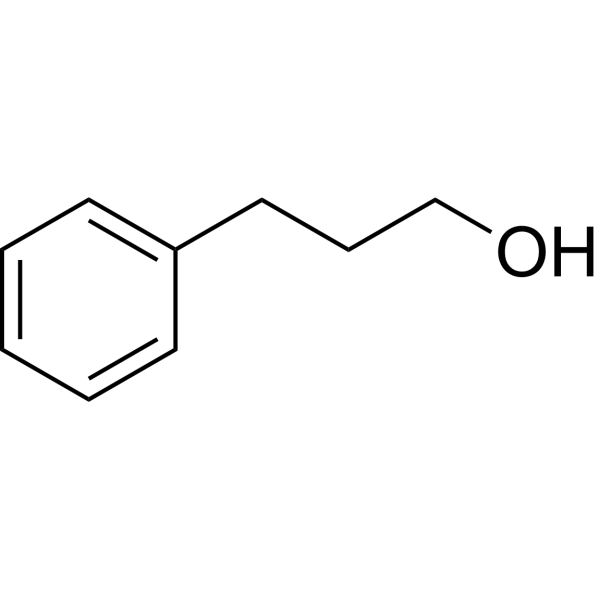
Physicochemical Properties
| Molecular Formula | C9H12O |
| Molecular Weight | 136.19 |
| Exact Mass | 136.088 |
| CAS # | 122-97-4 |
| PubChem CID | 31234 |
| Appearance |
Colorless liquid Slightly viscous, colorless liquid |
| Density | 1.0±0.1 g/cm3 |
| Boiling Point | 235.8±9.0 °C at 760 mmHg |
| Melting Point | −18 °C(lit.) |
| Flash Point | 109.4±0.0 °C |
| Vapour Pressure | 0.0±0.5 mmHg at 25°C |
| Index of Refraction | 1.528 |
| LogP | 1.88 |
| Hydrogen Bond Donor Count | 1 |
| Hydrogen Bond Acceptor Count | 1 |
| Rotatable Bond Count | 3 |
| Heavy Atom Count | 10 |
| Complexity | 74.8 |
| Defined Atom Stereocenter Count | 0 |
| SMILES | O([H])C([H])([H])C([H])([H])C([H])([H])C1C([H])=C([H])C([H])=C([H])C=1[H] |
| InChi Key | VAJVDSVGBWFCLW-UHFFFAOYSA-N |
| InChi Code | InChI=1S/C9H12O/c10-8-4-7-9-5-2-1-3-6-9/h1-3,5-6,10H,4,7-8H2 |
| Chemical Name | 3-phenylpropan-1-ol |
| HS Tariff Code | 2934.99.9001 |
| Storage |
Powder-20°C 3 years 4°C 2 years In solvent -80°C 6 months -20°C 1 month |
| Shipping Condition | Room temperature (This product is stable at ambient temperature for a few days during ordinary shipping and time spent in Customs) |
Biological Activity
| ADME/Pharmacokinetics |
Absorption, Distribution and Excretion An in vitro percutaneous absorption study of 3-phenyl-1-propanol, across human skin was conducted using a diffusion cell. Skin samples, approximately 280 um thick, were obtained from cosmetic surgical human abdominal skin. The dermatomed skin samples were fixed in 4% formaldehyde, embedded in paraffin. 3-Phenyl-1-propanol (5.0 mg/mL, working concentration) was dissolved in buffer solution at a concentration equivalent to approximately 75% of its solubility in that medium. The solution was used to fill the donor compartment while the receptor compartment was filled with pH 7.4 buffer solution. The experiments were carried out at 37 °C. The cells were immersed in a thermostatically regulated water bath. Assay duration was 7 hr. Receptor compartment sampling was carried out every 30 min and the extracted samples were replaced with the buffer solution. Samples were analyzed by gas chromatograph with a flame ionization detector. The mean permeability coefficient for 3-phenyl-1-propanol was reported to be 52.35 +/- 4.98 Kp[cm/hour] and the flow value was 1.18 +/- 0.11 J[mg/hr]. |
| Toxicity/Toxicokinetics |
Toxicity Summary IDENTIFICATION AND USE: 3-Phenylpropanol is a colorless liquid. It smells like hyacinths and tastes similar to apricot. It occurs in many fruits and berries, cinnamon and some types of balsam. 3-Phenylpropanol occurs in tobacco smoke. 3-Phenylpropanol is typically used as a perfume for applications such as antiperspirants, creams-lotions, lipsticks, talcum powder, tablet soap, shampoo, hair conditioner, bath/shower gel, detergent powder, liquid detergent, fabric softener, candles, incense. Also used in blossom compositions for balsamic and oriental notes. It is not registered for current pesticide use in the U.S., but approved pesticide uses may change periodically and so federal, state and local authorities must be consulted for currently approved uses. HUMAN EXPOSURE AND TOXICITY: In a multicenter study, 218 fragrance sensitive patients with proven contact dermatitis were patch tested. Reactions (0.9%) in fragrance sensitive patients were observed with 3-phenylpropanol at 5% in petrolatum. ANIMAL STUDIES: In rats dosed orally with 3-phenylpropanol at dose levels of 1.31, 2.56 and 5.0 g/kg/bw deaths occurred within the first 2 days. The clinical signs observed were slight lethargy and flaccid muscle tone. In a preliminary screen for an acute oral toxicity study, a 50% solution of 3-phenyl-1-propanol in corn oil was administered orally to 10 rats at a dose level of 5 g/kg bw, nine (9/10) rats died. In another study, rats were dosed orally with a 50% solution of 3-phenylpropanol in corn oil at dose levels of 1.47, 2.15, 3.16 and 4.64 g/ kg bw. One death occurred at 1.47 g/kg; and at 2.15 and at 4.64 g/kg. The clinical signs observed during the study were depression, hypopnea, ataxia and piloerection. Gross observations at necropsy revealed dark red areas in the lungs at the three lower doses and dark red lungs at the highest dose. In an irritation study in rabbits 3-phenylpropanol was applied for 24 hr under occlusion at dose levels of 2.5 and 5 g/kg. At 2.5 g/kg, moderate erythema and slight to moderate edema were observed. At 5 g/kg, moderate to severe erythema and moderate edema were observed. In another study in rabbits, 3-phenyl-1-propanol was applied for 24 hr under occlusion at 5 g/kg. Moderate to severe erythema, severe edema, scaling and necrosis were observed. A 0.5 mL aliquot of 3-phenylpropanol was applied to intact and abraded skin for 24 hr under occlusion. Moderate irritation was observed. Necrosis was also observed. No mutagenic or genotoxic activity in bacteria and mammalian cell line assay was found. Non-Human Toxicity Values LD50 Rabbit dermal <5.0 g/kg LD50 Rabbit dermal 5000 mg/kg LD50 Rat oral 2300 mg/kg |
| Additional Infomation |
3-Phenyl-1-propanol is a monocyclic arene. 3-Phenyl-1-propanol has been reported in Swertia japonica, Manilkara zapota, and other organisms with data available. |
Solubility Data
| Solubility (In Vitro) | May dissolve in DMSO (in most cases), if not, try other solvents such as H2O, Ethanol, or DMF with a minute amount of products to avoid loss of samples |
| Solubility (In Vivo) |
Note: Listed below are some common formulations that may be used to formulate products with low water solubility (e.g. < 1 mg/mL), you may test these formulations using a minute amount of products to avoid loss of samples. Injection Formulations (e.g. IP/IV/IM/SC) Injection Formulation 1: DMSO : Tween 80: Saline = 10 : 5 : 85 (i.e. 100 μL DMSO stock solution → 50 μL Tween 80 → 850 μL Saline) *Preparation of saline: Dissolve 0.9 g of sodium chloride in 100 mL ddH ₂ O to obtain a clear solution. Injection Formulation 2: DMSO : PEG300 :Tween 80 : Saline = 10 : 40 : 5 : 45 (i.e. 100 μL DMSO → 400 μLPEG300 → 50 μL Tween 80 → 450 μL Saline) Injection Formulation 3: DMSO : Corn oil = 10 : 90 (i.e. 100 μL DMSO → 900 μL Corn oil) Example: Take the Injection Formulation 3 (DMSO : Corn oil = 10 : 90) as an example, if 1 mL of 2.5 mg/mL working solution is to be prepared, you can take 100 μL 25 mg/mL DMSO stock solution and add to 900 μL corn oil, mix well to obtain a clear or suspension solution (2.5 mg/mL, ready for use in animals). Injection Formulation 4: DMSO : 20% SBE-β-CD in saline = 10 : 90 [i.e. 100 μL DMSO → 900 μL (20% SBE-β-CD in saline)] *Preparation of 20% SBE-β-CD in Saline (4°C,1 week): Dissolve 2 g SBE-β-CD in 10 mL saline to obtain a clear solution. Injection Formulation 5: 2-Hydroxypropyl-β-cyclodextrin : Saline = 50 : 50 (i.e. 500 μL 2-Hydroxypropyl-β-cyclodextrin → 500 μL Saline) Injection Formulation 6: DMSO : PEG300 : castor oil : Saline = 5 : 10 : 20 : 65 (i.e. 50 μL DMSO → 100 μLPEG300 → 200 μL castor oil → 650 μL Saline) Injection Formulation 7: Ethanol : Cremophor : Saline = 10: 10 : 80 (i.e. 100 μL Ethanol → 100 μL Cremophor → 800 μL Saline) Injection Formulation 8: Dissolve in Cremophor/Ethanol (50 : 50), then diluted by Saline Injection Formulation 9: EtOH : Corn oil = 10 : 90 (i.e. 100 μL EtOH → 900 μL Corn oil) Injection Formulation 10: EtOH : PEG300:Tween 80 : Saline = 10 : 40 : 5 : 45 (i.e. 100 μL EtOH → 400 μLPEG300 → 50 μL Tween 80 → 450 μL Saline) Oral Formulations Oral Formulation 1: Suspend in 0.5% CMC Na (carboxymethylcellulose sodium) Oral Formulation 2: Suspend in 0.5% Carboxymethyl cellulose Example: Take the Oral Formulation 1 (Suspend in 0.5% CMC Na) as an example, if 100 mL of 2.5 mg/mL working solution is to be prepared, you can first prepare 0.5% CMC Na solution by measuring 0.5 g CMC Na and dissolve it in 100 mL ddH2O to obtain a clear solution; then add 250 mg of the product to 100 mL 0.5% CMC Na solution, to make the suspension solution (2.5 mg/mL, ready for use in animals). Oral Formulation 3: Dissolved in PEG400 Oral Formulation 4: Suspend in 0.2% Carboxymethyl cellulose Oral Formulation 5: Dissolve in 0.25% Tween 80 and 0.5% Carboxymethyl cellulose Oral Formulation 6: Mixing with food powders Note: Please be aware that the above formulations are for reference only. InvivoChem strongly recommends customers to read literature methods/protocols carefully before determining which formulation you should use for in vivo studies, as different compounds have different solubility properties and have to be formulated differently. (Please use freshly prepared in vivo formulations for optimal results.) |
| Preparing Stock Solutions | 1 mg | 5 mg | 10 mg | |
| 1 mM | 7.3427 mL | 36.7134 mL | 73.4268 mL | |
| 5 mM | 1.4685 mL | 7.3427 mL | 14.6854 mL | |
| 10 mM | 0.7343 mL | 3.6713 mL | 7.3427 mL |