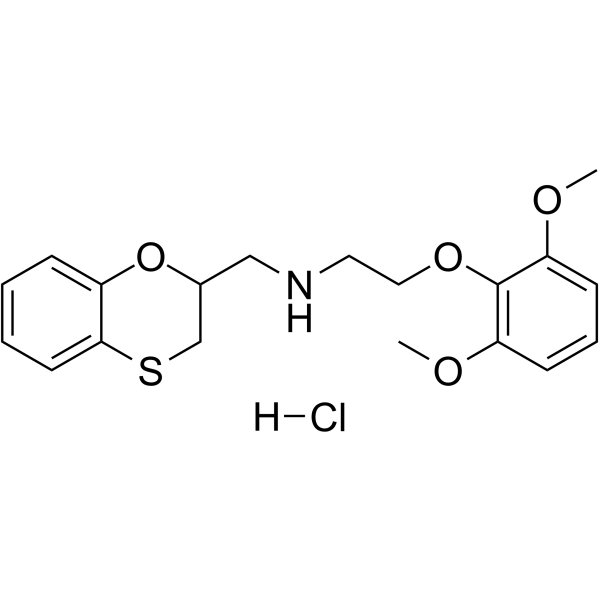
Physicochemical Properties
| Molecular Formula | C19H23NO4S.HCL |
| Molecular Weight | 397.91616 |
| Exact Mass | 397.111 |
| CAS # | 92642-97-2 |
| PubChem CID | 10386130 |
| Appearance | Typically exists as solid at room temperature |
| Boiling Point | 500.7ºC at 760 mmHg |
| Flash Point | 256.6ºC |
| LogP | 4.418 |
| Hydrogen Bond Donor Count | 2 |
| Hydrogen Bond Acceptor Count | 6 |
| Rotatable Bond Count | 8 |
| Heavy Atom Count | 26 |
| Complexity | 374 |
| Defined Atom Stereocenter Count | 0 |
| SMILES | COC1=C(C(=CC=C1)OC)OCCNCC2CSC3=CC=CC=C3O2.Cl |
| InChi Key | OWRADFDDJVNMGL-UHFFFAOYSA-N |
| InChi Code | InChI=1S/C19H23NO4S.ClH/c1-21-16-7-5-8-17(22-2)19(16)23-11-10-20-12-14-13-25-18-9-4-3-6-15(18)24-14;/h3-9,14,20H,10-13H2,1-2H3;1H |
| Chemical Name | N-(2,3-dihydro-1,4-benzoxathiin-2-ylmethyl)-2-(2,6-dimethoxyphenoxy)ethanamine;hydrochloride |
| Synonyms | Benoxathian hydrochloride; 92642-97-2; Benoxathian HCl; Benoxathian (hydrochloride); BenoxathianHydrochloride; Benzoxathian hydrochloride; NIOSH/DM2930000; 2-[[[2-(2,6-Dimethoxyphenoxy)ethyl]-amino]-methyl]-1,4-benzoxathian hydrochloride; |
| HS Tariff Code | 2934.99.9001 |
| Storage |
Powder-20°C 3 years 4°C 2 years In solvent -80°C 6 months -20°C 1 month Note: Please store this product in a sealed and protected environment, avoid exposure to moisture. |
| Shipping Condition | Room temperature (This product is stable at ambient temperature for a few days during ordinary shipping and time spent in Customs) |
Biological Activity
| Targets | α1 adrenoceptor |
| ln Vivo | Benoxathian hydrochloride (10 nM; paraventricular nucleus injection) totally reverses 2.5, 5.0, or 10.0 mg/kg phenylpropanolamine (IP)-induced anorexia in rats [1]. |
| Animal Protocol | Microinjection of the alpha-1 adrenergic receptor antagonist benoxathian (0, 2.5, 5.0 or 10.0 nmol) into the PVN was found to have no effect on baseline feeding behavior. Microinjection of 10.0 nmol benoxathian into the PVN completely reversed the anorexia induced by 2.5, 5.0 or 10.0 mg/kg PPA (IP), yet did not alter the hypodipsia produced by PPA. These data strongly suggest that PPA anorexia is mediated by an alpha-1 adrenergic satiety mechanism within the PVN.[1] |
| References | [1]. Wellman PJ, et al. Reversal of phenylpropanolamine anorexia in rats by the alpha-1 receptor antagonist benoxathian. Pharmacol Biochem Behav. 1991 Apr;38(4):905-8. |
| Additional Infomation |
Adrenergic alpha-Antagonists:
Drugs that bind to but do not activate alpha-adrenergic receptors thereby blocking the actions of endogenous or exogenous adrenergic agonists. Adrenergic alpha-antagonists are used in the treatment of hypertension, vasospasm, peripheral vascular disease, shock, and pheochromocytoma. Antihypertensive Agents: Drugs used in the treatment of acute or chronic vascular HYPERTENSION regardless of pharmacological mechanism. Among the antihypertensive agents are DIURETICS; (especially DIURETICS, THIAZIDE); ADRENERGIC BETA-ANTAGONISTS; ADRENERGIC ALPHA-ANTAGONISTS; ANGIOTENSIN-CONVERTING ENZYME INHIBITORS; CALCIUM CHANNEL BLOCKERS; GANGLIONIC BLOCKERS; and VASODILATOR AGENTS. Phenylpropanolamine (PPA) is a phenethylamine anorectic drug that exerts direct agonist effects predominantly on alpha-1 adrenergic receptors, with some alpha-2 adrenergic activity. Direct injections of PPA as well as the alpha-1 agonist 1-phenylephrine into rat paraventricular nucleus (PVN) suppress feeding. In the present study, we evaluate the hypothesis that systemic PPA acts within the PVN on an alpha-1 receptor population to suppress feeding. Accordingly, adult male rats were prepared with a unilateral guide cannula aimed at the PVN. Microinjection of the alpha-1 adrenergic receptor antagonist benoxathian (0, 2.5, 5.0 or 10.0 nmol) into the PVN was found to have no effect on baseline feeding behavior. Microinjection of 10.0 nmol benoxathian into the PVN completely reversed the anorexia induced by 2.5, 5.0 or 10.0 mg/kg PPA (IP), yet did not alter the hypodipsia produced by PPA. These data strongly suggest that PPA anorexia is mediated by an alpha-1 adrenergic satiety mechanism within the PVN.[1] |
Solubility Data
| Solubility (In Vitro) | DMSO : ~250 mg/mL (~628.27 mM) |
| Solubility (In Vivo) |
Solubility in Formulation 1: ≥ 2.08 mg/mL (5.23 mM) (saturation unknown) in 10% DMSO + 40% PEG300 + 5% Tween80 + 45% Saline (add these co-solvents sequentially from left to right, and one by one), clear solution. For example, if 1 mL of working solution is to be prepared, you can add 100 μL of 20.8 mg/mL clear DMSO stock solution to 400 μL PEG300 and mix evenly; then add 50 μL Tween-80 to the above solution and mix evenly; then add 450 μL normal saline to adjust the volume to 1 mL. Preparation of saline: Dissolve 0.9 g of sodium chloride in 100 mL ddH₂ O to obtain a clear solution. Solubility in Formulation 2: ≥ 2.08 mg/mL (5.23 mM) (saturation unknown) in 10% DMSO + 90% (20% SBE-β-CD in Saline) (add these co-solvents sequentially from left to right, and one by one), clear solution. For example, if 1 mL of working solution is to be prepared, you can add 100 μL of 20.8 mg/mL clear DMSO stock solution to 900 μL of 20% SBE-β-CD physiological saline solution and mix evenly. Preparation of 20% SBE-β-CD in Saline (4°C,1 week): Dissolve 2 g SBE-β-CD in 10 mL saline to obtain a clear solution. Solubility in Formulation 3: ≥ 2.08 mg/mL (5.23 mM) (saturation unknown) in 10% DMSO + 90% Corn Oil (add these co-solvents sequentially from left to right, and one by one), clear solution. For example, if 1 mL of working solution is to be prepared, you can add 100 μL of 20.8 mg/mL clear DMSO stock solution to 900 μL of corn oil and mix evenly. (Please use freshly prepared in vivo formulations for optimal results.) |
| Preparing Stock Solutions | 1 mg | 5 mg | 10 mg | |
| 1 mM | 2.5131 mL | 12.5653 mL | 25.1307 mL | |
| 5 mM | 0.5026 mL | 2.5131 mL | 5.0261 mL | |
| 10 mM | 0.2513 mL | 1.2565 mL | 2.5131 mL |